Animal behavior and taxonomy sit at the bottom of the USABO content weights — 5% each — so most students quietly skip them to spend more time on physiology and genetics. That is a mistake. Together these two domains are 10% of the Open Exam, and they are the fastest, most recall-friendly marks on the whole paper. Because there is no penalty for wrong answers, every one of these questions is winnable. This guide shows what they cover and how to bank them in a week.
Why 10% Is Worth More Than It Looks
On a 50-question, 50-minute Open Exam run by the Center for Excellence in Education (CEE), a 5% domain is roughly a handful of questions, and two of them together approach one question in ten. Crucially, behavior and taxonomy reward recall and pattern-reading far more than the deep multi-step reasoning that physiology and genetics demand. That makes their marks cheaper per hour of study — you reach competence quickly, then stop. Skipping them to add a fourth hour to an already-strong domain is poor economics.
- They are learnable fast. The core concepts are finite and well-defined, not open-ended.
- They are recall-friendly. Fewer calculations mean fewer places to slip under time pressure.
- They are guaranteed attempts. With no penalty for wrong answers, a half-remembered fact still becomes an educated guess — never a blank.
Put it in terms of return on effort. A strong student may already answer most of the physiology and genetics questions they will ever get right, so a fifth or sixth hour in those domains buys a fraction of a mark. The same hour spent moving behavior and taxonomy from shaky to reliable can secure several near-certain marks. On a paper decided at the margin, that trade is lopsided in your favour, and it is available to anyone willing to spend one unglamorous week on the domains everyone else skips.
Our overview of the USA Biology Olympiad lays out how the Open Exam fits into the wider competition. Weights can be adjusted between cycles, so confirm the current blueprint on cee.org — but the strategic point holds: do not leave cheap points on the table.
What Animal Behavior Covers (5%)
Behavior questions test how and why animals act, framed at roughly AP Biology plus introductory college depth. The single most useful mental model is a spectrum from innate (genetically programmed) to learned (shaped by experience) — place any behavior on that line and half the question answers itself.
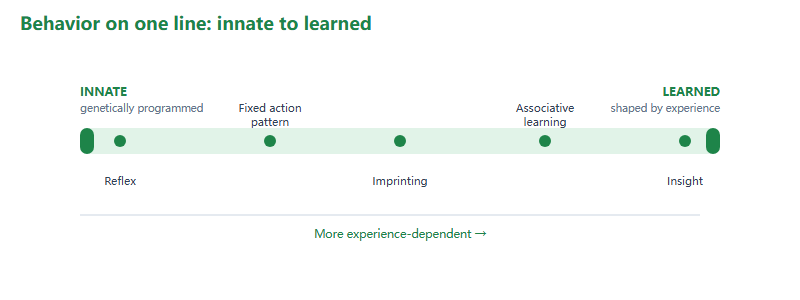
Around that spine, expect a compact set of recurring ideas:
- Innate behavior: reflexes, fixed action patterns and sign stimuli, kinesis and taxis.
- Learning: habituation, imprinting, classical and operant conditioning, insight.
- Behavioral ecology: optimal foraging, cost–benefit of behavior, communication signals.
- Social and evolutionary behavior: altruism, kin selection and inclusive fitness, mating systems.
Behavioral ecology is where these ideas earn their marks, because it asks why a behavior persists. Expect to reason about trade-offs: an optimal-foraging question weighs the energy gained from a food item against the time and risk of getting it, and a communication question asks what a signal costs the sender and what it buys. Frame any “why does the animal do this?” item as a cost-and-benefit balance and you will usually find the option that makes evolutionary sense.
Treat this as a fluency checklist, not a guaranteed question map — confirm the exact scope on cee.org. But master these and you can reason your way through almost any behavior item.
What Taxonomy Covers (5%)
Taxonomy questions test classification and evolutionary relationships, and the skill that unlocks most of them is reading a phylogenetic tree. Students who can interpret a cladogram — nodes, branches, and shared derived traits — convert guesswork into near-certain marks.
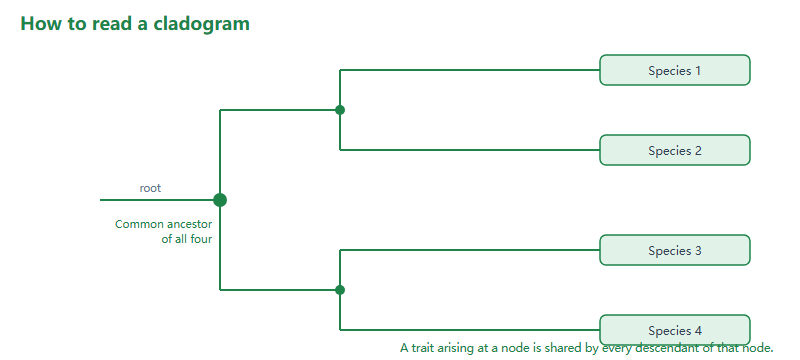
Beyond tree-reading, the taxonomy toolkit is small and highly memorisable:
| Concept | What to know |
|---|---|
| Classification hierarchy | The nested ranks from domain down to species, and binomial naming |
| Cladistics | Monophyletic vs paraphyletic groups; shared derived vs ancestral traits |
| Reading trees | Sister groups, most recent common ancestor, out-groups |
| Major lineages | The broad domains and kingdoms and their defining features |
| Evidence for relationships | Morphological, molecular, and developmental data |
Again, confirm the depth expected on cee.org rather than assuming a fixed split. Most taxonomy marks reward a student who can read a tree and reason about what is shared versus derived.
Two Traps That Quietly Cost These Marks
Because behavior and taxonomy feel easy, students usually lose their marks here to carelessness rather than difficulty. Two traps account for most of the damage, and naming them is most of the cure.
The behavior trap — read the verb, not the label. Many wrong answers come from blurring look-alike terms. Kinesis is an undirected change in the rate of movement in response to a stimulus; taxis is directed movement toward or away from one. In the same way, not every learned behavior is “conditioning” — habituation, imprinting and insight are distinct processes. The stem almost always tells you which is meant, so read the verb describing what the animal actually does before you look at the options.
The taxonomy trap — proximity is not relationship. A cladogram can be drawn many different ways for exactly the same relationships, because the branches at any node rotate freely without changing meaning. Students who read “closer together on the page” as “more closely related” walk straight into a classic distractor. What defines relationship is the most recent common ancestor two tips share, so trace back to the node rather than measuring the gap between tips. Build that one habit and a whole category of taxonomy questions becomes routine.
Both fixes cost minutes, not hours, which is exactly why these domains reward attention out of all proportion to their 10% weight. Confirm the depth expected on cee.org, but the reasoning habits above carry across whatever specific items appear on the day.
Bank These Points in One Focused Week
Because both domains are compact, a single concentrated week early in your preparation can move them from “skipped” to “secured” — after which they need only light upkeep. A workable rhythm:
- Days 1–2 — behavior. Build the innate-to-learned spectrum and slot every term onto it. Make a small deck of “which type of behavior is this?” prompts.
- Days 3–4 — taxonomy. Drill cladogram-reading until sister groups and shared derived traits are automatic. Practise translating a description into a tree and back.
- Days 5–6 — mixed retrieval. Self-test both domains together so you can switch modes quickly, the way the real paper forces you to.
- Day 7 — timed application. Pull behavior and taxonomy items from full papers and answer them under the clock.
Front-loading these domains has a second benefit: it clears mental space. Once behavior and taxonomy are genuinely secured, your remaining weeks belong entirely to the heavy domains, with no nagging sense that a whole slice of the syllabus is untouched. Finishing something completely, rather than leaving every domain half-done, is a real morale boost across a long preparation.
After this week, a five-minute weekly review keeps both domains warm. Compare that with the diminishing returns of a fifth hour on genetics, and the case for these “easy” 10% becomes obvious.
Pressure-Test With Past Papers
Recall feels solid until a real question phrases it sideways. Once you have the spectrum and the tree-reading skill, prove them under exam conditions: isolate behavior and taxonomy items from full sets and answer them timed. Our free USABO past-paper pack gathers several years, with worked solutions for some, so you can check reasoning rather than just a letter. If a “cheap” item still trips you, that is precisely the kind of quick fix worth making before exam day — a mark you can secure with minutes of work, not hours. The content is identical whether you sit via the USABO China-region path or elsewhere; only logistics differ, so confirm eligibility, dates, and the timezone of any deadline on the official and China-region pages.
Are behavior and taxonomy really worth studying at only 5% each?
Yes — together they are 10% of the paper, and they are recall-friendly, so the marks are cheap per study hour compared with the heavy domains.
What is the fastest way to improve at taxonomy?
Learn to read cladograms fluently: nodes as common ancestors, tips as taxa, shared derived traits inherited by descendants. Most marks flow from that skill.
How do I answer a behavior question I don’t fully know?
Place it on the innate-to-learned spectrum, eliminate options that don’t fit, and guess — there is no penalty for wrong answers.
Do these domains differ for China-region students?
The content is the same; only logistics differ. Confirm eligibility and dates on the official and China-region pages.
This is an independent guide operated by Hanlin Education for China-based international-school students. It is not affiliated with, endorsed by, or sponsored by the Center for Excellence in Education (CEE), which runs the USA Biology Olympiad. Competition details change year to year — always confirm current registration, eligibility, format, deadlines, and the timezone of any deadline on the official site, cee.org. Spotted an error? We correct verified mistakes within 7 working days.