Why This Distinction Traps Even Prepared Candidates
On the USABO Open Exam, an enzyme experiment item can look straightforward until you notice the answer choices split between “the reaction rate decreased” and “the equilibrium shifted toward products.” The two ideas live in different conceptual worlds. A rate change is a kinetic property: it tells you how fast the system approaches equilibrium. An equilibrium change is a thermodynamic property: it tells you where the reaction settles when forward and reverse rates match. Confusing them costs marks because USABO tests the distinction directly, not as a vocabulary check but as a reasoning test.
The source of confusion is real. In school biology, students often meet enzymes as catalysts that “speed up reactions” without ever discussing whether the reaction reaches a different endpoint. USABO expects you to separate what the enzyme does to the speed of approach from what it does not do to the final concentrations. This article works through the distinction with checked examples, a contrasting case where the same data leads to a different conclusion, and a diagnostic you can apply to your next practice set.
The Core Rule: Enzymes Alter Kinetics, Not Thermodynamics
An enzyme provides an alternative reaction pathway with lower activation energy. This can increase the rate at which substrate converts to product and, in the reverse direction, the rate at which product converts to substrate. For a simple reversible elementary first-order reaction, both forward and reverse rate constants increase by the same factor, so the equilibrium constant Keq = kforward/kreverse remains unchanged. However, this equal scaling is a property of that simple model, not a universal truth for arbitrary enzyme mechanisms. In general, enzymes change pathways without changing the thermodynamic equilibrium constant.
This is the first checkpoint. If an experiment reports a change in the final ratio [product]/[substrate] at completion, the enzyme is not the explanation. Something else must be at work: a temperature change, a removal of product, a coupled reaction, or a perturbation that alters the free energy landscape. Note also that a plateau in a progress curve may reflect enzyme inactivation or substrate depletion rather than true equilibrium.
Teaching Illustration — Worked Case 1: Rate Change Only
Consider a clearly hypothetical USABO-style experiment. A reaction mixture contains 10 mM total (substrate plus product) for the reversible conversion S ↔ P. At fixed temperature, the equilibrium constant Keq = [P]/[S] = 1.5, giving 6 mM product and 4 mM substrate at equilibrium. This is a teaching illustration, not an official contest problem.
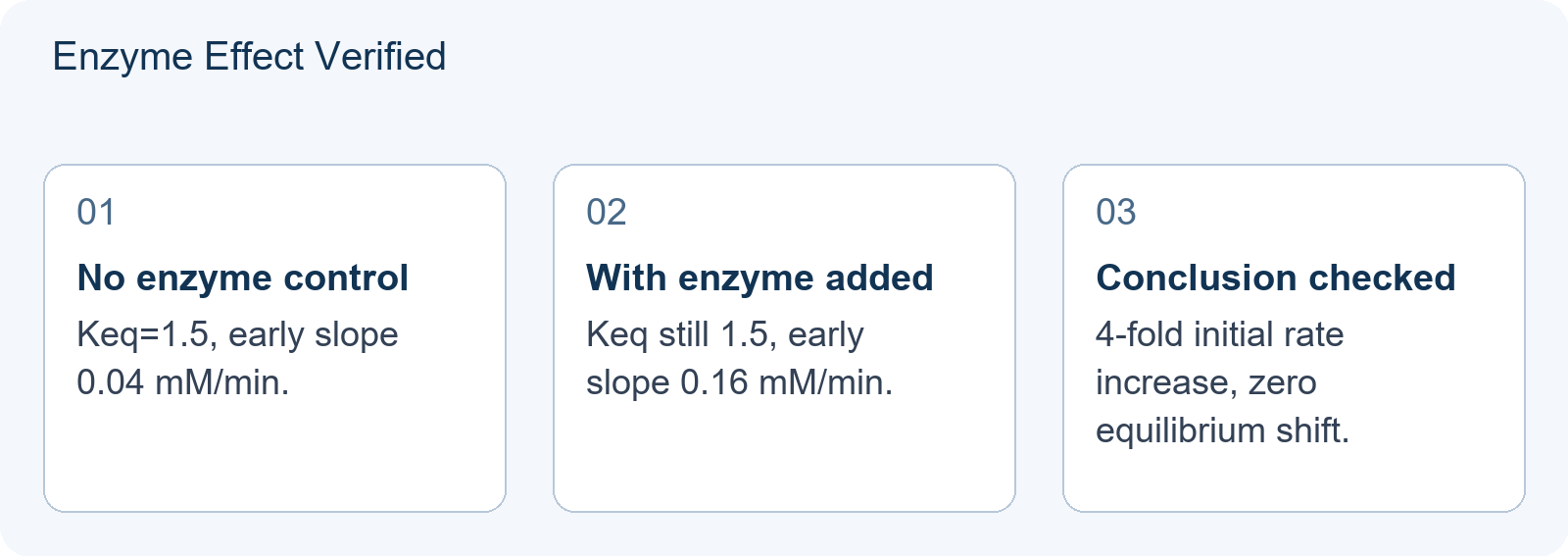
Step 1: Verify Keq. With [P] = 6 mM and [S] = 4 mM, Keq = 6/4 = 1.5. Checked.
Step 2: Measure initial rates from truly short initial intervals. Without enzyme, the early slope is 0.04 mM/min. With enzyme added, the early slope is 0.16 mM/min. The ratio of initial rates is 0.16/0.04 = 4. The enzyme accelerates the early approach to equilibrium.
Step 3: Verify the conclusion. The enzyme increases the initial rate by a factor of 4, but the equilibrium position remains unchanged at Keq = 1.5 (6 mM product, 4 mM substrate). Time to reach equilibrium within any practical tolerance is shortened, though exact completion is not a meaningful concept—equilibrium is approached asymptotically. This is a pure rate effect.
The USABO item would ask: “What effect does the enzyme have?” The correct answer identifies faster approach to the same equilibrium. A distractor might claim “the enzyme increases the yield of product,” which is false.
Teaching Illustration — Contrasting Case 2: When the Equilibrium Actually Shifts
Now suppose a second experiment with the same reaction. The mixture is prepared with 10 mM total at 25°C, giving Keq = 1.5 as before (6 mM P, 4 mM S). The temperature is raised to 37°C, and the mixture is allowed to equilibrate. The final concentrations are now 7 mM product and 3 mM substrate.
Step 1: Calculate the new Keq = 7/3 ≈ 2.333. This differs from 1.5.
Step 2: Recognize that temperature is a thermodynamic variable. It appears in the van’t Hoff equation and changes the Gibbs free energy of the reaction. The equilibrium position has genuinely shifted. Note: this 7/3 ratio is given hypothetical equilibrated data for this illustration; it is not guaranteed that all reactions increase Keq with temperature—exothermic reactions decrease Keq with temperature.
Step 3: Note that the rate also changed — the system likely reached equilibrium faster at 37°C due to increased molecular motion. But the key distinction for USABO purposes is that the final position moved. An enzyme would not cause this.
The superficial similarity is that both experiments show faster progress and a different final state. The critical difference is that in Case 1, the final state was unchanged; in Case 2, it was. The enzyme is ruled out as the cause of the shift in Case 2 because enzymes do not alter thermodynamic endpoints.
Teaching Illustration — Worked Case 3: Competitive Inhibition and Rate Change
A competitive inhibitor binds the enzyme’s active site, increasing the apparent Km but leaving Vmax unchanged under standard reversible Michaelis-Menten assumptions. Mixed and uncompetitive inhibition also change Vmax, so the competitive case is not the only possibility. In a USABO experiment, you might observe that with competitive inhibitor present, the reaction takes longer to approach the same final product concentration.
Step 1: Measure final product concentration without inhibitor: 6 mM at equilibrium.
Step 2: Measure final product concentration with competitive inhibitor: still 6 mM at equilibrium, but approached more slowly.
Step 3: The rate of approach is reduced. The equilibrium position is unchanged. This is still a kinetic effect, now a rate decrease rather than increase.
The trap for candidates is to see “less product at 10 minutes” and conclude “the equilibrium shifted toward substrate.” It did not. At any fixed time before equilibrium, less product is present because the rate is slower. Given sufficient time, the same equilibrium would be reached. The inhibitor affects how fast, not where. Be careful: a different finite-time endpoint does not prove thermodynamics has changed.
Diagnostic: Three Questions to Apply Under Exam Pressure
When you encounter an enzyme experiment item on the USABO, ask these three questions in order:
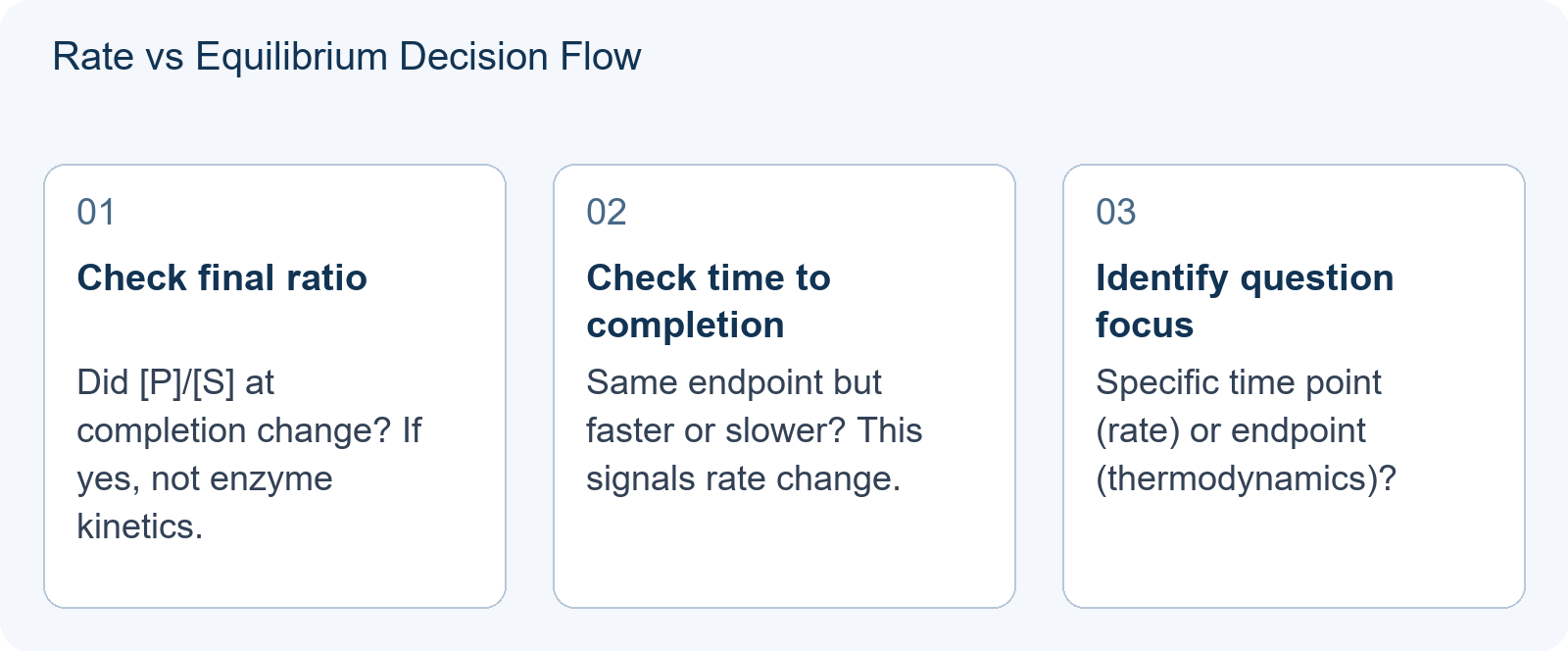
- Question 1: Did the final concentration ratio change at completion? If yes, the cause is thermodynamic (temperature, pressure, concentration removal, coupled reaction), not the enzyme. Remember: changed equilibrium composition can also arise from different initial amounts or product removal, not just changed K.
- Question 2: Did the time to reach completion change while the final ratio stayed constant? If yes, this is a kinetic effect — the enzyme or inhibitor altered the rate of approach.
- Question 3: Is the question asking about a specific time point or about the endpoint? If it asks about a specific time point, rate matters. If it asks about the endpoint, check whether the endpoint changed.
This diagnostic prevents the common error of attributing endpoint changes to enzymes. It also catches the reverse error: assuming that because an enzyme is present, all observed changes are kinetic.
What Your Diagnostic Result Means for Your Next Learning Task
If you applied the three-question diagnostic and found yourself hesitating at Question 1 — unsure whether the final ratio actually changed — your next task is to practice reading progress curves carefully. Look for the plateau level, not just the slope. The The Figure Is the Question: How to Read Data and Experiment Items on the USABO Open Exam article provides specific training on extracting endpoint data from USABO-style graphs where the axes and legends carry the real information.
If you hesitated at Question 2 — confusing temporary rate changes with permanent equilibrium shifts — your gap is likely in the transition from school biology to quantitative enzyme kinetics. The From IGCSE Biology to USABO: What to Close Before You Sit the Exam article maps exactly which school-level simplifications become dangerous on the USABO, including the common misconception that enzymes “make more product” rather than “reach the same product faster.”
If you hesitated at Question 3 — unsure whether the question targets a time point or an endpoint — you need practice with USABO item wording patterns. The USABO Past Papers: Choosing Useful Practice and Checking Answer Coverage article explains how to select past items that specifically test experimental interpretation, and how to verify whether your practice set actually covers rate-versus-equilibrium reasoning or merely tests recall of enzyme definitions.
Summary and Key Takeaway
The enzyme rate-versus-equilibrium distinction is not a memorization task. It is a reasoning discipline: enzymes alter the speed of approach to equilibrium without touching the equilibrium position itself. The worked cases above verify this with checked arithmetic. The contrasting case shows that when the endpoint does shift, the cause must be thermodynamic. The three-question diagnostic gives you a reproducible method for exam conditions. Apply it to your next practice set, identify where you hesitate, and use that hesitation as a precise target for further work.
Frequently Asked Questions
Can an enzyme ever shift the equilibrium position?
No. By definition, a catalyst provides an alternative pathway with lower activation energy. For a simple reversible elementary first-order reaction, both forward and reverse rate constants increase equally, so Keq = k_forward/k_reverse remains unchanged. For more complex mechanisms, enzymes still do not change the thermodynamic equilibrium constant. If the final ratio of product to substrate changes, look for a thermodynamic variable like temperature, pressure, removal of a reactant or product, or different initial amounts—not the enzyme.
Why do some USABO graphs show different final product levels with and without enzyme?
They should not, if the enzyme is the only variable. If you see different final levels, the item likely includes a second variable you missed — perhaps the enzyme-catalyzed reaction was run at a different temperature, or product was removed in one condition. Alternatively, the apparent ‘plateau’ may reflect enzyme inactivation or substrate depletion rather than true equilibrium. The USABO tests whether you catch this distinction. Always check whether the question states that all other conditions were held constant.
How does competitive inhibition differ from non-competitive in terms of rate and equilibrium?
Competitive inhibition increases apparent Km without changing Vmax under standard reversible Michaelis-Menten assumptions; the same equilibrium is reached, just more slowly. Mixed and uncompetitive inhibition also change Vmax. None of these shift the equilibrium position if given sufficient time. The equilibrium would only shift if the inhibitor were not merely binding the enzyme but participating in the reaction stoichiometry or altering the free energy of reactants or products. A different finite-time endpoint does not prove thermodynamics has changed.