On the USABO Open Exam you get 50 questions in 50 minutes, so a question you can answer from memory and a question built on a graph cost you exactly the same minute. That is the whole problem. Recall questions reward what you know; data and experiment questions reward a reading procedure. This article gives you that procedure, the control logic underneath it, and a way to drill both.
None of what follows requires extra biology. It is a technique for converting a figure into an answer quickly and reliably, which matters most for candidates who learned biology as a body of facts rather than as a set of experiments. If you have not yet mapped the exam itself, start with our overview of the USABO.
Why data questions behave differently
A recall question has one gate: do you know the fact. If you know it, you are done in fifteen seconds; if you do not, no amount of staring helps and you should eliminate, guess and move on — there is no penalty for a wrong answer, so a blank is the only genuinely wasted mark.
A figure question has three gates in sequence: read the figure correctly, work out what the question wants from it, then apply biology. Miss the first gate and the biology you apply is answering a question that was never asked. That is why strong students still lose these marks — the failure is upstream of their knowledge.
Two consequences follow. First, the recovery is different: on a data item, re-reading the axes is usually more productive than re-reading the options. Second, these items are the ones most worth practising deliberately, because the gain is procedural and therefore permanent, whereas a fact you drill may still evaporate by exam day.
One honest caveat on scope. USABO publishes what proportion of content each subject area carries — animal anatomy and physiology 25%, cell biology 20%, genetics and evolution 20%, plant biology 15%, ecology 10%, behaviour 5%, taxonomy 5% — but that is a content weighting, not a question-type breakdown. How many items in any given year are figure-based is not something to assume; judge it from the papers themselves and confirm current exam details on cee.org.
The four-step read
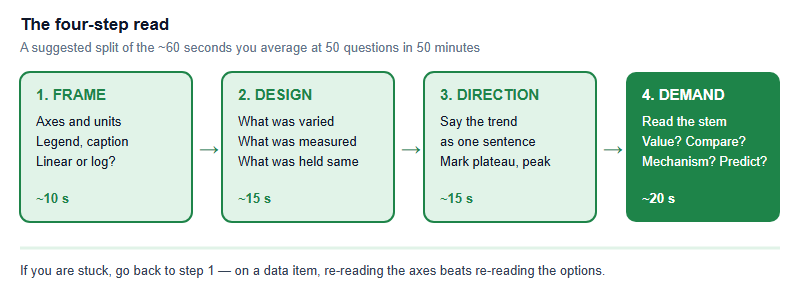
Do these in order, every time, until the order is automatic. The point of a fixed order is that it removes the decision of where to look first, which is where the seconds leak.
- 1. Frame. Axes, units, scale. What is on x, what is on y, and is either axis logarithmic? Read the legend and the caption. Log axes and per-unit units (per gram, per minute, per litre) are where careless misreadings live.
- 2. Design. What was deliberately varied, what was measured as a result, and what was deliberately held the same? If there are multiple lines or bars, ask what distinguishes them — that difference is almost always the point of the figure.
- 3. Direction. Say the trend out loud in your head as a sentence: as X increased, Y rose steeply then plateaued. Note where anything changes behaviour — a plateau, a peak, an inflection, a crossover between two lines. Those points are what questions are built on.
- 4. Demand. Only now read the stem carefully and ask what it wants from the figure: a value, a comparison, a mechanism, a prediction beyond the data, or a judgement about whether the data supports a claim. These are five different jobs and they are not interchangeable.
Six figures that keep coming back, and what each is really asking
Biology exams reuse a small number of figure archetypes. Learn what each one exists to test and you have pre-loaded step four before you even read the stem.
| Figure type | What it is really asking | Read this first | Common trap |
|---|---|---|---|
| Time course (one line, time on x) | When does the rate change, and why | The slope, not the height — and where the slope changes | Reading a high value as a fast rate |
| Concentration or dose series | Where the system saturates, peaks or is inhibited | The plateau and any optimum | Extrapolating past the last data point |
| Bars with error bars | Whether the difference between groups is real | Overlap of the bars, and what the bars represent | Calling a difference significant when the intervals overlap heavily |
| Two lines that cross (interaction) | Whether one factor changes the effect of the other | The crossover point and what differs between the lines | Describing each line separately and missing the interaction |
| Pedigree | Mode of inheritance | Affected offspring of unaffected parents; the sex ratio of affected individuals | Assuming a mode instead of testing it against the one informative family |
| Phylogenetic tree | Relatedness by shared ancestry, not by appearance | Where nodes sit — branch tips can be rotated freely | Reading left-to-right order as an evolutionary sequence |
The pedigree and tree rows are worth a special note because they are the two archetypes where an intuitive read is systematically wrong. On a tree, two tips drawn next to each other are not necessarily close relatives; only the branching points carry information. On a pedigree, the whole diagram usually turns on one or two informative matings, and finding those first is faster than scanning every individual.
The control logic behind experiment items
Where a figure comes attached to an experiment, most of the marks turn on three questions, in this order.
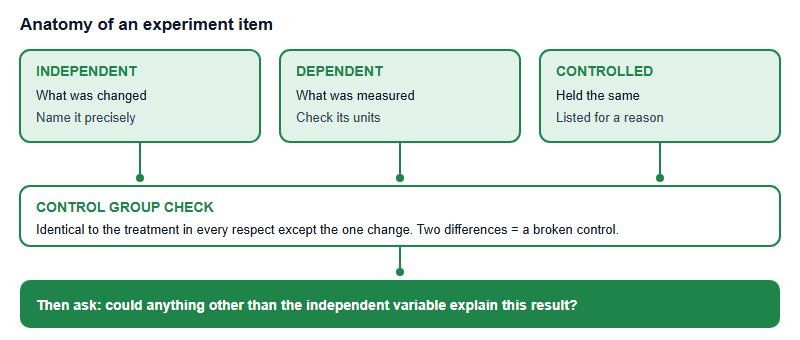
- What is the control, and is it a fair one? A control group must match the treatment in every respect except the single variable under test. If a stem tells you the control differed in two ways, that is not incidental detail; it is the answer to something.
- What is the only difference? Name the independent variable precisely. Vague naming (“temperature”) hides the real design (“temperature of the buffer during the incubation, held for 10 minutes”).
- What else could explain this result? This is the question that separates the top band. Before accepting the obvious mechanism, look for an uncontrolled variable, a sample-size problem, or a correlation being read as causation.
What AP Biology now buys you, and what it does not
This is worth a short detour because it changes the honest answer to a question a lot of candidates ask. From the 2026 administration, AP Biology moved to a digital hybrid format: multiple-choice and free-response are both read in Bluebook while the free response is still written by hand, and the multiple-choice section is now built on stimulus material throughout — data tables, experimental figures and models. Confirm the current format details with College Board, since exam formats are revised.
For a USABO candidate, that narrows one gap and leaves another wide open.
- Narrowed: the reflex. A stimulus-first paper trains exactly the habit described above — answer from the source in front of you rather than from memory, and treat a figure as the question rather than as decoration. If you sit AP Biology seriously, you are already rehearsing steps one to three repeatedly.
- Still open: breadth. USABO sits at roughly AP Biology plus introductory college biology and spreads across seven subject areas. The areas an AP course tends to touch lightly — plant biology at 15%, taxonomy and behaviour at 5% each — are 25% of the USABO content weighting between them. A figure-reading reflex does not manufacture plant physiology.
- Still open: speed. Whatever per-item time your AP paper allows this year, USABO fixes it at roughly a minute: 50 questions, 50 minutes. Reading a figure carefully is a different skill from reading it carefully inside sixty seconds, and only timed practice builds the second one.
The practical upshot: treat AP Biology as free reps on technique, and plan separately for the breadth and the clock. Neither is optional.
Four drills that build the skill
All of these run on real papers rather than textbook exercises, because textbook figures are usually built to illustrate a point you have just been told. Our past-paper pack is the raw material; worked solutions are available for some years only, and we keep adding to them.
- Cover the options. Read the figure and the stem, then write your answer before you look at the choices. This is the single highest-yield drill, because it stops the options from doing your reading for you and it exposes the moment you were about to be led.
- One-sentence conclusion. For every figure in a paper, write one sentence in the form: as X increased, Y did Z, which suggests W. If you cannot write it, you did not complete step three, and any answer you gave was a guess wearing a lab coat.
- Sixty-second sprints. Take ten figures out of old papers, ignore the questions entirely, and give yourself sixty seconds per figure to frame, design and direction. You are training the read, not the answer.
- Write the question. Take a figure you have already answered and invent a different question about it — a prediction, a control critique, a comparison. Question-writing forces you to see what a figure can and cannot support, which is precisely what step four asks.
Track these separately from content revision. A miss caused by misreading an axis and a miss caused by not knowing the Calvin cycle look identical on a score sheet and need completely different fixes. If you are preparing through the China region, the registration and route details sit on our China-region page; the technique above applies whichever route you are on.
Frequently asked questions
How many USABO questions are based on figures?
Not published. We work from a subject-area content weighting; the question-type mix is not something we can confirm. Judge it from past papers and confirm details on cee.org.
Should I read the stem or the figure first?
Frame the figure first (axes, units, design), then read the stem. It stops you hunting for a value before you know what is plotted.
Does AP Biology prepare me for USABO data questions?
It trains the figure-reading reflex well. It does not cover USABO breadth or the one-minute-per-question pace.
What if I misread a figure in practice?
Log it as a reading error, not a knowledge gap. The fix is procedure and timed repetition, not more textbook study.
This is an independent guide operated by Hanlin Education for China-based international-school students. We are not affiliated with, endorsed by, or sponsored by the Center for Excellence in Education (CEE). Exam format, content scope and dates are set by the organisers and can change — confirm current details on cee.org before you rely on anything here. Errors reported to us are corrected within 7 working days.