Ecology carries 10% of the USABO content weighting. On a 50-question paper that points to roughly five questions' worth of the syllabus — treat that as an expectation rather than a guarantee, since the exact item mix is not published. It is also the section most candidates revise last, revise badly, or skip on the theory that it is common sense. It is not common sense, and the arithmetic in it is the arithmetic nobody has practised.
This article covers what ecology means at USABO's level, the quantitative tools that turn vague understanding into marks, and the conceptual traps that catch students who have only ever met ecology in a school textbook. For where this sits in the whole paper, see our overview of the USABO.
Why a 10% section gets neglected — and why that is a mistake
Three things conspire against ecology. School courses put it at the end of the year, where it collides with exams and gets compressed. Its vocabulary is made of everyday English words — community, population, niche, succession — so it reads as though you already understand it, which suppresses the feeling of not knowing that normally triggers revision. And because it carries a low weight, a weight-proportional revision plan gives it a small slice, which students round down to zero.
The mistake is one of marginal value rather than total value. Ecology is a small section, but it is also a shallow one: the concepts are few, they are stable year to year, and unlike animal physiology there is very little to memorise in depth. Hours spent here convert to marks at a high rate right up until you know it, and then stop. That is close to the definition of a section you should finish rather than one you should ignore.
The rational plan is therefore not proportional but sequenced: take ecology to competence early and cheaply, then stop, and put the freed hours into the 25% and 20% sections where the ceiling is much higher. Low weight is an argument for finishing a section, not for skipping it.
What ecology means at this level
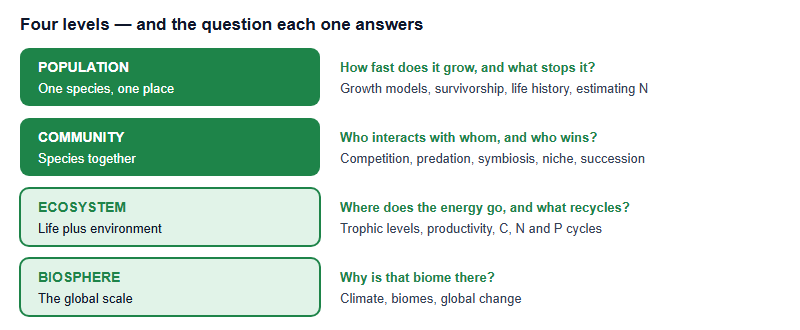
USABO sits at roughly AP Biology plus introductory college biology, and the ecology in an introductory college course is organised by level of biological organisation. Knowing that structure is itself worth marks, because it tells you which explanations are legitimate at which scale — an individual-level answer to a community-level question is a classic way to lose a mark you technically knew. Confirm the current syllabus scope on cee.org; what follows is the standard content of an introductory college treatment.
The quantitative ecology most candidates have never practised
Here is the part that actually separates candidates. Ecology is the one low-weight area that contains real calculation, and because students file it mentally under “descriptive biology” they arrive having never done a single one of these by hand. Each of these tools is standard introductory college content, which makes them reasonable preparation at USABO's level.
| Tool | The question it answers | Worth knowing | The trap |
|---|---|---|---|
| Exponential growth dN/dt = rN |
How fast when nothing limits | J-shaped curve; r is per capita, so growth accelerates as N rises | Confusing r (a rate) with dN/dt (a number of individuals) |
| Logistic growth dN/dt = rN(K − N)/K |
What happens as resources bite | S-shaped curve; absolute growth is fastest at about K/2, not at K | Saying growth is fastest at carrying capacity — at K it is zero |
| Mark–recapture N = MC/R |
Estimating a population you cannot count | Mark 40, recapture 50 of which 8 are marked → N = (40 × 50)/8 = 250 | Ignoring the assumptions: full mixing, no births, deaths or migration, marks do not affect survival |
| Survivorship curves | Where in the life span mortality falls | Type I late (large mammals), Type II constant, Type III early (many offspring, little care) | Reading the y-axis as linear when it is logarithmic |
| Trophic transfer roughly 10% |
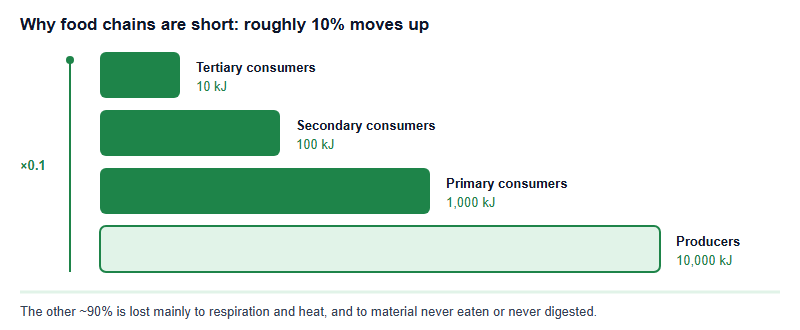
Why food chains are short | Most energy is lost to respiration and heat at each step | Applying it to biomass uncritically — inverted biomass pyramids exist where turnover is fast |
| Diversity: richness vs evenness | Which community is more diverse | Two communities can share species richness and differ sharply in evenness | Equating “more species” with “more diverse” |
Two of these repay a few minutes of explicit practice more than any amount of reading. Mark–recapture is trivial arithmetic that students get wrong because they mix up which number goes where — do three of them on paper, naming M, C and R out loud, and it is permanently secure. Logistic growth is the classic source of a scale error: the population is largest at K, the growth rate is largest near K/2, and the question will ask about one while your instinct answers the other.
The energy pyramid deserves the same treatment because it is quantitative in a way students underestimate. If a producer level fixes 10,000 kJ, roughly 1,000 reaches primary consumers and 100 reaches secondary consumers, which is a complete answer to why food chains rarely run beyond four or five links and why top predators need enormous ranges.
Community ecology: the six distinctions that decide the marks
Community ecology is where the everyday-word problem bites hardest, because each of these pairs sounds like a synonym and is not. Learn them as pairs, not as isolated definitions.
- Fundamental vs realised niche. The fundamental niche is where a species could live; the realised niche is where it actually lives once competitors, predators and parasites are accounted for. The realised niche is normally smaller — and a question showing a species expanding after a competitor is removed is testing exactly this.
- Competitive exclusion vs resource partitioning. Two species with identical requirements cannot coexist indefinitely; the usual real-world outcome is that they diverge in how they use the resource. Exclusion is the prediction; partitioning is what you observe.
- Keystone vs dominant species. A dominant species has a large effect because it is abundant. A keystone species has a large effect relative to its abundance — remove it and the community reorganises. Rarity is not evidence against keystone status; it is often the point.
- Primary vs secondary succession. Primary starts where there is no soil (bare rock, new volcanic surfaces) and is slow because soil must be built. Secondary starts where soil survives a disturbance and is much faster. The presence of soil is the whole distinction.
- Symbiosis by sign. Read interactions as a pair of signs: mutualism (+/+), commensalism (+/0), parasitism and predation (+/−), competition (−/−), amensalism (0/−). Converting a wordy stem into two signs answers most of these instantly.
- Density-dependent vs density-independent limits. Disease, competition and predation intensify as a population becomes crowded; a hard frost or a flood does not care how many individuals there are. Logistic growth is a density-dependent story.
The nitrogen cycle, and the one confusion worth killing
Of the biogeochemical cycles, carbon is usually secure because it is taught alongside photosynthesis and respiration, and phosphorus is short — no significant atmospheric phase, weathering of rock as the main source, and frequently the limiting nutrient in fresh water. Nitrogen is the one that generates errors, and almost all of them come from four similar-sounding processes.
| Process | Converts | Carried out by | Remember it as |
|---|---|---|---|
| Nitrogen fixation | N₂ → ammonia / ammonium | Nitrogen-fixing bacteria (free-living and root-nodule symbionts); also lightning | Air into life — the only way in |
| Ammonification | Organic N (dead matter, waste) → ammonium | Decomposers | Recycling what already died |
| Nitrification | Ammonium → nitrite → nitrate | Nitrifying bacteria, aerobic | Building the form plants prefer to absorb |
| Denitrification | Nitrate → N₂ | Denitrifying bacteria, anaerobic (waterlogged soils) | Life back to air — the way out |
The distinction that fails most often is fixation versus nitrification. Both involve bacteria and both move nitrogen “forward”, but fixation is the entry point from atmospheric N₂ and nitrification only rearranges nitrogen that is already in the soil. A stem describing waterlogged, oxygen-poor soil and asking why nitrogen is being lost is pointing at denitrification, because the process is anaerobic — that single link between soil oxygen and the process is worth committing to memory on its own.
A finish-it plan you can run in a few sessions
Because the goal is competence rather than mastery, treat ecology as a short project with an end date rather than as a topic you keep returning to.
- Session 1 — the map. Draw the four-level diagram above from memory and write, under each level, the two or three things it is tested on. If you cannot, reread one ecology chapter and try again. This alone fixes scale errors.
- Session 2 — the arithmetic. Do three mark–recapture problems, sketch exponential and logistic curves labelling r, K and K/2, and work one energy-pyramid chain end to end. Written by hand, not read.
- Session 3 — the pairs. Make one card per distinction in the community-ecology list, each with a one-line discriminator rather than two definitions. Test yourself on the discriminator only.
- Session 4 — the cycles. Redraw the nitrogen cycle as four labelled arrows with the organism responsible on each, then add carbon and phosphorus in outline.
- Then stop, and test. Pull every ecology question you can find from real papers and sit them timed. Our past-paper pack is the source; worked solutions exist for some years only. If you score well, ecology is done — move the hours to the 25% and 20% areas and revisit only in your final review.
Across our China-based cohorts, this is the section where a modest, bounded effort most reliably changes a score, precisely because so few candidates arrive having practised the calculations. That is our own observation from teaching rather than a published statistic, and individual results vary. If you are preparing through the China region, route and registration details are on our China-region page.
Frequently asked questions
How much of USABO is ecology?
Ecology carries 10% of the content weighting. That is a content proportion, not a promised question count; confirm current details on cee.org.
Is ecology worth revising if it is only 10%?
Yes. It is shallow and stable, so hours convert to marks quickly. Finish it early, then move to the heavier sections.
Which ecology calculations should I actually practise?
Mark–recapture, exponential and logistic growth (including K/2), and trophic energy transfer. Do them by hand, not by reading.
Why do students confuse nitrogen fixation and nitrification?
Both are bacterial. Fixation brings N₂ in from the air; nitrification only converts nitrogen already present in the soil.
This is an independent guide operated by Hanlin Education for China-based international-school students. We are not affiliated with, endorsed by, or sponsored by the Center for Excellence in Education (CEE). Syllabus scope, content weightings and exam details are set by the organisers and can change — confirm current details on cee.org before you rely on anything here. Errors reported to us are corrected within 7 working days.