The question students ask is “what grade should I be in to take USABO?” The useful question is different: am I ready to sit it in a way that produces something worth having? Eligibility rules belong to the organisers and must be confirmed on cee.org and, for China-based candidates, on our China-region page. Readiness is the part you can test in an afternoon — and it is what actually decides whether a sitting is worth the season.
This article gives you a four-check readiness test, an honest account of what a sitting is realistically for in each year of school, and how to think about a two-sitting arc without kidding yourself that a second attempt improves automatically. If you have not yet mapped the exam, start with our overview of the USABO.
Separate eligibility from readiness
These are two different gates and they fail in different ways. Eligibility is a rule: you either meet it or you do not, it is set externally, and it can change between seasons — so check it rather than inherit it from a friend who sat two years ago. It also differs by route. USABO runs a China region through which China-based students sit the exam and earn China-region recognition; selection for the US national team and the International Biology Olympiad runs on a separate path whose conditions turn on citizenship and residency rather than on where you are studying. Treat those as two different goals, and confirm the current registration channel and rules on the official channels and our China-region page.
Readiness is a judgement, and the failure mode is quieter: nobody stops you sitting an exam you are not prepared for. You simply spend a season, sit the paper, score somewhere unremarkable, and learn less than you would have from six more months of biology. That outcome is not a disaster — but it is a cost, and it should be a choice rather than an accident.
The rest of this article assumes you have checked eligibility and are asking the second question.
The four-check readiness test
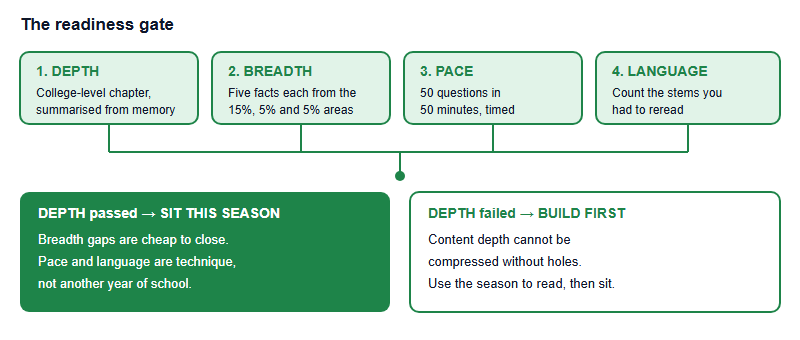
Each check is designed to be run this week, with a real pass or fail rather than a feeling. USABO sits at roughly AP Biology plus introductory college biology, spread across seven subject areas, and asks 50 questions in 50 minutes with no penalty for wrong answers. Every check below is derived from one of those facts.
| Check | What it tests | How to run it this week | If you fail it |
|---|---|---|---|
| 1. Depth | Whether you can work at introductory college level at all | Read a chapter of a college-level biology text you have never studied. Close it. Write a one-page summary from memory. | Build the content base first. A sitting now measures your textbook, not you. |
| 2. Breadth | Whether you have met all seven areas, not just the popular ones | Write five substantive facts each for plant biology, behaviour and taxonomy — the 15%, 5% and 5% areas. | Your gap is in the light areas, and it is cheap to close. Do that before sitting. |
| 3. Pace | Whether you can think at roughly one minute per question | Sit 50 mixed multiple-choice biology questions in exactly 50 minutes, timed, no pauses. | This is a technique problem, not a knowledge problem. Drill pacing separately. |
| 4. Language | Whether reading the paper costs you thinking time | On the same timed set, mark every stem where you had to reread to decode a word. | Vocabulary work first — decoding time comes straight out of reasoning time. |
Read the results as a set rather than a score. Passing checks 1 and 2 but failing 3 and 4 is a good position: you know the biology and need exam technique, which is fast to build and does not require another year of school. Failing 1 is the only result that genuinely argues for waiting, because content depth is the one thing that cannot be compressed into a few weeks without leaving holes.
What a sitting is realistically for, year by year
Grade labels do not determine eligibility — the organisers do — but they do describe your circumstances, and circumstances change what a sitting can achieve. Read this as a description of trade-offs rather than a rule.
| Stage | Biology usually behind you | Competing load | What the sitting is realistically for |
|---|---|---|---|
| Early (around Grade 9) | Partway through a first school course | Light | Orientation. You see the format and the level. Expect the score to reflect an incomplete syllabus, and plan accordingly. |
| Grade 10 | One full course, sometimes plus self-study at college level | Moderate | A genuine first attempt if the depth check passes. Also the best year to absorb a disappointing result without cost. |
| Grade 11 | Strongest content base for most students | Heaviest — coursework, standardised tests, internal assessments | The highest-yield year for most candidates, and the one that needs the most deliberate calendar protection. |
| Grade 12 | Strongest of all | Heavy early, lighter later | Content-wise ideal, timing-wise awkward: a result arriving in your final year may land after several application deadlines. Check both the exam date for your route and the deadlines that apply to you. |
The Grade 11 row is the one worth dwelling on. It is simultaneously the year most students are ready and the year they have least free time, which is why the common failure is not sitting too early but sitting in Grade 11 with no protected preparation time and discovering, weeks before the paper, that the calendar has eaten it. If Grade 11 is your target year, the planning that matters happens now, not in the term before.
The Grade 12 row carries a different caution. A strong result arriving after your applications have gone is not worthless — it is still a real achievement and it can matter for what you study next — but if the application signal is your main motivation, work backwards from the deadlines that actually apply to you rather than assuming the exam date fits.
The two-sitting arc, honestly
Many students sit USABO more than once, and the arc can work well — but only if the two sittings have different jobs and the year in between does specific work.
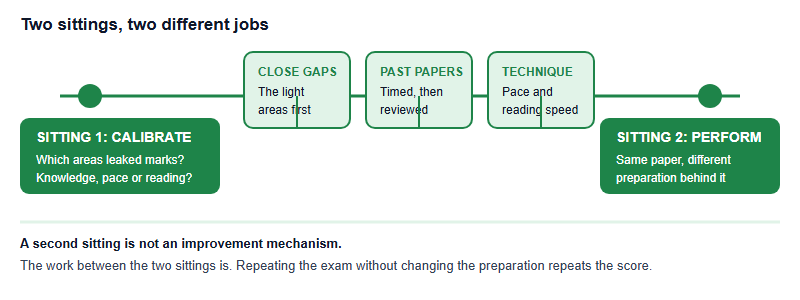
The first sitting is worth something only if you treat it as a diagnostic rather than a verdict. That means recording, immediately afterwards while it is fresh, which subject areas felt thin, how many questions you left unanswered, and how often you had to reread a stem. Those three notes convert a score into a plan. Without them you have a number and nothing to do with it.
The middle year then does three specific jobs, in this priority order: close the breadth gaps in the low-weight areas, because they are the cheapest marks on the paper; build a timed past-paper habit rather than an untimed reading habit; and fix pace and reading speed as separate skills. Our past-paper pack is the raw material for the second and third of those, with worked solutions available for some years only.
One honest caution, because the arc is often sold too confidently. Repeating an exam does not produce a better score by itself. Across our China-based cohorts, the students who improve between sittings are consistently the ones who changed what they did in between — usually by attacking the light-weight areas and the clock rather than rereading the topics they already enjoyed. That is our own observation from teaching rather than a published statistic, and individual results vary.
A decision you can make this week
Run the four checks. If depth passes, plan to sit and spend your preparation on breadth, pace and reading. If depth fails, use this season to read at college level and sit next year with something real behind you — that is a legitimate, deliberate choice, not a retreat.
Two things to avoid. Do not sit purely to have the name on a list; a sitting with no preparation behind it produces a line you will then have to describe honestly on an application, and honesty is the only sustainable option there. And do not let the decision drift: an unmade decision now becomes a rushed preparation in the weeks before the paper, which is the most reliable way to waste a season regardless of which year of school you are in.
Frequently asked questions
What grade do you have to be in to sit USABO?
Eligibility is set by the organisers and can change. Confirm the current rules on cee.org and, for China-based students, our China-region page.
Is Grade 9 too early?
Not automatically, but expect an orientation result. The depth check matters far more than the grade label you happen to be in.
Does sitting twice improve my score?
Not by itself. Improvement comes from the work in between, especially the low-weight areas and timed pacing. Results vary.
Can I aim for Team USA or the IBO from China?
That depends on citizenship and residency, not on where you study: the China region leads to China-region recognition, while the US national-team path sets its own conditions. Confirm both on the official channels.
This is an independent guide operated by Hanlin Education for China-based international-school students. We are not affiliated with, endorsed by, or sponsored by the Center for Excellence in Education (CEE). Eligibility, registration channels and exam dates are set by the organisers and can change — confirm current details on cee.org before you rely on anything here. Errors reported to us are corrected within 7 working days.