For many students preparing for the USA Biology Olympiad (USABO), pedigree analysis presents a unique challenge. Unlike multiple-choice questions that test factual recall, pedigree problems require rigorous logical deduction. The core skill is not just identifying a pattern, but actively testing an inheritance model against every individual in the chart to ensure no contradictions exist. This article demonstrates a systematic approach to verifying inheritance patterns, with explicit assumptions and checked worked cases that show how to eliminate incorrect models relative by relative.
The Core Principle: Falsification With Explicit Assumptions
A frequent mistake among candidates is looking for evidence that supports a hypothesis rather than evidence that refutes it. If you suspect a trait is autosomal dominant, finding one affected parent with an affected child confirms nothing; it merely fails to disprove the hypothesis. To truly verify a model, you must check if any individual’s phenotype contradicts the expected outcome of that model given their parents’ genotypes. If even one contradiction exists, the model is invalid under the standard assumptions: simple Mendelian inheritance, full penetrance, no new mutation or phenocopy, and accurate recorded relationships. This process of falsification is the backbone of scientific reasoning tested in USABO genetics sections.
Distinguishing Autosomal Dominant from Recessive
The first step in analyzing any pedigree is determining dominance. An autosomal dominant trait typically appears in every generation, and affected individuals usually have at least one affected parent. However, this rule has exceptions. A more robust method is to look for two unaffected parents producing an affected offspring. Under simple Mendelian assumptions with full penetrance, this specific configuration definitively rules out autosomal dominant inheritance because if the trait were dominant, at least one parent would need to carry the allele and thus express the phenotype. Conversely, if an affected parent has an unaffected child, this does not rule out dominance, as the parent could be heterozygous. Similarly, one unaffected parent with an affected child does not reject autosomal dominant; only two unaffected parents with an affected child does under the stated assumptions.
Worked Teaching Illustration: Testing Autosomal Dominance
Consider a concrete three-generation pedigree with labeled individuals:
Generation I: I-1 (unaffected male), I-2 (unaffected female)
Generation II: II-1 (affected male, son of I-1 and I-2), II-2 (unaffected female, spouse of II-1)
Generation III: III-1 (affected female, daughter of II-1 and II-2)
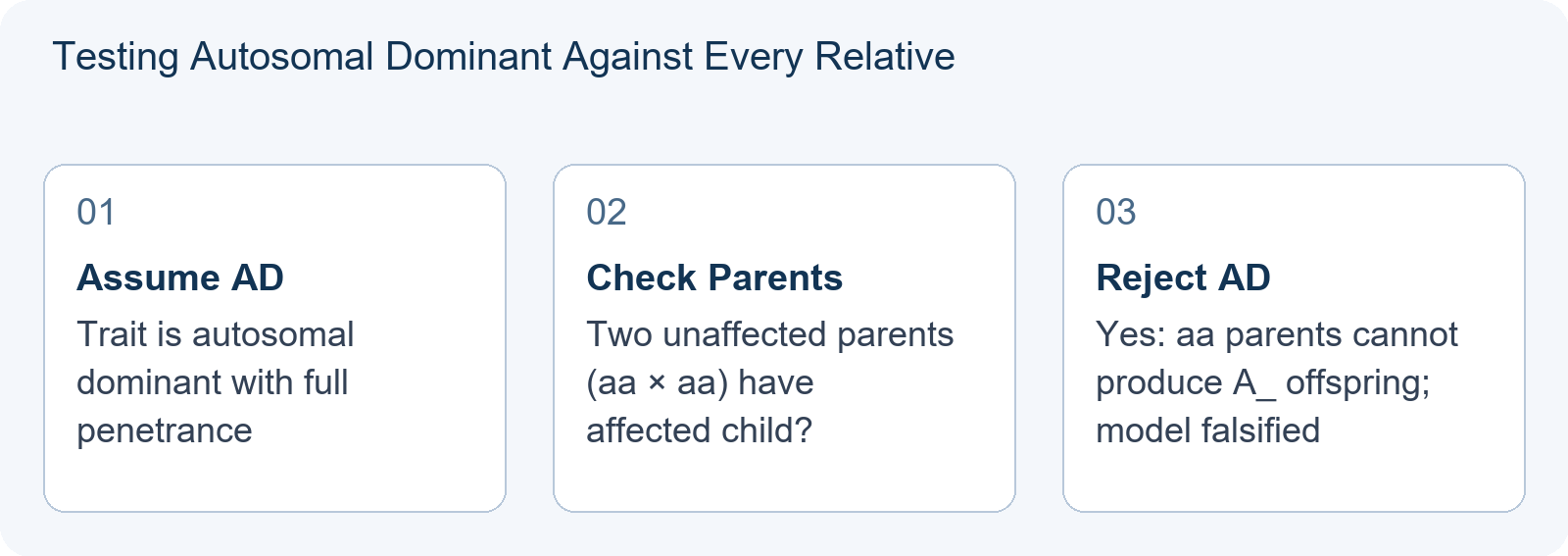
Let us test the hypothesis: “The trait is autosomal dominant.” Under this model with full penetrance, the affected son II-1 must have genotype Aa (assuming the allele is rare enough that AA is negligible). His parents I-1 and I-2 are both unaffected, so they must both be aa. Two aa parents have only a alleles to pass; they cannot produce an Aa offspring. Therefore, the autosomal dominant model is falsified immediately at Generation II.
Now test autosomal recessive: II-1 is aa, I-1 and I-2 are both carriers (Aa). This is consistent. For III-1 to be affected (aa), she must receive a from both parents. Father II-1 is aa (passes a). Mother II-2 is unaffected; she must be Aa to pass a. This is possible. Thus autosomal recessive remains viable.
However, this same pedigree also fits X-linked recessive: I-2 is a carrier (X^A X^a), passes X^a to II-1 (affected male, X^a Y). II-2 is a carrier (X^A X^a), passes X^a to III-1 (affected female, X^a X^a, father II-1 contributes X^a). The pedigree is not uniquely autosomal recessive; both AR and X-linked recessive models remain compatible with these data.
The Critical Role of Sex-Linked Inheritance
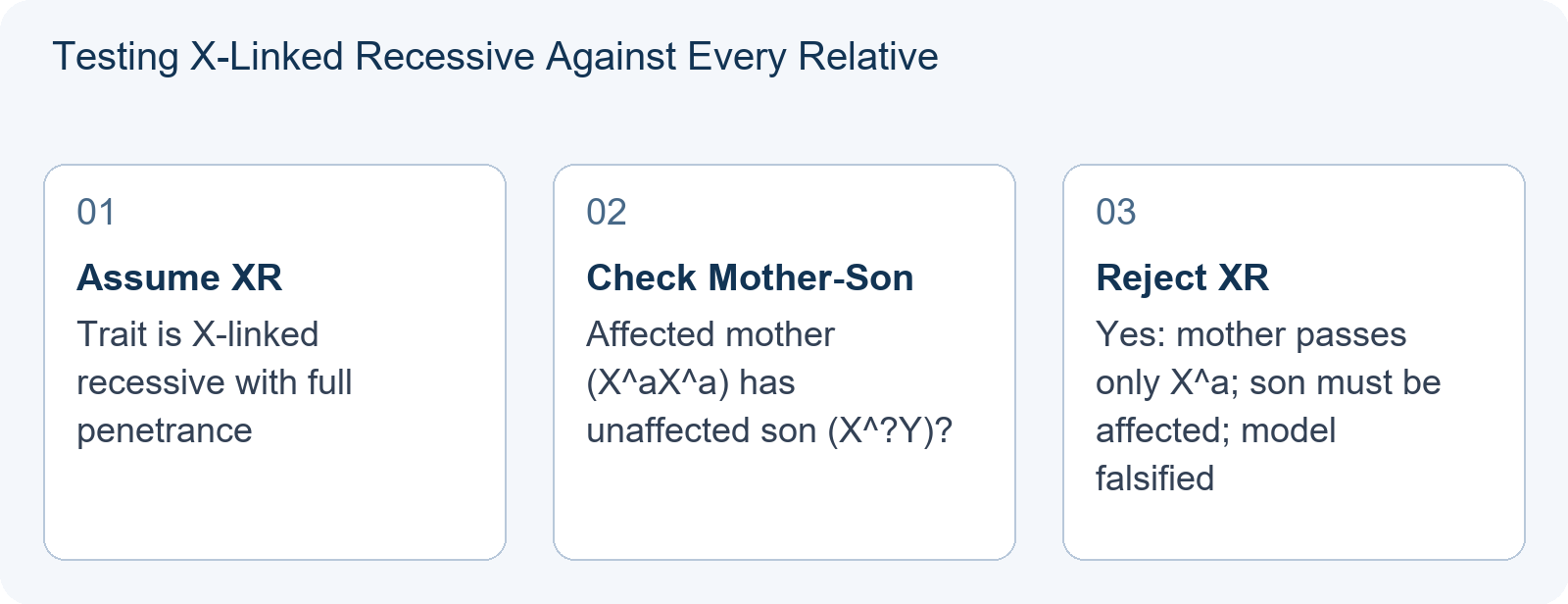
Once autosomal models are considered, sex-linked patterns must be evaluated. X-linked recessive traits show a distinct bias toward males. Key diagnostic features include: affected mothers who are homozygous always pass the trait to all sons; heterozygous carrier mothers pass it to half their sons. Affected fathers pass the mutant X to all daughters, who may be carriers or affected depending on the mother’s genotype; an unaffected heterozygous carrier mother is not normally called affected. A classic contradiction that rules out X-linked recessive is an affected mother having an unaffected son. Since the mother contributes the X chromosome, if she is affected (X^a X^a), all sons receiving her X^a will be affected under full penetrance. If a son is unaffected, the X-linked recessive model is false.
Contrasting Case: A Concrete Pedigree With Labeled Individuals
Consider this specific pedigree:
Generation I: I-1 (affected male), I-2 (unaffected female)
Generation II: II-1 (unaffected female, daughter of I-1 and I-2), II-2 (unaffected male, spouse of II-1)
Generation III: III-1 (affected male, son of II-1 and II-2)
A student might hastily conclude “X-linked recessive” because we see transmission through a female to a male. Let us test systematically against each relative.
Test Y-linked: For Y-linkage, I-1 (affected) should pass the trait to all sons. II-2 is an unaffected male married into the family, not a son of I-1. III-1 is a son of II-2, but Y-linkage requires direct father-to-son transmission. I-1’s Y goes to any sons he might have, not to his daughter II-1. For III-1 to be affected via Y-linkage, his father II-2 would need to be affected and pass Y. But II-2 is unaffected. Under simple assumptions, this observation—unaffected father II-2 with affected son III-1—falsifies Y-linkage. (Note: we do not invoke nonpaternity; we simply note the model fails under standard assumptions.)
Test X-linked recessive: I-1 is X^a Y (affected). He passes X^a to all daughters, so II-1 is X^A X^a (carrier, assuming I-2 is X^A X^A). II-1 passes X^a to half her sons. III-1 is X^a Y (affected). This is consistent. Now check every relative: I-2 is unaffected (X^A X^A, consistent), II-2 is unaffected (X^A Y, consistent), II-1 is unaffected carrier (consistent with phenotype under full penetrance). No contradiction.
Test autosomal recessive: I-1 is aa, I-2 is Aa (carrier), II-1 is Aa (carrier, unaffected), II-2 is AA or Aa (unaffected), III-1 is aa (affected, receiving a from both parents). This requires II-2 to be Aa. Check: II-1 (Aa) × II-2 (Aa) can produce aa offspring. All individuals are consistent.
The key takeaway: this pedigree fits both X-linked recessive and autosomal recessive. You cannot distinguish them without additional data, such as more offspring or molecular testing. The falsification power comes from checking each relative against each model’s predictions, not from pattern matching.
Systematic Verification: Worked Falsification Cases
To apply these principles effectively, use this structured verification process with explicit checks:
Case 1: Rejecting Autosomal Dominant
Pedigree: Two unaffected parents (both aa) have an affected child (A_). Under simple Mendelian assumptions with full penetrance, this is impossible for autosomal dominant because neither parent carries A. The model is rejected. Note: One unaffected parent with an affected child does NOT reject AD; the affected parent could be heterozygous (Aa) and pass A while the unaffected parent passes a.
Case 2: Rejecting Autosomal Recessive
Pedigree: Two affected parents (both aa) have an unaffected child (A_). Under simple assumptions, this is impossible for autosomal recessive because all offspring must be aa. The model is rejected. Note: One affected parent (aa) with an unaffected child does NOT reject AR; the other parent could be AA and all offspring would be carriers (Aa).
Case 3: Rejecting X-Linked Recessive
Pedigree: An affected mother (X^a X^a) has an unaffected son (X^A Y or X^? Y with normal phenotype). Under full penetrance, this is impossible because the mother can only pass X^a. The model is rejected. Note: An affected father (X^a Y) with an unaffected daughter does not reject XR; the mother could contribute X^A, making the daughter a carrier (X^A X^a).
Case 4: Considering Maternal (Mitochondrial) Inheritance
If all children of an affected mother are affected, but none of the children of an affected father are, suspect maternal inheritance. However, note the heteroplasmy caveat: if a mother has mixed mitochondrial genomes, not all offspring necessarily inherit the same proportion of mutant mitochondria, so expression may vary. This complicates simple binary classification.
Common Pitfalls and Edge Cases
USABO questions often include edge cases designed to trap students relying on simple heuristics. One such case is pseudodominance, where a recessive trait appears in every generation because affected individuals marry into families with high carrier frequency. Another is variable expressivity, where the same genotype produces different phenotypes, making it hard to classify individuals as strictly “affected” or “unaffected.” Always read the question stem carefully for mentions of penetrance or expressivity. If the problem states “assume full penetrance,” you can rely on strict binary classification. If not, be cautious about ruling out models based on single ambiguous individuals.
Applying Logic to Complex Pedigrees
In complex pedigrees with consanguinity (marriage between relatives), the probability of recessive traits increases significantly. When analyzing such charts, pay attention to loops in the family tree. These loops increase the likelihood that an individual inherits two copies of the same rare allele from a common ancestor. This context supports an autosomal recessive hypothesis over dominant ones, especially if the trait is rare in the general population. However, do not overstate this: consanguinity increases risk but does not prove recessive inheritance.
Diagnostic Application: Practice Strategy
To prepare for this type of question, do not just memorize patterns. Instead, practice generating pedigrees that fit specific models and then try to break them. Take a known autosomal recessive pedigree and ask: “What single change to one individual’s phenotype would make this impossible?” Then, take an X-linked dominant pedigree and ask: “Can an affected father have an unaffected son?” (Yes, because he gives Y). “Can he have an unaffected daughter?” (No, under full penetrance, because he gives X^D). By actively constructing counterexamples, you train your brain to spot contradictions quickly under time pressure. This active engagement is far more effective than passive review of solved examples.
Conclusion and Next Steps
Pedigree analysis in USABO tests your ability to apply Mendelian logic rigorously. The key is to move beyond pattern recognition to model falsification, with explicit assumptions stated. By systematically testing each inheritance mode against every individual in the chart, you can eliminate incorrect options with certainty. Remember that real biological data is messy, but competition problems usually assume idealized conditions unless stated otherwise. Focus on clear contradictions: two unaffected parents with affected child for dominant traits, or two affected parents with unaffected child for recessive traits. Mastering this deductive framework will not only improve your genetics score but also enhance your overall analytical skills for other biology topics.
For related preparation, see our guides on USABO Linkage Mapping: Reading Recombination Data Without Assuming Independence, Gene Regulation on the USABO: From the lac Operon to Epigenetics, and Twelve School-Biology Simplifications the USABO Punishes — and What to Replace Them With.
Frequently Asked Questions
How do I know if a trait is Y-linked?
Y-linked traits appear only in males and are passed from father to all sons. Under simple Mendelian assumptions, if an affected father has an unaffected son, or if any female is affected, Y-linkage is ruled out. For example, an affected grandfather with a daughter’s affected son does not reject Y-linkage on its own, because a father passes his Y chromosome only to his sons, not through his daughter; however, if that grandson’s father is unaffected, Y-linkage is rejected because the father cannot pass an affected Y.
What if the pedigree shows both males and females affected?
This suggests either autosomal inheritance or X-linked dominant. Test autosomal models first. For X-linked dominant, check if an affected father has an unaffected daughter; under full penetrance, this rejects X-linked dominant because he must pass his mutant X to all daughters.
Does consanguinity affect pedigree analysis?
Yes, marriage between relatives increases the chance of autosomal recessive traits appearing because it raises the probability that both parents carry the same rare allele. Look for loops in the pedigree when considering recessive hypotheses. However, consanguinity supports but does not prove recessive inheritance.