Gene-regulation questions on the USABO reward logic more than recall. Whether a stem describes a bacterial operon, a mutant in a partial diploid or a silenced gene in a mammal, it asks the same few things: which element is a DNA site and which is a diffusible product, which signals are present, and at what level expression is being set. Learn that logic once, through the lac operon, and it carries straight on to enhancers and epigenetics.
Where regulation sits on the paper, and why it is a logic topic
Our overview of the USABO lists gene expression under cell and molecular biology, which carries 20% in the content weighting this guide works from, and mutant and inheritance items also draw on genetics and evolution, another 20%. CEE publishes the content outline, so confirm the current version on cee.org. With 50 questions in 50 minutes and no penalty for a wrong answer, you have about a minute per item: enough to reason, not enough to reread a chapter in your head.
Regulation items come in four recurring shapes: a truth table (which conditions switch a gene on), a mutant or partial-diploid problem, a level-identification problem in eukaryotes, and an inheritance pattern that turns out to be epigenetic. In our coaching, students who treat this topic as vocabulary tend to plateau, while those who sketch a quick truth table before reading the options improve fastest.
The lac operon as a truth table
The lac operon is worth learning properly because it is one of the cleanest genetic switches biology offers. Three structural genes, lacZ, lacY and lacA, are transcribed together as one mRNA from a single promoter, and an operator overlaps that promoter. A separate gene, lacI, is expressed continuously from its own promoter and makes the repressor, which binds the operator and blocks transcription.
Two inputs set the output. Lactose acts through its isomer allolactose, which binds the repressor and releases it from the operator; experiments often use IPTG, an inducer the cell cannot break down. Glucose acts through cyclic AMP: when glucose is scarce, cAMP rises and binds the catabolite activator protein (CAP), and the complex binds near the promoter to help RNA polymerase. The repressor is negative control and CAP is positive control, so the operon runs at a high rate only when both favour it. In E. coli, glucose also reduces lactose uptake, a further layer beyond the CAP account most courses teach.
| Glucose | Lactose | Repressor on operator? | CAP–cAMP bound? | Transcription of lacZYA |
|---|---|---|---|---|
| Present | Absent | Yes | No | Off (basal only) |
| Present | Present | No | No | Low |
| Absent | Absent | Yes | Yes | Off (basal only) |
| Absent | Present | No | Yes | High |
The trp operon is the mirror image. It is repressible rather than inducible: its repressor is inactive on its own and becomes active only when tryptophan, the pathway's end product, binds as a corepressor. Introductory college courses add attenuation, in which the speed of a ribosome translating a short leader sequence decides whether a terminator hairpin forms in the mRNA. That mechanism works only because bacteria translate an mRNA while it is still being transcribed.
Mutants and partial diploids: the cis–trans test
Partial-diploid items put a second copy of the lac region on an F′ plasmid, so the cell carries two copies of each element. Two rules resolve almost all of them.
- Products diffuse, so they act in trans. The repressor made by one lacI allele reaches every operator in the cell. A working lacI+ is therefore dominant over a broken lacI−, and a super-repressor, lacIS, which cannot bind inducer, is dominant too: it keeps both copies off even when inducer is present.
- Sites do not diffuse, so they act in cis. An operator controls only the genes on its own piece of DNA. An operator-constitutive mutation, Oc, cannot bind repressor, so the genes beside it are expressed without inducer while the other copy behaves normally.
The method is two steps: classify each mutation as a site or a product, then follow each DNA copy separately and add up what the cell makes.
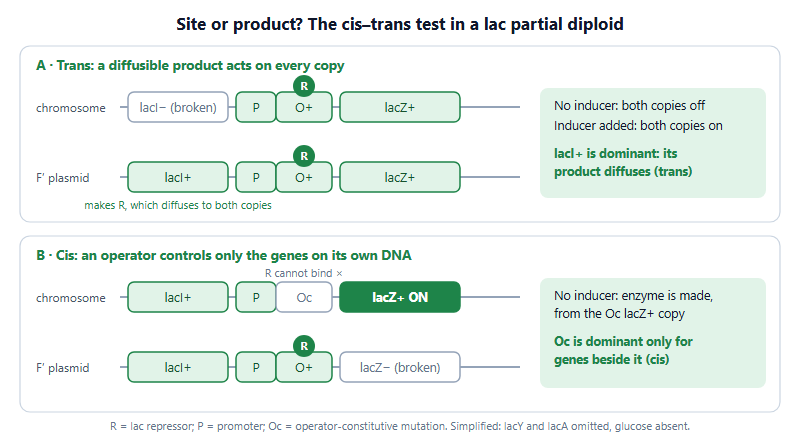
| Genotype (chromosome / F′) | No inducer | Inducer present | What it shows |
|---|---|---|---|
| I+ O+ Z+ | Off | On | Wild type: inducible |
| I− O+ Z+ | On | On | No repressor, so constitutive |
| I− Z+ / F′ I+ Z+ | Off | On | I+ is dominant: the repressor acts in trans |
| IS Z+ / F′ I+ Z+ | Off | Off | The super-repressor is dominant and ignores inducer |
| Oc Z+ / F′ O+ Z− | On | On | Oc switches on the Z+ beside it: cis-dominant |
| Oc Z− / F′ O+ Z+ | Off | On | The Oc copy has no working Z; the normal copy stays inducible |
The same test settles eukaryotic stems, which is why it repays the effort. An enhancer is a site, so deleting it on one chromosome affects only that copy; a transcription factor is a product, so a working allele acts on both copies, although a halved dose can still matter. When an item asks whether a mutation will be dominant in a heterozygote, “site or product?” is the first question to ask.
Eukaryotes add levels, not a new logic
Eukaryotic genes are generally transcribed one gene per mRNA; operons are essentially a bacterial and archaeal arrangement, with rare exceptions such as some nematode genes. What eukaryotes add is more places to intervene between DNA and a working protein.
Transcription is still the main control point for most genes. General transcription factors assemble at the promoter, while specific activators and repressors bind enhancers and silencers that can lie thousands of base pairs away and act by looping the DNA. Because each gene responds to a combination of factors, a modest set of regulators can specify many cell types. Around that step, chromatin packing decides whether the DNA is accessible at all; RNA processing, including alternative splicing, decides which mature mRNA is made; microRNAs and sequences in the 3′ untranslated region influence how long an mRNA lasts and how often it is translated; and phosphorylation and ubiquitin-tagged destruction by the proteasome decide what a protein does and how long it survives.
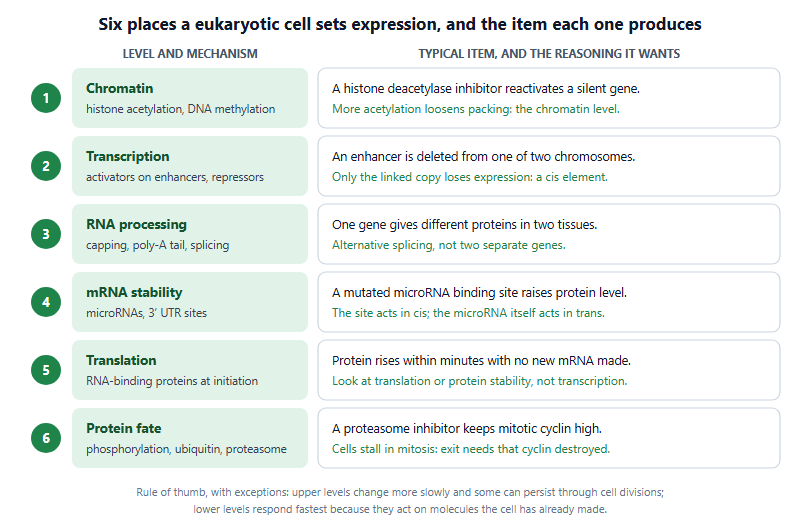
Reporter experiments test these levels directly. Join a promoter region to a gene for a fluorescent protein or luciferase, delete pieces one at a time and measure the signal: a piece whose loss removes expression contains a necessary element, and a piece whose loss raises expression contains a silencer. Treat such data items like any experiment item, by predicting what each deletion would do if a given region mattered.
Epigenetics, without the hype
Epigenetic changes alter gene expression in a way that passes through cell division without changing the DNA sequence. Three mechanisms cover most of what AP-plus-introductory-college biology asks. Methylation of cytosines, typically at CpG sites in promoters, is associated with silencing in mammals, and after replication a maintenance enzyme copies the pattern onto the new strand, which is how it persists through divisions. Histone acetylation neutralises positive charges on histone tails and loosens chromatin, usually favouring transcription, while deacetylation tightens it. Histone methylation can activate or repress, depending on which residue is modified.
Two inheritance patterns are classics. In X inactivation, one X chromosome in each cell of a female mammal is condensed into a Barr body early in development, coated by the non-coding RNA Xist. In placental mammals the choice is random and then inherited by each cell's descendants, which is why a female cat heterozygous for the X-linked orange gene can be tortoiseshell, with patches of orange and black fur. In genomic imprinting, a gene is expressed only from the copy inherited from one parent. The same chromosome 15 deletion causes Prader–Willi syndrome when inherited from the father and Angelman syndrome when inherited from the mother, so the pedigree follows the parent of origin rather than dominance.
Be cautious with options about inheritance across generations. In mammals most epigenetic marks are erased and re-established in germ cells and the early embryo, which limits what passes from parent to child; clearer multigeneration cases are known in plants and some invertebrates. An option claiming that an environmental effect is routinely inherited for generations in humans overstates the evidence.
Practising regulation in three drills
- Truth tables from a blank page. Rebuild the lac and trp tables, with and without glucose or tryptophan, until each takes under a minute.
- Site or product. Classify a mixed list, such as operator, promoter, enhancer, repressor gene, transcription-factor gene, splice site, microRNA gene and microRNA binding site, and predict whether each mutation would act in cis or in trans.
- Pattern reading. For a pedigree that ignores Mendelian ratios, test X-linkage, mitochondrial inheritance, imprinting and incomplete penetrance in turn.
Then move to timed items from our free past-paper pack, which gathers several years of papers, with worked solutions for some years rather than all, and log each miss as either a logic error or a knowledge gap. If you are sitting in the China division, the 2026 paper was on 4 April; confirm the 2027 dates on the China-region page and schedule this block well before your final month.
Where does gene regulation sit on the USABO?
It has no heading of its own. Gene expression sits with cell and molecular biology, and mutant problems draw on genetics and evolution.
What is the difference between cis-acting and trans-acting?
A cis element is a DNA site that controls only its own copy. A trans factor is a diffusible product that can act on every copy.
Why is the lac operon still worth learning?
It is one of the cleanest models of switch logic, and its site-or-product reasoning carries over to enhancers and transcription factors.
Are epigenetic marks inherited across generations?
Mostly not in mammals, where most marks are reset in germ cells and early embryos. Clearer cases are known in plants and some invertebrates.
This is an independent guide operated by Hanlin Education for China-based international-school students. We are not affiliated with, endorsed by, or sponsored by the Center for Excellence in Education (CEE). Exam format, content weightings, eligibility and dates are set by the organisers — please confirm current details on cee.org. The genotypes and item types above are standard textbook examples for practice, not exam content, and remarks on how students improve are our coaches' editorial judgement. If you spot an error, tell us and we will correct it within 7 working days.