For most China-based biology students the honest answer is both, in sequence. The USABO China-division paper is a 50-minute test of breadth that peaks in spring, while a research project is months of depth that peaks whenever your data are collected. Plan the heavy phases so they never collide, and the two become evidence for each other: an admissions reader can check the exam result against the project, and the project against the result.
What each one is actually evidence of
An olympiad result and a research project answer different questions about you, which is why they are rarely substitutes. The USABO Open Exam is 50 multiple-choice questions in 50 minutes, pitched at roughly AP Biology plus introductory college biology; our overview of the USABO sets out the full structure. A result there says you command a broad syllabus and can retrieve it under time pressure, and in the China division it is ranked against everyone who sat the paper that season. It says nothing about whether you can design an investigation, survive a failed experiment or write up months of work.
A project is the reverse. It shows that you can frame a question, choose a method, handle data that refuse to cooperate and explain what you found. Its weakness is calibration: an outsider cannot easily compare one project with another, so a reader looks for signs that the work is genuinely yours.
| USABO result | A research project | |
|---|---|---|
| What it demonstrates | Breadth, accurate recall, reasoning at speed | Question framing, method, persistence, communication |
| Shape of the commitment | Steady weekly study, peaking before one sitting | Uneven: light thinking phases, heavy data phases |
| When it peaks | The weeks before an early-April sitting (China division) | Whenever data are collected, often a summer |
| How a reader calibrates it | A ranking against a large field on one paper | Mentor comments, a write-up, your own explanation |
| Its usual weakness | Says little about independent inquiry | Hard to compare, and your contribution can look unclear |
| What corroborates it | Biology grades and teacher comments | A teacher or mentor letter, your essay and interview |
Two shapes of commitment, one school year
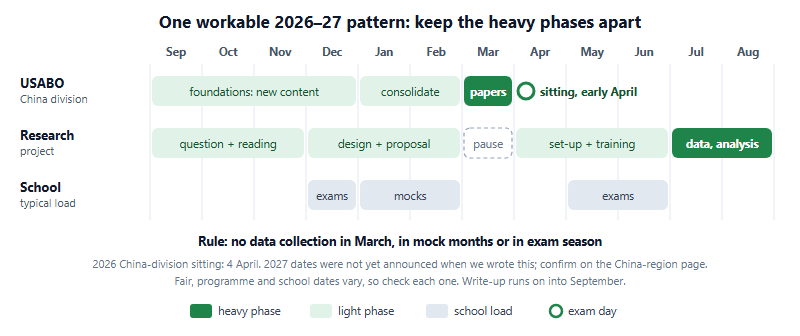
The USABO side of the year is predictable. On the China route, the 2026 sitting was on 4 April; the 2027 dates had not been announced when we wrote this, so confirm them on the China-region page. Preparation is steady rather than dramatic: new content in the autumn, consolidation through winter and timed papers in the final weeks.
A research project has a different shape. Its thinking phases — finding a question, reading, designing a method — are light but continuous, and they sit comfortably beside olympiad study because both are mostly reading. Its data phases are heavy, often tied to lab access, a mentor's schedule or a programme's dates, and they cannot be squeezed into spare evenings. Science fairs and summer programmes set their own deadlines; if you are aiming at the ISEF route, our sister guide to ISEF explains how that pathway works.
The collision rule follows directly: keep data collection out of March, out of your school's mock months and out of exam season. Those weeks belong to one commitment only.
How the two cross-validate in an application
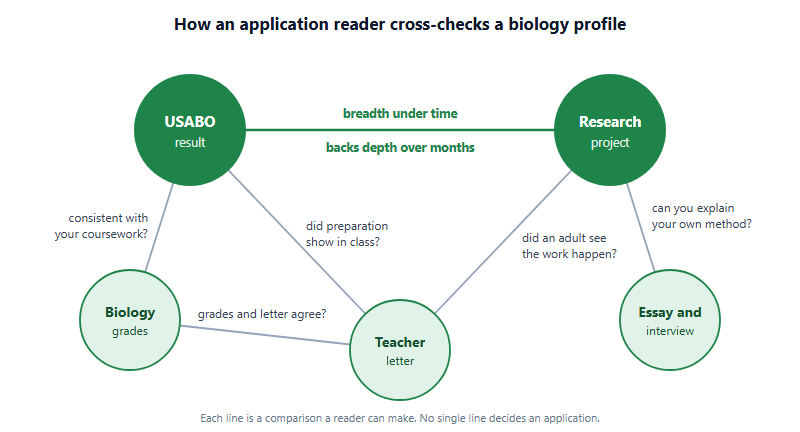
Admissions readers do not judge an award in isolation. They check it against the rest of the file: the transcript, the activity list, the teacher letters and the essays. When several pieces of evidence point the same way, each becomes more believable, and that is exactly where an olympiad result and a project help each other.
- The result against the grades. A strong USABO result beside strong biology grades reads as consistent ability. A strong result beside weak grades raises a question you should answer before a reader has to ask it.
- The project against the letter. A teacher or mentor who watched the work happen confirms that it was yours, which a reader cannot verify from a write-up alone.
- The project against your own account. In an essay or interview, explaining why you chose a method and what went wrong is the strongest evidence of ownership.
- The result against the project. Breadth tested under time backs depth built over months: the reader sees a student who knows the field broadly and has also worked hard on one question in it.
Two cautions keep this honest. First, a result can only corroborate what it actually is. The China-region page states that the Semifinal and National Finals, the stages that lead to Team USA and the International Biology Olympiad, require US citizenship or legal residency and are not part of the China-region programme, so never imply otherwise. Second, the olympiad ceiling is real but narrow: per Hanlin, two students it coached won a gold and a merit award at IBO 2026, but they reached it through their own country's national selection, not the USABO China route, and IBO places are national-team places decided by each country's own selection, results vary, and for most readers of this guide the USABO result itself is the evidence that matters.
The timing trap for final-year students
Work backwards from application deadlines. Most US early deadlines fall in November and most regular deadlines in early January; the UCAS deadline for equal consideration is in October for Oxford, Cambridge and most medicine courses, and in late January for most others. An early-April sitting in your final year therefore comes after almost every application has gone in.
In practice, the sitting that can appear on an application is the one in Grade 11 or earlier, so if the result matters to you, make that the season you prepare for properly, and check on the China-region page when results are released. The same logic applies to research: a project begun in the autumn of your final year is usually too thin by the deadline to carry much weight, so the data phase needs to fall in the summer before Grade 12 at the latest. A final-year sitting can still be worth doing for the biology itself; just be honest with yourself about what it can add.
Four situations, four sequences
| Where you are in 2026–27 | USABO | Research | Why this order |
|---|---|---|---|
| Grade 9 | Build foundations and sit in April as a calibration | Reading and a small school-based investigation | Low stakes on both sides; learn how each kind of work feels |
| Grade 10 | Prepare properly and sit in April | Follow the full pattern: a question in autumn, data collection in the summer | A real result and a finished project, a year before applications |
| Grade 11 | Your key sitting: likely the one that appears on your application | Data collection in the summer after the sitting, at the latest | Both are largely done before Grade 12 deadlines |
| Grade 12 | Optional, for the learning rather than the application | Write up and present existing work; do not start a new project as evidence | Deadlines arrive before new work can mature |
School-embedded research counts too. IB students already write an Extended Essay, and A-Level students may take an Extended Project Qualification; either can grow out of a question your olympiad reading raised. The China-region page also lists a scholarship bonus for award winners enrolled in ASDAN's EPQ programme at the time of the exam, so check its current terms there if that applies to you.
Skills that transfer, and a decision to make this month
The two activities also train each other. Olympiad breadth speeds up the reading phase of a project, because the background to most papers is already familiar. Research makes the experiment and data items on the USABO easier, because you have had to think about controls and confounds for real. Practise that crossover on timed items from our free past-paper pack, which gathers several years of papers, with worked solutions for some years rather than all.
In our coaching, plans that fail are rarely too ambitious in total; they fail because two heavy phases land in the same month. Before October ends, answer five questions on paper:
- Which April sitting is the one that could appear on your application?
- Do you have a research question you would still care about in six months?
- When are your school's mock and exam seasons this year?
- Where does your data phase fall, and does it stay clear of March?
- Who will see the work happen, and could they write about it?
Can I prepare for USABO and do a research project in the same year?
Yes, if the heavy phases do not overlap. Keep reading-heavy research work in autumn and collect data after the April sitting.
Which counts for more, a USABO result or a research project?
Neither has a fixed weight. Readers check each against your grades, letters and essays, and results that corroborate each other convince more.
Will a final-year USABO sitting appear on my application?
Usually not. An early-April China-division sitting comes after most US and UK deadlines, so plan around an earlier sitting.
Does the China-region path lead to Team USA or the IBO?
No. Per the China-region page, the Semifinal and National Finals require US citizenship or legal residency and are not part of it.
This is an independent guide operated by Hanlin Education for China-based international-school students. We are not affiliated with, endorsed by, or sponsored by the Center for Excellence in Education (CEE). Exam format, eligibility, dates and results timing are set by the organisers — please confirm current details on cee.org and on the China-region page. University deadlines vary by institution and year; the planning model above is our coaches' editorial judgement, not an admissions rubric; and first-party results are reported per Hanlin, de-identified, and vary from student to student. If you spot an error, tell us and we will correct it within 7 working days.