A compressed USABO run is a triage exercise, not a syllabus. You cannot cover seven content areas in a month, so you stop trying: you rank blocks by weight against your own gaps, chase reasoning rather than facts in physiology, and let past-paper errors choose your reading. It can work. It is still the second-best plan, and this article is honest about why.
We are writing this because the question arrives every season, usually in a slightly panicked message: the exam is close, I have not started properly, is it worth entering? Rather than answer with encouragement, here is a method — drawn from a de-identified account of a student we supported who prepared in under a month and reached the Semifinal in the US region. Read it as method. It is not a promise about your result, and results vary.
What a short run can buy, and what it cannot
Start with the structural facts of the exam, because they are what make compression possible at all. The Open Exam is 50 questions in 50 minutes, with no penalty for a wrong answer, sampling seven content areas at roughly AP Biology plus introductory college level. Two features of that design matter enormously to a late starter:
- The weightings are public and uneven. Animal anatomy and physiology carries 25 per cent; cell biology and genetics and evolution carry 20 per cent each; plants 15; ecology 10; behaviour and taxonomy 5 each. Four blocks account for 80 per cent of the paper. A month spent evenly across seven areas is a month spent badly.
- No penalty means no blank answers. Coverage gaps do not compound into negative marks. On a compressed run you will meet questions you simply have not studied — and the scoring design means an educated guess costs you nothing but the seconds.
So what can a month buy? Realistically: a solid pass over the two or three highest-weight blocks, familiarity with the question style, a working time strategy, and a vocabulary sweep over the small blocks. That is a genuinely competitive position.
What it cannot buy: depth in the low-weight blocks, comfort with the unusual, or the mechanism-level command that comes from a slower read. Compression trades ceiling for floor. It raises your floor fast and caps how high you can go. If you have six months, use six months — the same total hours convert better when they are spread, because the reading and the papers get to feed each other repeatedly instead of once.
The triage rule: weight against your own gaps
The instinct on a short runway is to start at chapter one and go as far as time allows. That is the worst available ordering, because chapter one is rarely your weakest high-weight block.
Instead, run a two-axis sort in the first two days. On one axis, the published weight of each block. On the other, your honest current confidence — measured, not felt, by sitting one full timed past paper before you study anything at all. That diagnostic paper is uncomfortable and it is the single highest-value hour of the whole month, because it converts “I think I am weak at physiology” into a number.
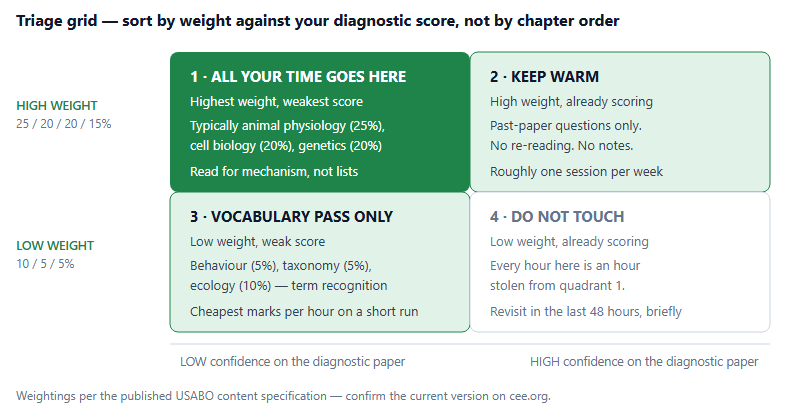
Two counter-intuitive consequences fall out of this grid, and both were decisive in the case we are describing.
Quadrant 3 is cheap. Behaviour and taxonomy are only 5 per cent each, and a late starter is tempted to write them off completely. Do not. At USABO level they lean heavily on recognising terminology rather than reasoning through mechanism, which means a systematic vocabulary sweep converts them faster than any high-weight block converts. On a thirty-day budget, two or three evenings there is one of the best trades available.
Quadrant 2 is a trap. Re-reading a block you already score well on feels productive because it is pleasant. It is the single most common way compressed runs waste their scarcest resource.
The four-week shape
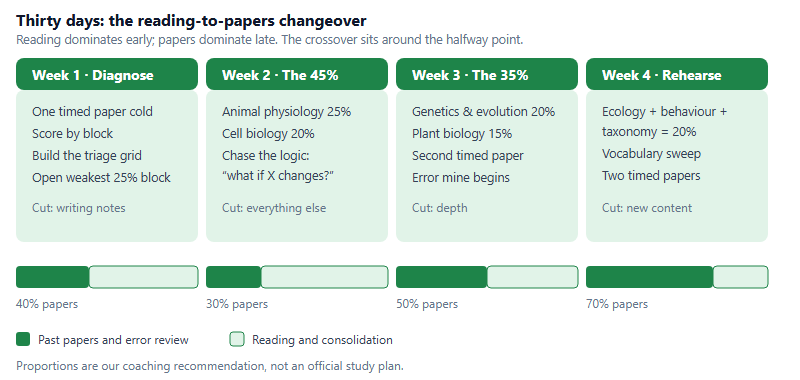
What follows is the shape of the month, not a prescription — your diagnostic paper decides the contents. The proportions are the transferable part: reading dominates early, papers dominate late, and the changeover happens around the halfway mark.
| Week | Primary job | Blocks in play | Papers | What you deliberately cut |
|---|---|---|---|---|
| 1 | Diagnose and map | One full timed paper first, then your weakest high-weight block | 1 timed, fully reviewed | Note-making from scratch. Use the textbook index, not blank pages. |
| 2 | Mechanism in the 45% | Animal physiology (25%) and cell biology (20%) — reasoning, not lists | Topic questions only | Any block outside quadrant 1. Genuinely any. |
| 3 | Second high-weight sweep | Genetics and evolution (20%), plants (15%) | 1 timed, fully reviewed | Depth. You are buying coverage now, not mastery. |
| 4 | Vocabulary sweep and rehearsal | Ecology, behaviour, taxonomy (20% combined) as terminology | 2 timed, fully reviewed | New content. Nothing new enters in the final week. |
The habit that carried the short run: chase the logic
When we debriefed the student afterwards, the advice they gave to the next cohort came out in one sentence: go after the logic, especially in physiology.
That is not a slogan, it is a time calculation. Animal physiology at 25 per cent is a large body of factual material — every hormone, every regulatory loop, every transport mechanism. Memorised as a list, it is unlearnable in a month. Understood as a small number of principles applied repeatedly — negative feedback, gradients, pressure and flow, surface area and diffusion distance, compensation — it becomes a block you can reason your way through even when the specific example is unfamiliar.
The practical test on every physiology page: can you predict what happens if one variable moves? If blood pressure falls, what does the kidney do, and why, and in what order? If you can answer, you own the page. If you can only recite it, you own nothing that will survive an unfamiliar question stem.
The same principle downgrades genetics in a useful way. Genetics and evolution at 20 per cent contains calculation questions that reward a handful of reliable procedures rather than a broad reading of the literature — good news on a short runway.
Papers as instrument, not scoreboard
On a compressed run the temptation is to save the papers for the end, so as not to “waste” them before you are ready. This is exactly backwards. Papers are a diagnostic instrument; the whole point of a short run is to be diagnosed early and often.
Three rules from the case:
- Full and timed, from day one. A paper done untimed and in pieces measures nothing you need.
- Review takes longer than the paper. Fifty minutes to sit it; expect ninety or more to review it properly. If your review is shorter than your sitting, you are collecting scores instead of information.
- Mine the errors for frequency. The student we are describing kept a running tally not of individual mistakes but of topics that generated repeated mistakes. Those recurring topics became the reading list. This is the single mechanism by which a month of study aims itself.
You can work from our gathered past-paper pack for this; note that worked solutions exist for some years only, which on a compressed run means you should spend your solution-supported papers on diagnosis early rather than saving them.
Ten days instead of thirty, and what we would change
If the runway is ten days, the plan does not compress proportionally — it changes shape. Drop the reading almost entirely. Sit papers, review them at length, and read only the specific pages your errors point to. Do the vocabulary sweep over the small blocks, because it is the only place where ten days can still buy something close to full coverage. Accept that quadrant 1 will remain partly unconverted, and go in knowing the no-penalty scoring rule means unfamiliar questions still deserve an answer.
And the honest closing note. Asked what they would do differently, the student’s first answer was simply start earlier. A month works; it works by cutting things that a longer run would have converted into marks. If you are reading this with a season still ahead of you, the correct takeaway is not “a month is enough” — it is “the triage grid is good, and it is far better with six months behind it.”
Some context on outcomes, de-identified and reported by us rather than by the organisers. Across our 2026 USABO cohort we recorded 10 super-gold, 20 gold, 37 silver, 36 bronze and 30 regional merit results — “super-gold” and “regional merit” are our own internal record labels rather than USABO award categories, and the organiser’s published recognition tiers carry different names; in the US Division a number of the students we supported reached the Semifinal, and one reached the National Finals top-20 group and was selected for the 2026 US team through the United States national selection route, which carries its own citizenship and residency requirements, rather than through the China region. Those Semifinal and Finals stages sit in the US region — routes and eligibility differ by region, so if you are studying in mainland China read our China-region pathway page and confirm current eligibility on cee.org rather than assuming the same ladder applies. And one number we want to be precise about, because it circulates loosely: a figure of 91 dual golds sometimes quoted in promotional material is cumulative across 2020 to 2026, not annual — the 2026 figure alone was 6. Nothing here predicts your result, and a competition result on its own does not produce a university offer.
Frequently asked questions
Is it worth entering if I have only a month?
Often yes, because the no-penalty scoring rule means gaps do not cost you marks directly. Treat it as a triage exercise rather than a syllabus.
Should I save past papers until I have finished reading?
No. On a short run papers are the diagnostic that aims your reading. Sit one cold in the first two days.
Which block should I cut first?
Cut depth everywhere before you cut a block entirely, and never spend time on high-weight material your diagnostic already shows you can answer.
Do the small 5 per cent blocks matter on a short runway?
Yes, disproportionately. Behaviour and taxonomy lean on terminology recognition, so a vocabulary sweep converts them faster than high-weight blocks.
This is an independent guide operated by Hanlin Education for China-based international-school students. We are not affiliated with, endorsed by, or sponsored by the Center for Excellence in Education (CEE). Exam format, content weightings, eligibility and registration are set by the organisers — please confirm current details on cee.org. Student outcomes described here are our own de-identified records, reported by us and not by the organisers; results vary and nothing on this page is a prediction or a guarantee. If you spot an error, tell us and we will correct it within 7 working days.