USABO publishes seven subject areas with weights — animal anatomy and physiology 25%, cell biology 20%, genetics and evolution 20%, plant biology 15%, ecology 10%, behaviour 5%, taxonomy 5%. Those percentages describe how marks are labelled. They do not describe how questions are built. In our own reading of past papers, a large share of items sit on a bridge between two areas, and a student who has revised each area in its own silo can know both halves and still get the item wrong.
This is the most common reason a well-prepared candidate plateaus: study hours keep rising, content keeps being added, and the score does not move. The missing skill is not more biology. It is the habit of moving between areas inside a single question.
Percentages describe the syllabus, not the question
A weighting table is an administrative document. It presumably tells the people writing the paper roughly how many items to draw from each area so the exam stays balanced across seasons. It is not a promise that each item lives cleanly inside one area, and in biology it could not be — the subject does not partition that way. An action potential is simultaneously animal physiology and membrane cell biology. A question about why a bird helps raise its sibling’s chicks is filed under behaviour and answered with evolutionary accounting.
When an item is written, it gets one label for the balance sheet. When you sit it, you need whatever it actually requires. Those two facts come apart constantly, and the gap between them is where marks disappear.
This has a practical consequence for how you read the weights. Budgeting revision hours by percentage is sensible — the 25% area deserves more time than the 5% areas — but it silently assumes that the hours spent on animal physiology only pay out on animal physiology items. They do not. An hour spent on membrane transport pays out in cell biology, in plant water relations and in neurobiology, which is three areas totalling 60% of the paper. The weights are a reasonable first pass at allocation; they are a poor guide to what any individual hour is worth. For the underlying shape of the exam and its subject areas, see our overview of the USABO.
Notice also that this compounds the timing problem. With 50 questions in 50 minutes, an item you can answer only by assembling two areas on the spot — from cold, under a clock — costs far more than a minute. Cross-topic connections need to be rehearsed in advance so that on the day they are recall rather than construction.
The six bridges that carry the most traffic
Not all pairings are equally common. These six recur because they follow the causal structure of biology itself, and between them they touch every one of the seven areas.
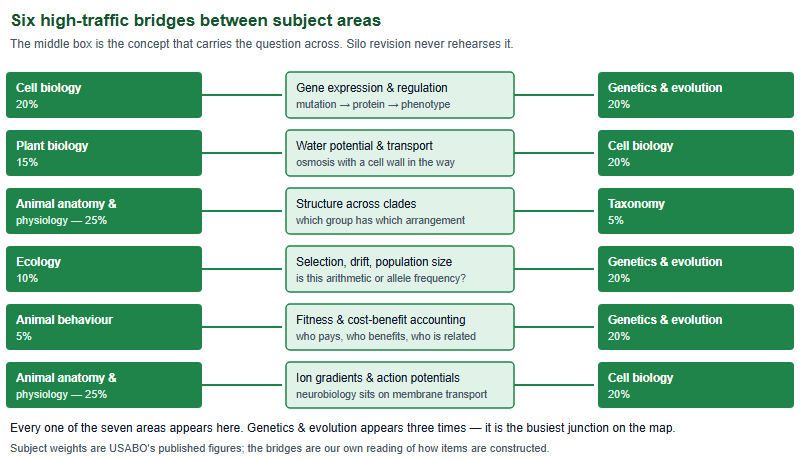
The table below is the same map written out, with what the stem tends to look like and why a silo reviser walks past it.
| Bridge | The carrying concept | What the stem often looks like | Why silo revision misses it |
|---|---|---|---|
| Cell ↔ Genetics | Gene expression and regulation | A mutation is described in a regulatory sequence; you are asked for the consequence for a protein or a phenotype. | Transcription is filed under “cell”, mutation under “genetics”, so the chain from one to the other is never rehearsed end to end. |
| Plant ↔ Cell | Water potential and membrane transport | A “plant” item that is really solute potential, turgor and the behaviour of a walled cell. | Osmosis was learned in animal cells. The wall changes the outcome, and nobody re-derived it in a plant context. |
| Animal A&P ↔ Taxonomy | Structure across clades | An unfamiliar organism is named and you must infer how it exchanges gas, moves blood or excretes nitrogen. | If physiology was learned as human physiology, an unfamiliar name makes the whole item unanswerable. |
| Ecology ↔ Genetics | Selection, drift and population size | A population scenario that could be ecological arithmetic or a change in allele frequency — you must notice which. | Two different toolkits sit under two different headings, and the stem does not tell you which drawer to open. |
| Behaviour ↔ Genetics | Fitness and cost-benefit accounting | An animal does something apparently costly; the answer is an evolutionary argument, not a behavioural term. | Behaviour revision tends to be vocabulary. The item wants reasoning about relatedness and payoff. |
| Animal A&P ↔ Cell | Ion gradients and action potentials | A neurobiology item that turns on channels, pumps and gradients rather than on nerve anatomy. | The membrane work sat in cell biology weeks earlier and was never re-applied to a neuron. |
What a bridge error looks like in your review
Bridge errors are easy to misdiagnose, and the misdiagnosis is expensive: you conclude you have a knowledge gap, you go and read more, and the next paper produces the same result.
There is a fast test. When you look at the answer, start a timer and try to explain why it is right using only facts you already knew before you opened the paper. If you can do it inside about twenty seconds, it was a bridge error — you owned both halves and did not connect them under time pressure. If you cannot, because a required fact is genuinely absent, it is a knowledge gap and more reading is the right response.
The two need completely different treatment:
- Knowledge gap. Go to the source, learn the material, add it to your review cycle. Ordinary and cheap.
- Bridge error. Reading more will not help, because nothing is missing. What is missing is retrieval across headings, and the fix is practice at connecting, not at absorbing.
Tag both kinds in whatever error log you keep, and count them separately. If bridge errors are more than about a third of your wrong answers, you have found your plateau: your content base is adequate and your revision method is the constraint. That is good news, because connection work is faster than content work.
Bridge drills: twenty minutes, twice a week
These are deliberately small. They are not a replacement for content revision; they are the layer that makes content revision pay.
- The pair prompt. Pick two of the seven areas at random and write one exam-style question that genuinely requires both. Writing items is the fastest way to understand how they are built — you will find yourself thinking about which distractor catches someone who only knows one half, which is exactly the trap you keep falling into.
- The unfamiliar organism. Take any organism you have never studied. Place it taxonomically, then predict three physiological consequences, then one ecological role. That is three areas on one index card, and it directly rehearses the A&P–taxonomy bridge that unfamiliar-species stems exploit.
- The two-tag pass. On a paper you have already sat, go through and label each item with the two areas it touches rather than one. Two things happen: you see how many items are genuinely two-tagged, and you start reading stems for structure rather than for topic.
- The downstream chain. Take one fact and ask what it constrains elsewhere. A membrane pump constrains what a neuron can do, which constrains how fast an animal can respond, which constrains what ecological niche is available to it. Four areas, one chain, five minutes.
All four work best on material you have already met, which is why they belong in the middle of a season rather than the start. If you want stems to practise on, the free gathered pack of USABO past papers is the most faithful source of real question construction — use already-sat papers for the two-tag pass and keep unseen ones back for timed measurement.
Where bridge work belongs in a season
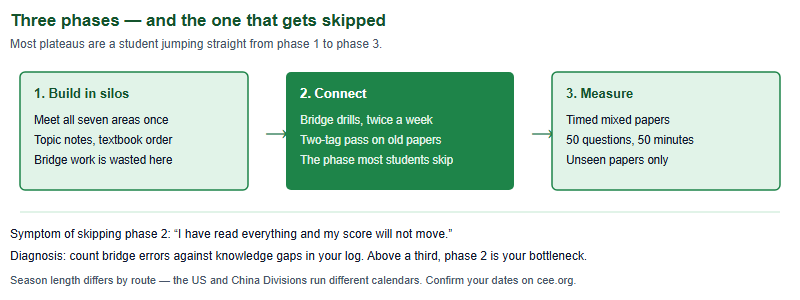
Bridge work is genuinely wasted before phase 1 is complete: you cannot connect areas you have not met, and trying produces confusion rather than integration. It is equally wasted if you postpone it until the final fortnight, when there is no time to rebuild anything you discover. The window is the middle of the season — after the seven areas exist in your head, before the timed papers start carrying real weight.
How long that middle stretch is depends entirely on your route, since the divisions sit on different calendars: the US Division Open Exam is in February and the China Division in April. Count backwards from your own date rather than from someone else’s. If you are not certain which applies to you, confirm it on cee.org and our China-region page before you plan anything else.
Frequently asked questions
What is a bridge error on the USABO exam?
Getting an item wrong when you already knew both halves of the biology but did not connect them under time pressure. Reading more does not fix it.
How do I tell a bridge error from a knowledge gap?
Try explaining the correct answer in twenty seconds using only what you already knew. If you can, it was a bridge error.
Should I stop revising USABO by topic?
No. Build the seven areas in silos first. Bridge work is the layer on top, and it is wasted before the areas exist.
Which USABO subject area appears in the most cross-topic questions?
On our own map of the bridges it is genetics and evolution, which links to cell biology, ecology and behaviour. It is the busiest junction on the map.
This is an independent guide operated by Hanlin Education for China-based international-school students. We are not affiliated with, endorsed by, or sponsored by the Center for Excellence in Education (CEE). Subject weights quoted here are the organisers’ published figures; eligibility, registration channels and exam dates are set by the organisers and can change — confirm current details on cee.org before you rely on anything here. Errors reported to us are corrected within 7 working days.