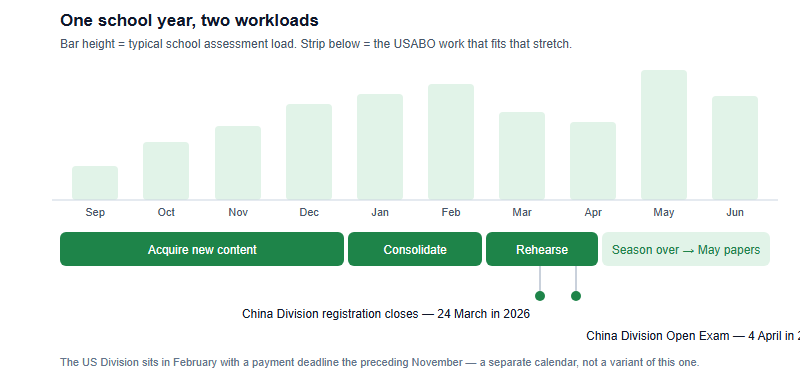
If you are on the China route, your USABO date sits in early April — in 2026 the Open Exam fell on 4 April, with registration closing on 24 March. That places it a few weeks after most schools’ mock season and a few weeks before May papers. A season is entirely winnable inside a normal international-school year, but only if you sequence it against the school calendar rather than hoping for spare evenings.
Most students who run out of road do not run out of ability. They run out of calendar. They start in October with enthusiasm, lose November and December to school assessments, lose January and February to mocks, and arrive in the last fortnight before the paper trying to meet plant biology for the first time. The fix is not more hours. It is putting the right kind of hour in the right month.
Two divisions, two calendars — anchor everything to your own date
USABO is run by the Center for Excellence in Education, which also selects and trains the United States team for the International Biology Olympiad, and more than 10,000 US high-school students enter each year. There is a China region, and it does not run on the American calendar.
The US Division Open Exam sits in February, with a registration payment deadline the preceding November. The China Division Open Exam sits in early April; in 2026 it was 4 April, with registration closing on 24 March. Those are two calendars, not two descriptions of the same one. A revision plan copied from a US-based student — and most of the plans circulating in English online are — runs roughly two months early for a China Division candidate. You will peak in February and go flat in the week that actually matters.
Dates move from season to season, so the diary entry you make today should be provisional. Confirm the current dates on cee.org and on our China-region page before you build anything around them, and confirm eligibility and what each division leads on to with the organisers rather than assuming the two routes are interchangeable.
What you are preparing for is short and dense: 50 questions in 50 minutes, no penalty for a wrong answer, pitched at roughly AP Biology plus introductory college biology. That combination is worth holding in mind while you plan, because it tells you the season is about breadth and speed rather than a single deep project. For the shape of the exam itself, see our overview of the USABO.
The collision map: what the school year actually does to your evenings
School calendars vary, so treat the table below as a template to overwrite with your own dates rather than a fixed schedule. But the shape is remarkably consistent across IB, A-Level and AP schools in China: a light autumn opening, a heavy December, a punishing January–February mock stretch, a brief March lull, and then May.
| Month | What school is typically doing | USABO work that fits | What not to attempt |
|---|---|---|---|
| September | New syllabus, low assessment load | First-encounter content in the areas school never teaches | Timed papers — you have nothing to time yet |
| October | First internal assessments; club commitments start | Continue acquisition; build the error-log habit | Adding a second competition in the same window |
| November | Rising assessment load; application deadlines for Year 13 | Short reading blocks; topic quizzes of 12–15 items | Starting a second textbook |
| December | End-of-term examinations | Maintenance only: retrieval on what you already built | Meeting a new subject area for the first time |
| January | Mock season begins at most schools | Consolidation of areas school is revising anyway | Full 50-item papers in an assessment week |
| February | Mocks continue; predicted grades take shape | Same — ride the school revision, do not fight it | New content of any kind |
| March | Post-mock lull; registration closes for the China Division | Timed papers, mixed sets, gap repair | Discovering an untouched subject area now |
| Early April | Coursework deadlines; final school revision starting | The sitting itself, then a hard stop | Cramming the two nights before a 50-minute paper |
| May–June | AP, IB and A-Level papers | Nothing new — harvest the biology you already built | Treating USABO as unfinished business |
Two features of that map deserve attention. First, September and October are the only stretch in the year with genuinely low competing demand, and they are also the stretch most students waste, because April feels far away. Second, the March lull is short, and it is the only month in which timed rehearsal fits comfortably — which means everything that has to be learned must be learned before it.
Sequence by what school is doing for you, not by topic size
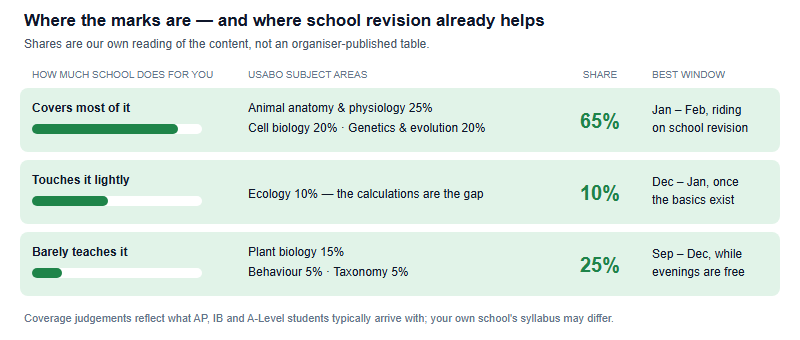
The usual advice is to allocate revision hours in proportion to the subject weights. On our own reading of the content, those weights are animal anatomy and physiology 25%, cell biology 20%, genetics and evolution 20%, plant biology 15%, ecology 10%, behaviour 5% and taxonomy 5% — that is our reading, aligned to AP Biology plus college general biology, and not a table published by the organisers. Proportional allocation is a sensible first pass at how much. It says nothing about when.
The scheduling question is a different and better one: in which month is each area cheapest to learn? An area your school is about to revise for its own mocks is cheap in January, because the school does half the work and you are only adding depth. An area your school never teaches is expensive in January and cheap in September, because it requires undivided first-encounter attention that mock season will not give you.
That reframing produces a clear instruction. Front-load the areas the school syllabus barely touches. In our experience of what AP, IB and A-Level students arrive with, that means plant biology, behaviour and taxonomy — a quarter of the paper on our own reading, and the quarter most likely to still be untouched in March. Leave cell biology, genetics and evolution, and animal anatomy and physiology for the winter, where school revision is already pushing in the same direction.
Ecology sits awkwardly between the two bands. Most syllabuses cover the vocabulary — trophic levels, succession, population growth — and skip the arithmetic, which in our experience is where the harder ecology items sit. Treat it as a December or January job: the concepts arrive from school, and you add the calculations on top.
Two protection rules that keep both scores intact
Rule one: no first-encounter content in a mock month. Meeting a subject area for the first time requires a kind of slow, unhurried attention that January and February simply do not contain. If you try, you will half-learn it, and half-learned biology is worse than none, because it produces confident wrong answers on a paper where there is no penalty for guessing and therefore no reason to leave anything blank.
Rule two: no full 50-item timed paper in the week of a school assessment. A full paper is not fifty minutes; it is fifty minutes plus the hour of honest review that makes it worth sitting, and it costs a disproportionate share of the attention your school assessment needs. In assessment weeks, substitute a 12- to 15-item set drawn from one or two subject areas — it keeps the retrieval habit alive at a fraction of the cost. Our compiled past-paper pack is easy to slice this way, since you can pull items by area rather than sitting a whole paper.
Beyond the two rules, one habit matters more than any schedule: a fixed weekly slot. Students who protect two named hours a week from September survive December. Students who work opportunistically — whenever an evening happens to be free — discover in February that no evening has been free since October. Results vary, but the difference between those two patterns shows up long before the paper does.
Finally, be willing to drop things. A USABO season plus a second competition in the same window is usually one commitment too many, and so is a third club in the autumn term, which is precisely the stretch the season needs. Deciding what not to do in September is the cheapest scheduling decision available to you, and the only one that gets more expensive the longer you delay it.
The month after the paper, which almost nobody plans
An early-April sitting has an underrated property: it finishes before May papers rather than during them. The biology you spent seven months building is therefore at its warmest exactly when AP Biology, IB Biology and A-Level Biology revision begins. Students who treat the season as closed on exam day throw that away; students who spend the following fortnight rewriting their USABO error log as school revision notes get the overlap for free.
Mid-April is also the right moment to decide about next year, while the experience is vivid rather than reconstructed. Whether you sit again, and what you would change, is a much better question then than in the following October. If you do plan another season, note the two dates you now know matter — the registration close and the sitting itself — and confirm both for the new season on our China-region page and with the organisers rather than assuming they repeat.
Frequently asked questions
When is the USABO Open Exam for China-based students?
The China Division sits in early April — 4 April in 2026, with registration closing 24 March. Dates move and the 2027 China-region dates are not yet announced; confirm on our China-region page and with the organisers.
Can I follow a US student’s USABO revision timeline?
No. The US Division sits in February with a payment deadline the previous November, so a US plan peaks about two months too early.
Which subject areas should I study before mock season?
The ones school barely teaches — plant biology, behaviour and taxonomy. New content is hardest to absorb during January and February.
Will USABO preparation damage my AP or IB grades?
It need not. The content overlap is large, and an early-April sitting finishes before May papers if you stop adding new material in March.
This is an independent guide operated by Hanlin Education for China-based international-school students. We are not affiliated with, endorsed by, or sponsored by the Center for Excellence in Education (CEE). Subject weights described here are our own reading of the content, not an organiser-published table; eligibility, registration channels and exam dates are set by the organisers and can change — confirm current details on cee.org before you rely on anything here. Errors reported to us are corrected within 7 working days.