The dangerous material in a USABO paper is rarely the biology you have never met. It is the biology you met in a simplified form, believed completely, and never revisited. School teaches workable approximations because they are teachable. Olympiad items are frequently written at the exact point where the approximation stops being true — and because the exam carries no penalty for a wrong answer, you will answer confidently and never flag it.
Below are twelve of the simplifications we see most often in students who arrive from AP, IB and A-Level classrooms, with the correction each one needs and the kind of item that exposes it. None of this is exotic. It is all standard first-year college biology, which is roughly the level the exam is pitched at — see our overview of the USABO for the shape of the paper.
Why a simplification costs more than a gap
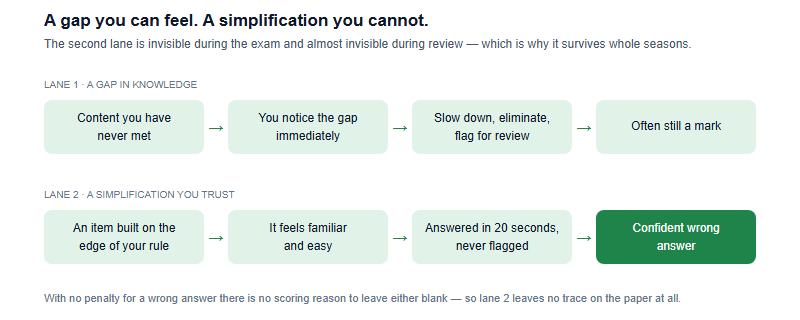
A gap announces itself. You read the stem, recognise that you have never met the content, slow down, work by elimination, and often still take the mark. The whole process is conscious, and because it is conscious it also gets logged and repaired afterwards.
A simplification does the opposite. The stem feels familiar. A rule you have used successfully for two years fires immediately, produces an option that is sitting right there in the list, and you move on inside twenty seconds. You do not flag it, you do not revisit it, and when you check your score you cannot tell it apart from the items you genuinely knew. That is why a paper full of “careless mistakes” is usually nothing of the kind: it is a paper full of confidently applied approximations.
Energy, membranes and the cell: four that are not quite true
1. “Mitochondria make energy.” Nothing makes energy. Mitochondria transduce it: electrons from reduced carriers pass along the inner-membrane chain, protons are pumped, and the resulting electrochemical gradient drives ATP synthase. The gradient is the intermediate step, and it is exactly the step school skips. Every question about uncouplers, about brown adipose tissue generating heat, or about why the ATP yield per glucose is quoted as a range rather than a fixed number, lives at that step. If your model ends at “mitochondria make ATP”, you have nothing to reason with.
2. “ATP stores energy like a battery.” ATP is turnover currency, not storage. A cell holds a tiny pool relative to its consumption and regenerates it continuously; the free energy released on hydrolysis is not a fixed textbook number but depends on the prevailing ratio of ATP to ADP and inorganic phosphate. Storage is glycogen, starch and triacylglycerol. Items that ask why a muscle cell contains so little ATP, or why creatine phosphate exists at all, are testing whether you understand the difference between a buffer, a store and a currency.
3. “Enzymes have an optimum temperature, usually 37 °C.” The familiar bell curve is the sum of two opposing processes: reaction rate rising with temperature, and the enzyme population denaturing faster with temperature. The apparent optimum therefore shifts with how long the assay ran — a real experimental variable, not a trick. And 37 °C is a human number: enzymes from thermophilic archaea, Antarctic fish and temperate plants have entirely different profiles. Expect stems set in organisms that are not mammals.
4. “The membrane is a phospholipid sandwich with proteins stuck in it.” It is a fluid mosaic: lipids and many proteins diffuse laterally, the two leaflets differ in composition, and organisms actively adjust fatty-acid saturation and sterol content to hold fluidity roughly constant as temperature changes. This is why cholesterol is described as a fluidity buffer rather than simply as something that makes membranes more or less fluid, and why a cold-adaptation stem is a membrane-composition question in disguise.
Genes, dominance and selection: four more
5. “One gene, one protein.” The map from genome to proteome is one-to-many. Alternative splicing lets one transcript yield several mature mRNAs; post-translational modification and proteolytic processing multiply the products further; and some genes are transcribed to functional RNA and never translated at all. Any item that compares gene counts across species and asks you to explain proteome complexity is aimed squarely at this, as is any item on a splice-site mutation.
6. “Dominant alleles are common, recessive alleles are rare.” Dominance is a statement about the phenotype of the heterozygote. Frequency is a separate, population-level property, and the two are independent: a dominant allele can be vanishingly rare, and a recessive allele can sit near fixation. This is the single most productive misconception in Hardy–Weinberg items, where a candidate quietly assumes the dominant phenotype must be the majority and the arithmetic goes wrong from the first line. “Dominant” also does not mean stronger, better or advantageous.
7. “Evolution acts for the good of the species.” Selection acts on heritable differences in reproductive success among individuals. Behaviour that looks altruistic — alarm calls, helpers at the nest, sterile workers — is accounted for by inclusive fitness, through relatedness and shared alleles, or by reciprocity. Behaviour is only about 5% of the paper on our own reading of the content, but it is disproportionately populated by exactly these scenarios, and in our experience the group-benefit option is usually there and always sounds reasonable.
8. “Natural selection produces optimal design.” Selection works with the variation that happens to exist, along a history that constrains what is reachable, under trade-offs, and against a background of drift. The vertebrate blind spot and the recurrent laryngeal nerve are not puzzles to be explained away; they are the expected result of a path-dependent process. Whenever a stem asks why evolution has not eliminated something, the intended answer is almost always constraint, trade-off or drift rather than a hidden benefit.
Whole organism, plants and ecology: the last four
9. “Water moves from where there is less salt to where there is more.” Water moves down a water-potential gradient, and water potential has a solute term and a pressure term. In a walled plant cell, turgor pressure rises as water enters until it opposes further net inflow — which is why a plant cell placed in pure water becomes turgid and stops, while an animal cell in the same beaker lyses. Any item that puts both cell types in one solution is testing the pressure term, not the solute term.
10. “Plants photosynthesise by day and respire at night.” Plants respire continuously. What changes in the light is the net gas exchange. At the light compensation point, gross photosynthesis exactly matches respiration and net exchange reads zero — which is emphatically not the same as photosynthesis having stopped. This one arrives most often as a data item: a carbon-dioxide exchange curve crossing the axis, with an option asserting that photosynthesis has ceased. In our experience it is one of the most reliable traps we see.
11. “Arteries carry oxygenated blood, veins carry deoxygenated blood.” Artery and vein describe direction relative to the heart, not oxygen content. The pulmonary artery carries deoxygenated blood, the pulmonary veins carry oxygenated blood, and fetal circulation departs further still. Saturation is also a sigmoid function of partial pressure that shifts with carbon dioxide, pH and temperature — not a binary label. Dissociation-curve items reward students who abandoned the binary years ago.
12. “Carrying capacity is a fixed number for a species.” K is a property of a particular population, in a particular environment, at a particular time, and it is a parameter of a model — the logistic — that assumes instantaneous density dependence and a constant environment. Real populations lag, overshoot, cycle and track shifting resources. When a stem presents field data that does not settle onto a flat line, the option claiming the population “has reached its carrying capacity” is usually the distractor.
All twelve at a glance, and how to hunt your own
| The simplification | What is actually true | How an item exploits it |
|---|---|---|
| Mitochondria make energy | They transduce it via a proton gradient | Uncouplers, brown fat, variable ATP yield |
| ATP is stored energy | A currency turned over continuously | Why the ATP pool is small; creatine phosphate |
| Enzymes peak at 37 °C | Optimum depends on organism and assay length | Non-mammal stems; two-duration experiments |
| Membrane is a static sandwich | Fluid mosaic, composition actively adjusted | Cold adaptation; the role of sterols |
| One gene, one protein | Splicing and processing make it one-to-many | Gene count versus proteome; splice mutations |
| Dominant means common | Dominance is heterozygote phenotype only | Hardy–Weinberg arithmetic |
| Evolution benefits the species | Selection acts on individual reproductive success | Alarm calls, helpers, sterile castes |
| Selection yields optimal design | Constraint, trade-off, drift, history | “Why has this not been eliminated?” |
| Water moves toward more salt | Down a water-potential gradient, solute plus pressure | Plant and animal cells in one solution |
| Plants respire only at night | Respiration is continuous; net exchange changes | Compensation-point gas-exchange curves |
| Veins are always deoxygenated | Direction, not oxygen; saturation is a curve | Pulmonary and fetal circulation; Bohr shift |
| Carrying capacity is fixed | Population-, place- and time-specific model parameter | Field data that never flattens |
You will have simplifications this list does not contain, and they are the ones that will cost you. The method for finding them is the three-layer test. Take any fact you would state confidently, and try to state it at three levels: the claim, the mechanism underneath it, and the condition under which it fails. School teaching usually delivers layer one. Olympiad stems are typically written at layer two, and the options separate at layer three.
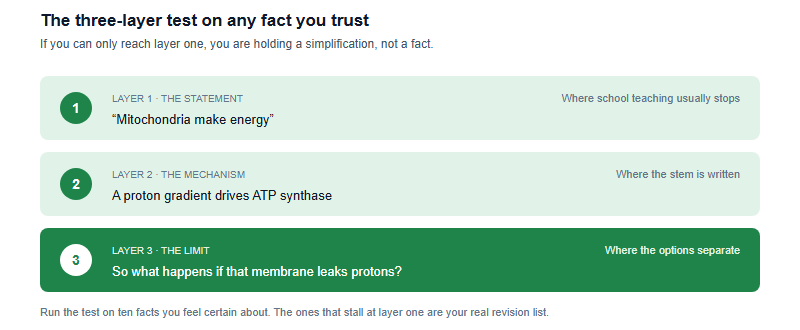
Practically, run the test twice a week on a handful of statements you feel certain about, and again on every past-paper item you got wrong. The diagnostic question during review is simple: could you state the rule that produced your wrong answer? If you can — if there was a confident rule, not a blank — you have found a simplification rather than a gap, and it needs rewriting rather than re-reading. Working through our compiled past-paper pack in this frame turns each paper into a diagnostic instrument rather than a score.
The best time for this work is autumn and early winter, well before your sitting. Rewriting a belief takes longer than learning a fact for the first time, and it does not compress well into the fortnight before a paper. If you are on the China route, the sitting is in early April — confirm the season’s dates on cee.org and our China-region page, and count backwards generously.
Frequently asked questions
How do I tell a simplification from a knowledge gap?
Ask whether you could state the rule behind your wrong answer. A confident rule means a simplification; a blank means a gap.
Does USABO really test beyond school biology?
It is pitched at roughly AP Biology plus introductory college biology, so stems often sit at the mechanism layer school stops short of.
Which of the twelve costs students the most marks?
In our experience, the two that recur most are dominance meaning “common” and plants respiring only at night.
When should I do this misconception work?
Autumn and early winter. Rewriting a belief you already trust takes far longer than learning something new, and it does not cram.
This is an independent guide operated by Hanlin Education for China-based international-school students. We are not affiliated with, endorsed by, or sponsored by the Center for Excellence in Education (CEE). Subject shares mentioned here are our own reading of the content, not an organiser-published table; eligibility, registration channels and exam dates are set by the organisers and can change — confirm current details on cee.org before you rely on anything here. Errors reported to us are corrected within 7 working days.