A school USABO group succeeds or fails on three decisions made early: which sitting you are actually planning towards, who you let into the room, and what you use contact time for. Content coverage — the thing most groups obsess over — matters far less than any of them, because content is the one part students can genuinely do alone.
This is written for the biology teacher or club lead who has been asked to start something, and for the student who wants to argue for one. It assumes no budget, one hour a week, and a mixed group of students at different stages.
Start from the exam date, and be sure which exam date it is
The most common planning error is building the year around the school calendar rather than around the sitting your students will actually take. Get this wrong and everything downstream is misaligned by months.
There is more than one calendar in play, and they must never be merged in a planning document. The US Division sits its Open Exam in February, with a registration payment deadline in the preceding November. The China Division sits in early April — in 2026 the exam fell on 4 April, with registration closing on 24 March. Those are separate cycles with separate deadlines. A school working to the wrong one will either miss an administrative window entirely or spend the spring revising for a paper its students sat two months earlier.
Two practical consequences. First, if your students are in the US Division, the decisive administrative step lands in the autumn, not in the new year — you cannot open the question in January. Second, whichever division applies, the entry route and who may take part are set by the organisers, and they can change between cycles. Confirm the current dates, entry arrangements and eligibility on cee.org and on the China-region path page before you publish anything to parents. A deadline you remember from last season is not evidence, and a teacher circulating a wrong date does more damage than one circulating none.
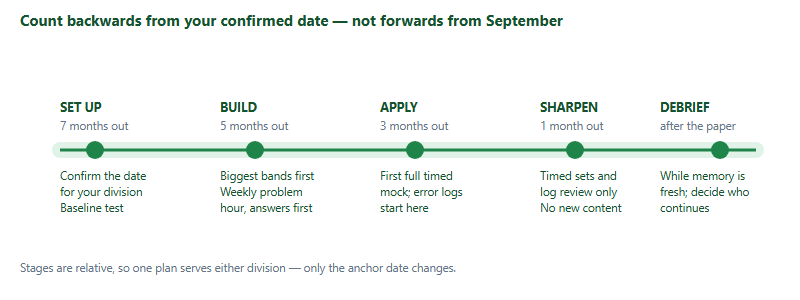
Write the confirmed date at the top of your plan and count backwards from it. Every milestone below is expressed relative to that date rather than to a month, precisely so the plan survives whichever division you are in.
Selection: who should be in the room
Two instincts pull against each other here, and both are partly right. Open the door too wide and the hour drifts toward the least prepared student; gatekeep on grades and you exclude exactly the students who tend to thrive.
What works better is an open door plus an honest briefing plus an early baseline. Tell students plainly what the commitment is before they sign up, admit anyone willing to take it, then run a timed set under real conditions in the first month. The Open Exam format is 50 questions in 50 minutes with no penalty for a wrong answer, which is about a minute an item, and nothing you say in a briefing communicates that pressure as efficiently as sitting it once. Confirm current format on cee.org rather than assuming it from an old paper.
The baseline is not for ranking. It does two jobs: it lets students self-select honestly, having felt the thing rather than imagined it, and it shows you the spread you are actually teaching. Groups that skip this step usually discover the spread only in the final weeks before the paper, when there is no time left to respond to it.
Three further principles worth holding:
- Do not select on current biology grades alone. School assessment rewards accurate reproduction of a syllabus; this rewards reasoning under time about material partly outside it. The overlap is real but loose, and every experienced group lead has watched a mid-grade student outperform the obvious candidate.
- Do not split by year group. Split by what students need. A Year 11 who has finished cell biology may be ahead of a Year 12 who has not, and a mixed room gives you peer explanation for free — which is one of the few teaching resources that improves the explainer as much as the listener.
- Be honest about the size of the field. In the US Division, more than 10,000 high-school students enter each year. Students deserve to know they are entering something genuinely competitive, and a group built on a realistic picture holds together far better in the crunch weeks before the paper than one built on optimism.
What contact time is uniquely for
The scarce resource in a school group is not information. Textbooks, recordings and question banks are abundant and students can reach them at midnight. The scarce resource is a knowledgeable adult in a room with them, and almost every failing group spends it on the one thing that does not require it — lecturing content the students could have read.
The test to apply is simple: could a motivated student do this alone at home? If yes, it should not consume the hour.
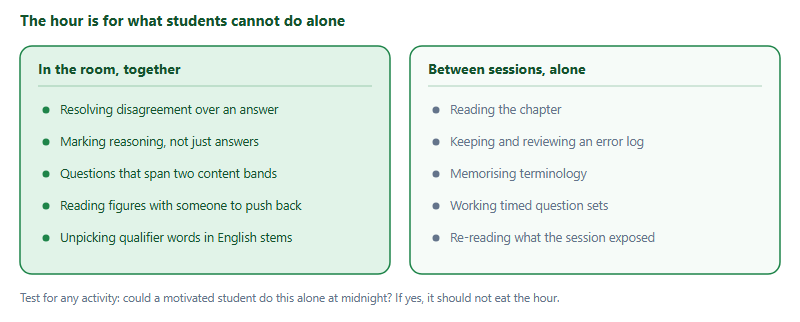
A format that works reliably: set one problem before the session, require every student to commit to an answer in writing before discussion opens, then run the discussion. Commitment before discussion is what separates a real argument from a room agreeing with whoever spoke first, and it makes disagreement visible — which is the raw material you want.
Two things deserve deliberate slots. Cross-topic items, where the biology sits at the join between two bands, because students almost never generate these for themselves. And the English itself: for China-based international-school students the load is real, and multiple-choice biology hides its meaning in small qualifying words — most likely, primarily, best explains, all of the following EXCEPT. A student reading alone does not notice what they are failing to notice. In a room, someone will.
A stage-by-stage shape for the year
Stages are given relative to your confirmed exam date rather than as months, so the same plan works for either division.
| Stage | Group session focus | Independent work | Checkpoint that tells you it is working |
|---|---|---|---|
| About 7 months out | Briefing, syllabus map, one baseline set under timed conditions | Begin the largest content band | Students can state what the format demands without looking it up |
| About 5 months out | Weekly problem hour; content blocks in order of weight | Reading plus end-of-chapter questions | Written answers before discussion, not after |
| About 3 months out | First full timed mock; introduce error logs | Log every miss by cause, not by topic | Logged errors are being resolved, not merely recorded |
| About 1 month out | Timed sets and log review only | Revisit personal weak bands; stop new content | Most of the group finishes the paper in time |
| Exam period | Light contact; protect sleep and school assessment | Maintenance, not cramming | Nobody is starting a new topic |
| After the paper | Debrief while memory is fresh; decide who continues | Write down what they would change | The group survives the result, in either direction |
Six ways school groups fail, and what to watch instead
1. Lecturing the textbook. The most comfortable use of an hour and the least valuable. If students leave having heard content rather than having been challenged on their reasoning, the session could have been an email.
2. Burning the past papers early. Real papers are a limited calibration resource: once a student has seen one, it can never again tell you what they would have scored cold. Spend them deliberately, keeping at least one intact for the final month. Our compiled past-paper pack — gathered and annotated by our teachers, with worked solutions available for some years rather than all — is what most groups build their timed sets from, but the discipline about spending them applies to any source.
3. Teaching to the strongest student. It is enormously satisfying and it quietly hollows out the room. If one student answers everything, use written commitment before discussion; it makes every student’s thinking visible and removes the reward for speed alone.
4. Keeping no written record. Without error logs the same misconception returns every few weeks and nobody notices it is the same one. The log belongs to the student, but the group lead should see the pattern across the room — three students logging the same confusion is a session topic that has just written itself.
5. Refusing to yield to school assessment. A group that competes with internal exams loses, and takes its most conscientious students down with it. Plan the collision in advance: lighten deliberately in your school’s heaviest assessment weeks and say so, rather than watching attendance decay and reading it as a lack of commitment.
6. Selling it as an admissions lever. Outcomes vary and depend on far more than a single exam, and a group recruited on that promise dissolves the moment results arrive. Recruit on the biology — on the fact that this is the most interesting reasoning most students will do all year — and the group survives whatever the scores say.
What to measure while the season is still running. Scores are lagging and noisy. By the time a mock tells you something, weeks have gone. Better leading indicators, all observable from inside the room:
- Can students explain a wrong answer? Not name the right one — explain why the option they picked was attractive. This is the single best predictor that review is doing real work.
- Are logged errors closing? A log that grows without resolution is a diary, not an instrument.
- Completion rate under time. Whether students reach the end of a timed set is a cleaner early signal than the score itself, because it separates a pacing problem from a knowledge problem.
- Attendance in the hardest month. Stability through your school’s heaviest term is a better sign of a healthy group than enthusiasm in the first week.
One honest caveat to carry into any conversation with parents or a head of department: cohort outcomes vary substantially with intake, preparation time and the students themselves, and no group structure can promise a result. What a well-run group can reliably deliver is students who reason better under time pressure than they did in September — which is worth having regardless of what any single paper returns.
Frequently asked questions
Does a student need a school teacher to enter?
Entry routes and who may take part are set by the organisers and differ by division. Confirm on cee.org and the China-region path page.
How large should a school group be?
Small enough that every student speaks in every session. Beyond that, written commitment before discussion matters more than the exact number.
Which year groups should be invited?
Invite by readiness rather than year. Mixed-year rooms work well because peer explanation benefits the explainer as much as the listener.
How much independent work is realistic?
A few sustained hours a week across a season beats occasional long bursts, and it survives school assessment far better.
This is an independent guide operated by Hanlin Education for China-based international-school students. We are not affiliated with, endorsed by, or sponsored by the Center for Excellence in Education (CEE), which runs the USA Biology Olympiad. Confirm current rules, formats, dates, entry routes and eligibility on cee.org. Errors reported to our editorial desk are corrected within 7 working days.