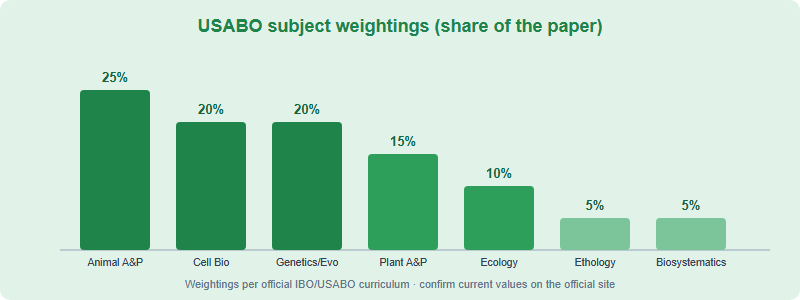
USABO is not evenly weighted across topics. It follows the seven IBO subject areas, split roughly Animal Anatomy & Physiology 25%, Cell Biology 20%, Genetics & Evolution 20%, Plant Anatomy & Physiology 15%, Ecology 10%, Ethology 5%, Biosystematics 5%. The commonest USABO prep mistake is spreading study time evenly — or over-investing in a favourite topic. This guide converts those percentages into a revision-hour budget so your effort lands where the marks are.
The seven areas and what they weigh
The same seven areas are tested across all four USABO exams (Open, Semifinal, Nationals) and at the International Biology Olympiad. Knowing the weightings is the closest thing USABO gives you to a marking scheme, because it tells you the expected proportion of the paper each area occupies:
| Subject area | Approx. weight | What it covers (indicative) |
|---|---|---|
| Animal Anatomy & Physiology (incl. neurobiology) | 25% | Systems physiology, homeostasis, nervous & endocrine control, circulation, respiration, excretion, immunity |
| Cell Biology | 20% | Membranes & transport, respiration & photosynthesis, the cell cycle, signalling, molecular biology of the gene |
| Genetics & Evolution | 20% | Mendelian & molecular genetics, population genetics, selection, speciation, phylogenetics |
| Plant Anatomy & Physiology | 15% | Plant tissues, transport, hormones, photoperiodism, reproduction and development |
| Ecology | 10% | Populations, communities, energy flow, nutrient cycles, biomes |
| Ethology | 5% | Animal behaviour, innate vs learned behaviour, signalling, behavioural ecology |
| Biosystematics | 5% | Classification, taxonomy, major groups and their relationships |
Two areas — Animal Physiology (25%) and the pair of Cell Biology + Genetics & Evolution (20% each) — together account for roughly 65% of the paper. That is the headline that should shape your calendar. For a fuller orientation to the competition itself, see what the USABO is.
Turning percentages into a revision-hour budget
The simplest, most honest way to plan is to allocate study hours in proportion to the weightings, then adjust for your personal weak spots. Suppose you have 100 hours of focused USABO revision before the Open Exam. A weight-proportional baseline looks like this:
| Area | Weight | Baseline hours (of 100) | Adjust up if… |
|---|---|---|---|
| Animal Anatomy & Physiology | 25% | ~25 h | Your school course skimmed systems physiology |
| Cell Biology | 20% | ~20 h | You are shaky on respiration/photosynthesis or molecular biology |
| Genetics & Evolution | 20% | ~20 h | Population genetics maths is unfamiliar |
| Plant Anatomy & Physiology | 15% | ~15 h | Plants were under-taught (common for many students) |
| Ecology | 10% | ~10 h | You have not done quantitative ecology |
| Ethology | 5% | ~5 h | Rarely needs more — keep it lean |
| Biosystematics | 5% | ~5 h | Rarely needs more — keep it lean |
The discipline this imposes is valuable in both directions. It stops you pouring 20 hours into Biosystematics because you find taxonomy satisfying (it is worth ~5%). And it stops you neglecting Animal Physiology because it feels dense (it is worth ~25% — the largest single block). If you scale up to 200 hours, keep the same ratios: the weightings do not change, only your total does.
One caution on the 5% areas: low weight does not mean skip. Ethology and Biosystematics are cheap points — a few focused hours can lock in most of what those areas ask, precisely because the scope is narrow. Treat them as high-efficiency, not ignorable.
How to spend the big three blocks
The three heavyweight areas absorb most of your calendar, so it is worth being specific about where the hours go inside each one. These notes are indicative of the kind of depth USABO rewards; always check the current official syllabus for the definitive scope.
- Animal Anatomy & Physiology (~25%). This is the largest block and the one most likely to be under-taught by a standard school course, because it spans many organ systems. Prioritise the control systems — the nervous and endocrine systems, homeostasis, and how feedback loops regulate the internal environment — alongside circulation, gas exchange, excretion and immunity. Because neurobiology sits here, expect membrane potentials and signalling to appear. Study these as mechanisms with diagrams, not as lists of facts.
- Cell Biology (~20%). The high-yield core is bioenergetics — respiration and photosynthesis, step by step — plus membrane transport, the cell cycle and its control, cell signalling, and the molecular biology of the gene (replication, transcription, translation). These topics recur across the paper and often underpin questions that appear to be about something else, so a solid cell-biology foundation pays compound interest.
- Genetics & Evolution (~20%). Split your time between the qualitative and the quantitative. On the qualitative side: Mendelian and molecular genetics, linkage, and the mechanisms of evolution and speciation. On the quantitative side: population genetics, including Hardy–Weinberg calculations and allele-frequency reasoning. The maths here is a common weak spot for students whose school course stayed descriptive, and it is exactly the sort of applied reasoning the harder rounds test.
For the mid-weight and light areas — Plant Physiology (15%), Ecology (10%), Ethology and Biosystematics (5% each) — aim for confident, complete coverage of the essentials rather than deep specialisation. Plants in particular are frequently under-taught relative to their 15% share, so do not let a strong animal-biology background lull you into neglecting plant transport, hormones and reproduction.
A study method that fits the weightings
Because USABO sits at roughly the AP Biology plus introductory college biology level, your baseline textbook coverage (for example a standard college biology text) will already touch every area. The weightings tell you where to go deeper than the textbook, and past questions tell you how each area is examined:
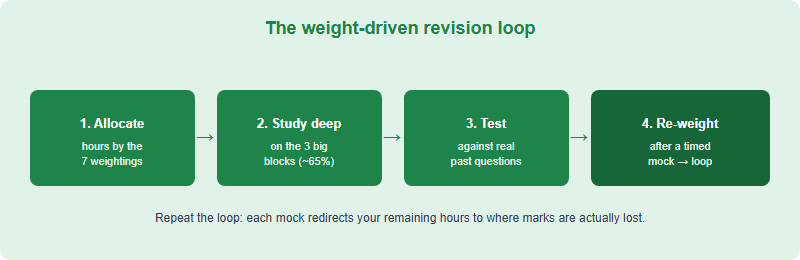
- Depth follows weight. For the three big blocks (Animal Physiology, Cell Biology, Genetics & Evolution), go beyond definitions into mechanisms, diagrams and quantitative problems. For the 5% blocks, aim for confident coverage of the essentials, not encyclopaedic depth.
- Calibrate with real questions. After studying an area, test it against real items in that area. Our USABO past-papers pack is a free set our team has gathered so you can see exactly how, say, genetics or animal physiology is examined; worked solutions exist for some years only and we keep adding to them.
- Re-weight after a mock. Take a timed Open-Exam-style mock, then reallocate your remaining hours toward the areas where you actually lost marks — not the areas you assume are weak.
Why this beats an even study plan
An evenly split plan feels fair but wastes effort. Under the USABO weightings, one extra hour on Animal Physiology is worth about five times as much, at the margin, as one extra hour on Ethology — simply because the former occupies roughly five times the paper. Weight-proportional planning is how strong students quietly out-score peers who studied just as hard but distributed their hours by interest rather than by marks.
The weightings are also a useful sanity check when you feel behind. If your remaining time is short, protecting the three big blocks — even at the expense of polishing the 5% areas — keeps your effort pointed at roughly two-thirds of the available marks. It is far better to be genuinely solid on the areas that make up most of the paper than to be thinly spread across all seven. Let the percentages, updated after each mock, tell you where the next hour belongs.
This principle also transfers cleanly to the British Biology Olympiad (BBO), which overlaps with roughly 70-90% of USABO’s content on our own syllabus comparison. If you are preparing for both in one cycle, the same weight-driven budget largely serves both papers — you drill each paper’s format separately, but the underlying biology, and where it is concentrated, is the same. For international students planning their season, this is efficient: one weight-driven core, sat as two papers. Where and how you can participate, including through the USABO China-region pathway, should be confirmed on the official channels before you build your calendar around a specific date. However you study — alone or with a tutor — the point is to let the marks, not your preferences, set the calendar.
Frequently asked questions
What are the USABO subject weightings?
Roughly: Animal Anatomy & Physiology 25%, Cell Biology 20%, Genetics & Evolution 20%, Plant 15%, Ecology 10%, Ethology 5%, Biosystematics 5%. Confirm current values on the official site.
Which USABO topic is most important to study?
Animal Anatomy & Physiology carries the largest single share at about 25%. Together with Cell Biology and Genetics & Evolution (20% each) it makes up roughly 65% of the paper.
Should I skip the 5% areas like Ethology and Biosystematics?
No. They are low-weight but high-efficiency: a few focused hours usually locks in most of what they ask, because their scope is narrow. Cover them, but keep them lean.
Do the same weightings apply to BBO?
USABO and BBO overlap across roughly 70-90% of content on our own syllabus comparison, with a similar spread of biology, so a weight-driven plan largely serves both. Paper formats differ; confirm on the official site for each.
This is an independent English-language guide for China-based international-school students preparing for the USA Biology Olympiad, operated by Hanlin Education. It is not affiliated with, endorsed by, or sponsored by the Center for Excellence in Education (CEE). Subject weightings, syllabus and exam format can change each year — confirm current details on cee.org and the official USABO channels. Any errors will be corrected within 7 working days.