A past paper used casually is a study resource. A past paper used properly is a measuring instrument — and you only get to use each one once, because a paper you have already seen can never measure you again. This article sets out a protocol: how to separate study mode from test mode, what conditions make a mock mean something, what to record inside the 50 minutes, and how many real papers a season should actually consume.
This is deliberately about the sitting, not the review. How to build an error log and work through what a mock exposes is a separate discipline that we cover elsewhere. Everything here happens before you mark the paper. It also assumes you already know the shape of what you are simulating; if not, start with our overview of the USABO.
Two modes, and why mixing them ruins both
Every encounter with practice material is either learning or measurement, and the two have incompatible rules. Most students run a blurred version of both at once and get neither.
| Study mode | Test mode | |
|---|---|---|
| Purpose | To learn biology and learn how items are built | To produce a number you can trust |
| Timer | None. Take an hour on one item if it is teaching you something. | Exactly 50 minutes, unpaused, one block. |
| Resources | Textbook open, dictionary allowed, discuss with a friend. | Nothing. No notes, no lookups, no dictionary. |
| What you do with a hard item | Stop and dig until you understand the underlying concept. | Eliminate, choose, move on. Never leave it blank. |
| Output | Notes, corrected misconceptions, a sense of question design. | A score, a timing profile, and a confidence map. |
| Material to spend on it | Question banks, textbook problems, papers you have already sat. | Reserved, unseen papers only. |
The blurred version — timing yourself but pausing to check two things, or looking up a term “just to be sure” — produces a contaminated number. That is worse than no number at all, because you then plan around it. A mock that says 38 when the honest figure is 31 will convince you to stop doing content work exactly when content work is what you need.
Past papers are a non-renewable calibration resource
There is a finite supply of real papers, and worked solutions exist for some years only, not all of them. Once you have worked through a paper in study mode, its measuring power is gone permanently: on a second encounter you are partly recognising answers rather than deriving them, and recognition inflates a score in a way you cannot subtract out.
So decide, before you start a season, which papers you are spending on which mode. A workable split for most students:
- Reserve three or four unseen papers as calibration instruments. Do not open them, do not skim them, do not let a study group work through them in front of you.
- Spend everything else in study mode — slowly, with the textbook open, hunting for the reasoning pattern behind each item rather than the answer to it.
- Build practice sets from mixed sources for timing work: textbook end-of-chapter questions, question banks, items you have already sat but not in that combination. Pacing can be trained on anything with a plausible difficulty; only calibration needs the real thing.
If you are assembling your material now, our free gathered pack of USABO past papers is the place to start — and note the coverage honestly when you plan: worked solutions accompany some years, not every year, so budget study-mode time for the papers where you will have to reason out the answer yourself. That is not a defect. Working out why an answer is right without being told is closer to what the exam asks of you than reading a solution.
The protocol: conditions that make a mock mean something
A mock is only a measurement if the conditions are stable enough to compare one sitting with the next. Fix these, write them down once, and do not renegotiate them on the day.
| Dimension | The rule | Why it matters |
|---|---|---|
| Time | One unbroken 50-minute block. If you stop, the sitting is void — mark it as study mode and move on. | The exam is 50 questions in 50 minutes. Pace under sustained load is one of the things you are measuring. |
| Materials | Permitted materials are set by the organisers — confirm on cee.org for your route. Until you have, practise under the strictest reading. | Practising with something you may not be allowed builds a dependency you cannot use on the day. |
| Environment | Desk, phone in another room, no open tabs, no notes visible on the wall. | A glance at a poster you have looked at 200 times is a lookup, whether or not it feels like one. |
| Language | English only. Until you have confirmed what is permitted on your route, practise with no dictionary and no translation app. | Decoding time comes straight out of thinking time, and you need to know how much it is costing. |
| Answering | Answer all 50. There is no penalty for wrong answers, so a blank is strictly a wasted mark. | Leaving blanks corrupts the score and rehearses a habit that costs you real marks. |
| Marking | Mark cold, immediately, with no benefit of the doubt and no lookups until the score is final. | Every point of generosity is a point of self-deception, and it compounds across a season. |
| Slot | Same time of day each time; ideally matching your exam window if you know it. | Alertness varies by several marks across a day. Hold it constant so the variable you are reading is you. |
What to record inside the 50 minutes
Most students record one number: the score. The score is the least informative thing a mock produces. Two extra pieces of data cost you almost nothing during the sitting and change what you can learn from it.
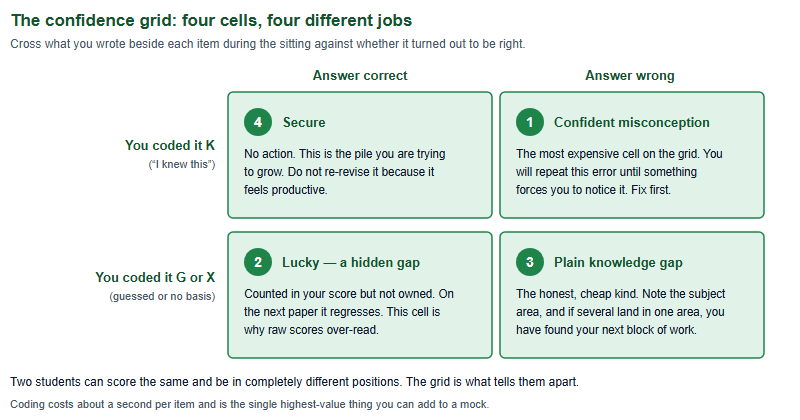
The confidence code. As you answer, put a single letter beside each item: K if you knew it, G if you narrowed it down and guessed between two, X if you had no real basis at all. It takes under a second per item. When you mark, cross the code against the outcome and you get four cells instead of one score — and the four cells have completely different meanings.
The halfway split. Note the clock when you finish question 25. That one number diagnoses your pacing better than a stopwatch on every item. Well past halfway on time means you are over-deliberating early and will be rushed late, which is the classic profile of a strong student who scores below their knowledge. Well ahead of halfway usually means you are skimming stems — check whether your errors cluster in the long, figure-heavy items.
How many mocks, and where they go in a season
More mocks is not better. Each one costs a reserved paper, and a paper spent early on a half-built candidate tells you mostly about your syllabus rather than your ability.
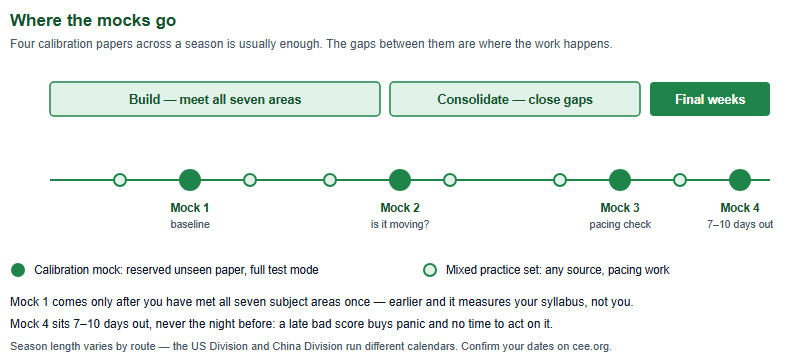
Spacing matters as much as count. Four to six weeks between mocks during the build phase gives the intervening work time to actually change something; two to three weeks in the final stretch is fine because you are then adjusting technique rather than adding content. If you find yourself wanting another mock a week after the last one, what you usually want is reassurance, and reassurance is not worth a reserved paper.
What a mock score tells you — and what it does not
A clean mock is genuinely informative about four things: your pace under load, which of the seven subject areas is bleeding marks, whether your errors are knowledge failures or reading failures, and how much of your score is secure versus lucky. Those four are enough to plan an entire month.
It does not tell you the following, and treating it as though it does is the most common misuse:
- It does not predict a cutoff. Thresholds are set by the organisers, vary between seasons and between routes, and are not something a home mock can forecast. Confirm anything about scoring outcomes on cee.org and, for China-based candidates, our China-region page.
- It does not transfer across routes. The divisions run different calendars; a number produced under one set of assumptions is not evidence about another.
- One mock is not a trend. Day-to-day variation on a 50-item paper is real. Two points make a guess; three or four make a direction.
- A mock on a paper you have seen predicts nothing at all. It measures memory, and memory of a specific paper is the one skill the exam will not reward.
Used this way, a season of four papers gives you more usable information than a season of twelve papers sat casually — and it leaves you with something most candidates lose well before their own exam date: an unseen paper you can still trust.
Frequently asked questions
How many USABO past papers should I sit under exam conditions?
Three or four across a season is usually enough. Reserve them unseen; spend the rest in study mode with the textbook open.
Should I guess on a USABO mock if I do not know the answer?
Yes. There is no penalty for wrong answers, so a blank is strictly worse than a guess. Code it G so you can spot lucky marks later.
When should I sit my first USABO mock exam?
Only after you have met all seven subject areas at least once. Before that, a mock measures how far your syllabus has got, not you.
Can a USABO mock score tell me whether I will advance?
No. Thresholds are set by the organisers and vary by season and route. Confirm anything about outcomes on cee.org.
This is an independent guide operated by Hanlin Education for China-based international-school students. We are not affiliated with, endorsed by, or sponsored by the Center for Excellence in Education (CEE). Eligibility, registration channels, permitted materials and exam dates are set by the organisers and can change — confirm current details on cee.org before you rely on anything here. Errors reported to us are corrected within 7 working days.