Techniques questions are the ones candidates say came out of nowhere. They are not a named topic on any content list, they arrive dressed as cell biology or genetics, and they almost never ask you to recite a protocol. They ask what a method can and cannot show. School biology teaches these as procedures to memorise; the USABO treats them as instruments to reason with.
That difference is the whole gap. A student who can list the three steps of PCR still loses the mark when the question shows a gel with one unexpected band and asks what it implies. The knowledge needed is not the recipe but the logic: what physical property is doing the separating, what the readout is actually measuring, and which conclusions the result does not license.
Why techniques questions feel unfair
Three things make them disproportionately painful for candidates who came through IB, A-Level or AP Biology.
First, they have no home. Look at how the content divides — on our own reading of the material, the paper spreads across animal anatomy and physiology at roughly 25%, cell biology 20%, genetics and evolution 20%, plants 15%, ecology 10%, and behaviour and taxonomy at 5% each. There is no “methods” slice in that list. Techniques are distributed through the others, which means a candidate budgeting revision by topic weight can skip them entirely without ever noticing the omission.
Second, school syllabuses teach the subset that fits a practical lesson. You will very likely have done chromatography of leaf pigments and looked down a light microscope. You are much less likely to have reasoned about why differential centrifugation releases organelles in the order it does, or what a Western blot proves that a qPCR result does not.
Third, the format punishes hesitation. The Open Exam runs 50 questions in 50 minutes with no penalty for a wrong answer, which leaves about a minute an item. Techniques questions tend to carry a figure and a scenario, so they eat clock. Recognising the underlying principle in five seconds is worth more here than anywhere else on the paper. Formats and rules are set by the organisers and can change between cycles, so confirm the current position on cee.org rather than inferring it from an old paper.
Separation first: three methods, three physical properties
Almost every separation technique on a school-to-olympiad syllabus is a variation on one question — what property am I exploiting to pull this mixture apart? Get the property right and you can reconstruct the rest.
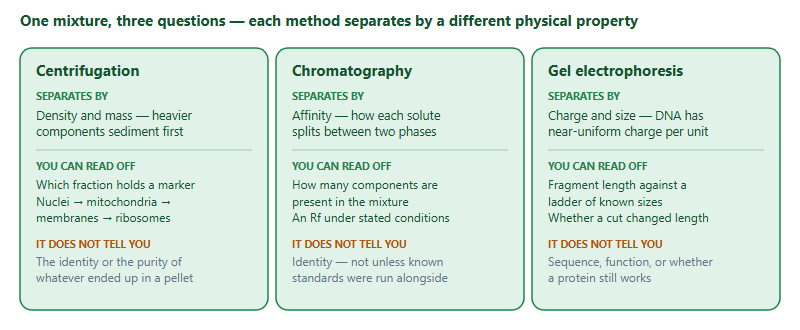
Centrifugation exploits density and mass. Spin a homogenised cell and components sediment in order of how fast they fall through the medium, which is why differential centrifugation gives you nuclei at low speed, then mitochondria and chloroplasts, then membrane fragments, then ribosomes at the highest speeds. The classic exam hook is asking which fraction a given enzyme should appear in — a question about where the enzyme lives, disguised as a question about a machine. Density-gradient variants separate things of similar size but different density, which is how the Meselson–Stahl experiment distinguished heavy from light DNA.
Chromatography exploits differential affinity between a stationary phase and a mobile phase. A solute that interacts more with the moving phase travels further. That single sentence generates paper chromatography of pigments, Rf values, and by extension column methods that separate by size, charge or specific binding. The hook here is usually interpretation: an Rf value is only meaningful for a stated solvent and stated conditions, so a number on its own identifies nothing without standards run alongside.
Gel electrophoresis exploits charge and size together. DNA works cleanly because its phosphate backbone gives an almost constant charge-to-mass ratio, so migration distance depends essentially on length, and short fragments travel furthest. Proteins do not behave that way naturally, which is why SDS is used to coat them in uniform negative charge and force separation by size — and why methods that deliberately omit it separate by native charge or isoelectric point instead. If a question tells you the detergent was left out, it is telling you the separation principle changed.
Amplify, then detect: the molecular half of the toolkit
The second family of techniques is about making something detectable rather than pulling it apart.
PCR cycles between denaturing the template, annealing primers, and extending with a heat-stable polymerase, doubling the target region each round. Two features generate most questions. The primers define the boundaries of what gets amplified, so anything the primers do not flank is invisible no matter how much of it is in the tube. And the amplification is exponential, so trace contamination amplifies just as enthusiastically as your sample — which is why a contaminated negative control is fatal to the whole run. Reverse transcription first converts RNA into cDNA, which is how the method is applied to gene expression; quantitative variants track product accumulation as it happens rather than only at the end.
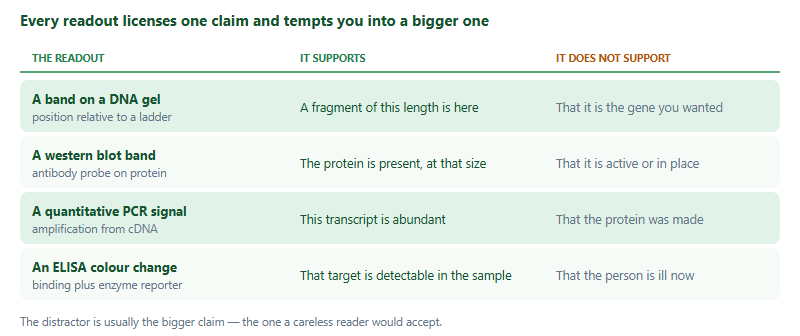
Hybridisation and blotting methods run a separation, transfer the separated molecules to a membrane, and then probe. Southern blots probe DNA with a complementary sequence, northern blots probe RNA the same way, and western blots probe protein with an antibody. Candidates lose marks by mixing up which molecule each one interrogates, and lose more by over-reading the result: a western blot band says a protein is present at a given size, not that it is functional, correctly folded, or in the right compartment.
Antibody-based assays such as ELISA detect a specific antigen or antibody using binding specificity plus an enzyme-linked reporter that produces a visible or measurable signal. The exam-relevant subtlety is what a positive means: detecting antibodies against a pathogen shows exposure and an immune response, which is not the same claim as showing that the pathogen is currently present.
Restriction enzymes cut at specific, usually palindromic, recognition sequences, and the fragment pattern on a gel lets you infer a map. Mapping questions are pure logic puzzles once you accept the rule that total fragment length must equal the original, and they reward a candidate who works in sizes rather than guessing.
Seeing and measuring
Two more instruments show up often enough to deserve deliberate revision.
Microscopy questions almost always hinge on the distinction between magnification and resolution. Magnification makes an image bigger; resolution is the ability to distinguish two close points as separate, and in light microscopy it is fundamentally limited by the wavelength of light. That is why electron microscopy reveals internal ultrastructure that a light microscope physically cannot, no matter how far you magnify an image — empty magnification produces a bigger blur, not more information. Transmission methods show internal detail in very thin sections; scanning methods show surface topography. Staining exists to create contrast, and stains that distinguish groups of organisms — the peptidoglycan-thickness logic behind Gram staining, for instance — are classic cross-topic hooks into taxonomy.
Spectrophotometry underpins a large share of quantitative biology on any olympiad-level paper. Absorbance rises with concentration, which turns a colour change into a number, which turns an enzyme reaction into a rate. Nucleic acids and proteins absorb at characteristically different wavelengths, so an absorbance ratio reports on the purity of a preparation. When a question gives you absorbance against time, it is nearly always asking about rate, and the shape of the curve — steep then flattening — is asking why the rate fell: substrate depletion, product inhibition, enzyme denaturation, or something else you must choose between on the evidence given.
The table below is the version worth revising from. Principle first, then the hook it generates, then the error that knowing the principle prevents.
| Technique | Principle it exploits | Typical exam hook | Most common candidate error |
|---|---|---|---|
| Differential centrifugation | Sedimentation rate: mass, size, density | Which fraction contains a named enzyme or organelle marker | Memorising the order without knowing why it is that order |
| Density-gradient centrifugation | Buoyant density, not size | Distinguishing labelled from unlabelled DNA | Treating it as identical to differential spinning |
| Paper and thin-layer chromatography | Partition between mobile and stationary phase | Interpreting Rf and pigment separation | Reading Rf as an absolute identifier |
| Gel electrophoresis (DNA) | Uniform charge-to-mass ratio, so size dominates | Restriction mapping, fragment size logic | Assuming a band identifies a gene |
| SDS-PAGE | Detergent imposes uniform charge, so size dominates | Estimating subunit mass; comparing with native runs | Forgetting native gels separate by charge and shape too |
| PCR and reverse-transcription PCR | Primer-bounded exponential amplification | Why a control amplified; what primer choice excludes | Ignoring what sits outside the primer boundaries |
| Southern, northern, western blots | Separate, transfer, probe with something complementary | Choosing the right blot for the molecule in question | Confusing which blot interrogates which molecule |
| ELISA | Antibody specificity plus an enzyme reporter | Interpreting a positive result correctly | Reading exposure as current infection |
| Light and electron microscopy | Resolution limited by wavelength | Why a structure is invisible under light optics | Confusing magnification with resolution |
| Spectrophotometry | Absorbance scales with concentration | Enzyme rate curves; purity ratios | Describing the curve instead of explaining why it bends |
How to close the gap in about three weeks
This is a small, finite body of material, which makes it unusually good value per hour — unlike a content band you could revise forever, the technique toolkit has edges.
Week one, build the principle map. Write one line per technique answering only this: what physical or chemical property is doing the work? Do not write protocols. If you cannot state the property in a sentence, you do not yet understand the method, and a longer set of notes will not fix it.
Week two, practise the inference, not the recall. For each technique write the pair of statements the diagram above models: the claim this result supports, and the tempting bigger claim it does not. This is the exact discrimination the multiple-choice format tests, because a well-built distractor in a technique item is usually true biology applied one step beyond the evidence.
Week three, go find them in real papers. Work through the technique-flavoured items in our compiled past-paper pack — a set our teachers have gathered and annotated, with worked solutions available for some years rather than all of them — and tag each one by principle rather than by topic. Two useful things happen. You start recognising that apparently different questions are the same question in new clothing, and you find out which principles you only thought you understood.
One caution about scope. Techniques questions reward familiarity with how experimental biology works, not encyclopaedic recall of every method in the literature. If you find yourself learning the fine mechanics of a specialised method you have never seen referenced on a paper, you have drifted past the point of return and that hour belongs in the larger content bands instead.
If you are working out where this fits in a first season overall, the China-region path page sets out who takes part and how the route is structured; eligibility and entry arrangements differ by division, so treat cee.org and that page as the authority rather than anything you read second-hand.
Frequently asked questions
Is there a techniques section on the USABO?
No named section. Method questions are distributed through cell biology, genetics and data-handling items rather than sitting in their own band.
Do I need to memorise PCR temperatures?
Understand what each step achieves and why a heat-stable polymerase is needed. Reasoning about primers and controls beats recalled numbers.
Is AP Biology enough preparation for these questions?
It gives you a genuine start on gels, PCR and microscopy, but usually stops short of the interpretation depth these items ask for.
How much revision time do techniques deserve?
Far less than the big content bands, but not zero. A few focused hours converts a recurring blind spot into reliable marks.
This is an independent guide operated by Hanlin Education for China-based international-school students. We are not affiliated with, endorsed by, or sponsored by the Center for Excellence in Education (CEE), which runs the USA Biology Olympiad. Content weightings described here are our own reading of the material, not an official published breakdown. Confirm current rules, formats, dates and eligibility on cee.org. Errors reported to our editorial desk are corrected within 7 working days.