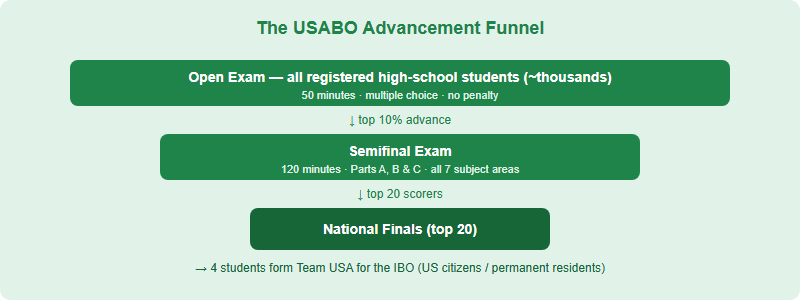
Once you clear the USABO Open Exam, the next round is the Semifinal Exam — a 120-minute paper sat by roughly the top 10% of Open Exam participants. Unlike the fast, all-multiple-choice Open Exam, the Semifinal has three parts (standard multiple choice, complex data-and-calculation questions, and short answer/essay) across all seven IBO subject areas, and only the top 20 scorers advance to the National Finals. This guide breaks down what it asks and how to prepare.
The round almost no guide explains
Search “USABO” and you will find dozens of pages about the Open Exam, cut-off scores, and one-month prep plans. Far fewer explain the Semifinal — which is odd, because the Semifinal is the round that decides who reaches the national stage. The Open Exam is a wide screen: it is a 50-minute multiple-choice paper open to any registered US high-school biology student, with no penalty for wrong answers. The Semifinal is where the field narrows sharply and the question style changes.
If you are already comfortable with Open-Exam-style recall, understanding the Semifinal early is a genuine edge: it tells you what kind of thinking to train in the weeks between the two rounds, rather than simply doing more of the same multiple-choice drills. For context on the competition as a whole, see our overview of what the USABO is.
The three parts of the Semifinal
The Semifinal is proctored over a 120-minute window and is built from three kinds of question, each testing a different skill. The exact section names and mark splits are set by the organiser each year, but the published structure is consistent in shape:
| Part | Question style | What it tests | Rough time guidance |
|---|---|---|---|
| Part A | Standard multiple choice (1 point each) | Broad factual recall and quick reasoning across all seven areas | ~35–40 minutes |
| Part B | Complex, sequenced multiple choice with calculations and graph/data interpretation (2 points each) | Applying concepts to unfamiliar data, multi-step reasoning, quantitative biology | ~55–60 minutes |
| Part C | Short answer / brief essay | Explaining mechanisms precisely in your own words | ~20–25 minutes |
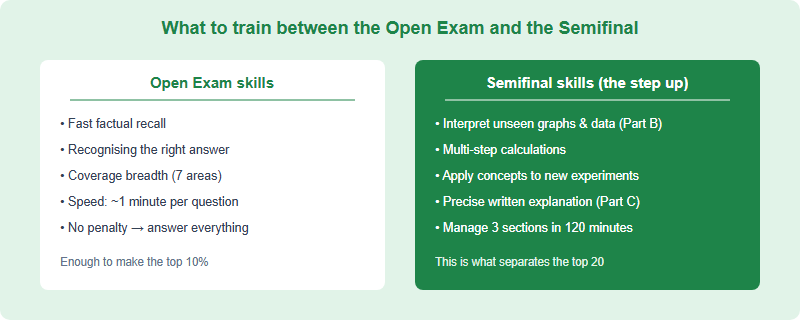
The single biggest jump from the Open Exam is Part B. Open-Exam questions mostly reward fast recognition; Part B hands you a graph, a dataset, or an experimental result you have never seen and asks you to reason through several linked steps. Marks per question are higher here, so Part B often decides your placement. The practical implication: between the Open and the Semifinal, spend the majority of your prep on data interpretation and applied problems, not more flashcards. The published guidance that Part B questions are “constructed to be completed in approximately 55 to 60 minutes” tells you the organiser expects you to spend roughly half the paper there.
Part C rewards a skill Chinese international-school students often under-train: writing a precise, well-structured biological explanation in English under time. A good habit is to practise answering “explain why / explain how” prompts in three or four tight sentences that name the mechanism, the cause, and the consequence — no padding.
Because the three parts reward different skills and carry different point values, how you allocate the 120 minutes is itself a scoring decision. The published time guidance — roughly 35–40 minutes for Part A, 55–60 for Part B, and 20–25 for Part C — is our own suggested pacing — only Part B's ~55–60 minutes is set by the organiser, and the exam lets you pace the three sections yourself. Three pacing principles follow from it:
- Do not overspend Part A. Part A questions are worth 1 point each and reward recognition. If a Part A item is not coming to you quickly, mark your best answer and move on — every extra minute here is a minute stolen from the higher-value Part B.
- Protect Part B’s hour. Part B items are worth 2 points each and are where placement is decided. Guard the ~55–60 minute block for it, because a rushed Part B is the most expensive way to lose rank on the whole paper.
- Leave Part C real time. Short-answer and essay responses take longer to write than a multiple-choice tick, and a half-finished explanation earns partial credit at best. Reserving the final 20–25 minutes prevents you from arriving at Part C with the clock nearly gone.
A useful rehearsal habit is to sit at least one full timed run in which you deliberately hold to that 40/60/25-ish split, even when a question tempts you to linger. The goal is to make the allocation automatic, so that on the day your time management is a reflex rather than a series of anxious decisions. This is the same discipline that separates students who “know the biology” from students who convert it into marks under exam conditions.
How Semifinal recognition works
Reaching the Semifinal is itself an achievement worth naming on an application — it means you were in roughly the top 10% of a national biology field. The Semifinal then carries its own recognition tiers, awarded by score band:
| Semifinal recognition | Score band (by rank) |
|---|---|
| Recognition of Academic Excellence | Top 50 scores |
| Honorable Mention | Next 75 scores |
| Certificate of Merit | Next 100 scores |
| National Finalist | Top 20 scores (invited to National Finals) |
Two things follow from this. First, the difference between “made the Semifinal” and “top-50 recognition” is meaningful, so it is worth pushing for a placement band rather than treating the Semifinal as a pass/fail gate. Second, because the bands are defined by rank (top 50, next 75, next 100), your target is relative: you are competing against the other Semifinalists, most of whom have already proven they can handle Open-Exam content. That is why Part B performance matters so much — it is the section where ranks actually spread out.
What lies beyond the Semifinal
For the very top of the field, the Semifinal feeds into the National Finals: the top 20 scorers are invited to a residential programme of about 10 days of instruction from university faculty and former finalists, culminating in a 9-hour examination made up of a 6-hour practical (laboratory) exam and a 3-hour theoretical exam. From there, four students are selected to represent the United States at the International Biology Olympiad (IBO).
One honest and important point for our readers: Team USA selection requires US citizenship or legal permanent residency. If you are an international student, the National Finals and Team USA route may not be open to you in the same way — but the Open Exam and the recognition earned through it, including via the USABO China-region pathway, are still real, verifiable achievements. Always confirm your exact eligibility on the official channels before planning around any specific round. We cover the full picture in our guide to the China-region path.
How to train specifically for the Semifinal
- Front-load data questions. Practise reading graphs, tables and experimental figures cold, then answering linked follow-ups. This is Part B, where the marks and the rank spread live.
- Rehearse written explanations. For Part C, drill three-to-four-sentence answers that state mechanism → cause → effect, in clear English, under a timer.
- Use real past material. The best preparation is prior questions in the real format. Our USABO past-papers pack is a free set our team has gathered to help you practise the actual question styles; worked solutions are available for some years only, and we add to them over time.
- Practise the 120-minute split. Do full timed runs that force you to allocate roughly 35–40 / 55–60 / 20–25 minutes across the three parts, so exam-day pacing is automatic.
Frequently asked questions
How do you qualify for the USABO Semifinal?
By placing in roughly the top 10% of Open Exam participants. The Open Exam is the nationwide screening round; the Semifinal is the next stage. Confirm current thresholds on the official site.
How long is the USABO Semifinal and what is on it?
It is a 120-minute paper in three parts: standard multiple choice, complex data/calculation multiple choice, and short answer/essay, spanning all seven IBO subject areas.
How many students go from the Semifinal to National Finals?
The top 20 scorers on the Semifinal are invited to the National Finals. Semifinal recognition tiers also cover the top 50, next 75, and next 100 scores.
Can international students reach the National Finals?
Team USA selection requires US citizenship or permanent residency, so the Finals/Team USA route may differ for international students. Check your eligibility on the official channels.
This is an independent English-language guide for China-based international-school students preparing for the USA Biology Olympiad, operated by Hanlin Education. It is not affiliated with, endorsed by, or sponsored by the Center for Excellence in Education (CEE). Exam structure, recognition bands, advancement numbers and eligibility can change each year — confirm current details on cee.org and the official USABO channels. Any errors will be corrected within 7 working days.