The USABO Open Exam is a 50-minute, multiple-choice paper with no penalty for wrong answers and four or five choices per question. Those facts dictate the correct strategy. Because blanks and wrong answers both score zero, you should answer every single question; because you have roughly one minute per question, never let one hard item eat the time of three easy ones. This guide turns the scoring rules into a concrete way to sit the paper.
The three rules that decide your tactics
Most USABO prep focuses on content. But two students with identical biology knowledge can score differently on the Open Exam purely because of how they manage the paper. Start from what the rules actually are:
| Rule | The fact | The tactical consequence |
|---|---|---|
| No penalty | Wrong answers are not deducted; a blank and a wrong answer both score 0 | Guessing is strictly free — never leave a blank |
| Time | ~50 questions in 50 minutes | Budget ~1 minute per question; move on when you exceed it |
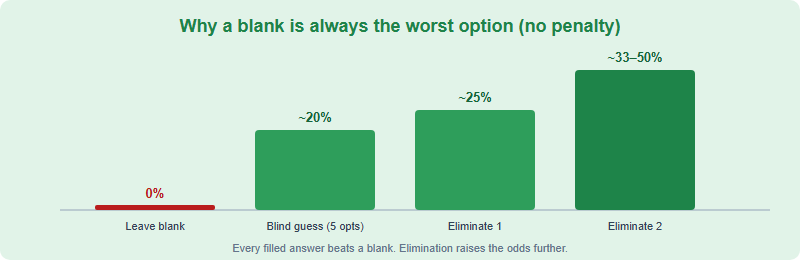
| Choices | Four or five options per question | Eliminating options lifts a guess from 20–25% to 33–50% |
The “no penalty” rule is the one students most often fail to exploit. On papers that do penalise wrong answers, leaving a blank can be correct. On the USABO Open Exam it never is: an unanswered question is a guaranteed zero, whereas even a blind guess on a five-option question is a ~20% chance of a mark for free. If you eliminate two options first, that blind guess becomes a coin-flip. For a fuller picture of the exam and where it sits, see what the USABO is.
A minute-by-minute plan for 50 questions
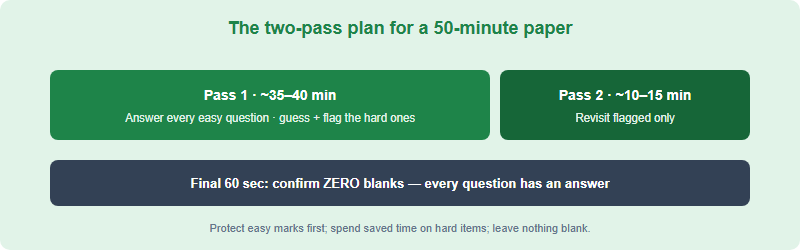
One minute per question sounds generous until a single genetics calculation swallows five minutes. The fix is a two-pass system that protects your easy marks first:
- Pass 1 (aim ~35–40 min): Go front to back. Answer every question you can settle in under a minute. If a question is slow or uncertain, put your best current guess, flag it, and move on — you never leave it blank, even temporarily.
- Pass 2 (remaining ~10–15 min): Return only to flagged questions. Now spend your saved time on the hard items, upgrading guesses to reasoned answers where you can.
- Final 60 seconds: Confirm there are zero blanks on the answer sheet. On the online platform, scan for any unselected question and fill it — a rushed guess still beats a zero.
This ordering matters because the Open Exam mixes easy and hard questions without warning. A student who works strictly in order and refuses to skip can run out of time with several easy questions unseen at the end — the most expensive mistake on the paper. The two-pass method guarantees every easy mark is captured before any hard question is allowed to consume time.
The trap to watch for is the “sunk-cost” question: you have already spent two minutes on a hard item, so you feel you must spend a third to justify the first two. On a no-penalty paper this is backwards. The two minutes are gone whatever you do; the only question is whether the next minute is better spent finishing this item or capturing an easier mark elsewhere. Almost always it is the latter. Setting a hard personal ceiling — “if I have spent ninety seconds and I am not close, I guess, flag, and move” — removes the decision from the moment and hands it to a rule you made calmly in advance.
Elimination: turning knowledge you half-have into marks
Because there are four or five options, elimination is worth as much as recall. You rarely need to know the answer outright; you need to remove the wrong ones. Practical elimination moves for biology multiple choice:
- Kill absolutes. Options with “always,” “never,” or “only” are frequently wrong in biology, which is full of exceptions.
- Spot the paired opposites. When two options are exact opposites, the answer is often one of them — the examiner built the distractor from the truth.
- Use units and magnitude. On quantitative items, cross out options whose units or order of magnitude cannot be right before you finish the calculation.
- Check scope against the stem. Eliminate answers that are true statements but do not actually answer the question asked — a classic distractor is a fact that is correct in general but irrelevant to this particular question.
- Beware the “too specific” and “too broad” pair. When one option is an over-narrow special case and another is a sweeping generalisation, the balanced middle option is frequently the intended answer.
Every option you legitimately eliminate raises the value of the guess you then make — and under “no penalty,” that guess is always worth making.
Read the stem before the options
A large share of avoidable errors on a fast multiple-choice paper are misreadings, not knowledge gaps — and misreadings are pure lost marks, because the student actually knew the biology. Under one-minute pacing the temptation is to skim the question and jump to the options, which is exactly when careless mistakes happen. A few disciplined reading habits protect against this:
- Find the actual task word. Questions ask different things — “which is not true,” “which best explains,” “what would increase.” The single most common slip is answering a “which is NOT” question as if it were “which IS.” Locate and mentally underline the task word before looking at any option.
- Note the conditions. Phrases like “at low pH,” “in the absence of oxygen,” or “in a heterozygote” change the answer entirely. Register the condition first; then the correct option is often obvious.
- Predict before you peek. Where you can, form your own answer from the stem before reading the choices. If your prediction is present, that is strong confirmation; if it is not, you have a warning to slow down.
- Trust your first read on recall items. For pure knowledge questions, second-guessing tends to cost marks. Reserve changes of mind for cases where you find a concrete reason, not a vague feeling.
None of this requires extra biology; it converts knowledge you already have into marks you might otherwise have thrown away. Because these habits cost only a few seconds each, they fit comfortably inside a one-minute-per-question budget once they are practised.
Rehearse the rules, not just the biology
Tactics only help if they are automatic on the day. Build them in during practice:
- Always practise timed. Do full 50-in-50 runs so one-minute pacing and the two-pass rhythm become instinct rather than something you try for the first time under pressure.
- Practise on real question styles. The Open Exam is delivered on the Art of Problem Solving (AoPS) online platform, so get comfortable answering and flagging on screen. Work from authentic items — our USABO past-papers pack is a free set our team has gathered so you can rehearse the real format; worked solutions are available for some years only and we keep adding to them.
- Log why you missed each question. Was it knowledge, misreading, or time? Only knowledge gaps need more study; the other two are fixed by technique.
These tactics apply to the Open Exam specifically; the later Semifinal is a longer, three-part paper with free response and data questions, so it needs its own approach. If you are an international student, note too that participation routes and eligibility — including the USABO China-region pathway — should always be confirmed on the official channels before you plan around them.
Frequently asked questions
Is there a penalty for wrong answers on the USABO Open Exam?
No. Wrong answers are not deducted, so a blank and a wrong answer both score zero. That means you should answer every question — guessing is free. Confirm current rules on the official site.
How much time do I have per USABO Open Exam question?
About one minute: roughly 50 questions in 50 minutes. Use a two-pass system so hard questions never eat the time of easy ones.
Should I guess if I do not know the answer?
Yes, always. With no penalty, a blank scores zero while a guess has positive expected value. Eliminate any options you can first to improve the odds.
What platform is the USABO Open Exam taken on?
It is administered online via the Art of Problem Solving (AoPS) platform. Practise answering and flagging on screen so the interface is familiar; confirm on the official channels for current arrangements.
This is an independent English-language guide for China-based international-school students preparing for the USA Biology Olympiad, operated by Hanlin Education. It is not affiliated with, endorsed by, or sponsored by the Center for Excellence in Education (CEE). Exam format, timing, scoring rules and platform can change each year — confirm current details on cee.org and the official USABO channels. Any errors will be corrected within 7 working days.