The single biggest reason students plateau on USABO past papers is that they do papers instead of reviewing them. Scoring a paper and moving on teaches you almost nothing. The points come from a disciplined review loop: log every miss, classify why it happened, and re-test the weakness on a schedule. This guide gives you that system, tuned to the Open Exam’s 50-question, 50-minute, no-penalty format (confirm current rules on the USABO overview and cee.org).
Why raw paper-grinding stalls out
Doing a fresh paper every day feels productive. But a raw paper only surfaces what you got wrong on that set of questions — it does not fix the underlying gap, and it does not tell you whether the miss was a knowledge hole, a misread, or a timing panic. Two students can both score 28/50 on a practice paper for completely different reasons: one is weak in plant physiology, the other keeps running out of time and guessing the last ten questions. The same score, opposite fixes. Without a log, you cannot tell your story apart.
The USABO Open Exam has no penalty for wrong answers, so on the real day you should answer everything. But in practice, a blind guess that happens to land right is a hidden weakness — it inflates your score and hides a gap. That is exactly the kind of thing an error log is designed to catch.
The four categories every miss falls into
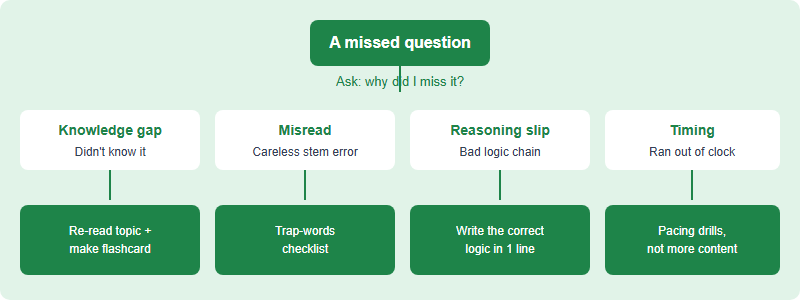
When you review a paper, force every wrong (or guessed-right) question into one of four buckets. This classification is the heart of the method, because each bucket has a different fix.
| Category | What it looks like | The fix |
|---|---|---|
| 1. Knowledge gap | You genuinely did not know the fact, pathway, or mechanism. | Add the topic to a review list; re-read the relevant Campbell / college-bio section; make a flashcard. |
| 2. Misread / careless | You knew it but misread “not”, “except”, “increase vs decrease”, or a graph axis. | Build a personal “trap words” checklist; slow down on question stems. |
| 3. Reasoning slip | You had the facts but combined them wrongly, or fell for a distractor. | Write out the correct chain of logic in one sentence; study why each distractor is wrong. |
| 4. Timing / pressure | You rushed, skipped, or guessed because the clock ran out. | Practise pacing drills (see below); this is not a content problem. |
The value of this is instant. If 70% of your misses are category 2, you do not need more content — you need to slow down and read stems carefully. If they are category 1 and cluster in one subject area, you have found exactly where to spend your next week. Pair this log with the USABO past-paper pack so you always have fresh material to re-test on.
Building the log: five columns, nothing fancy
A spreadsheet or a notebook both work. Keep it lightweight or you will abandon it. Five columns are enough:
- Paper & question number — so you can find it again (e.g. “2014 Open, Q31”).
- Subject area — tag it against the Open Exam’s content weights so patterns emerge: animal anatomy & physiology, cell biology, genetics & evolution, plant biology, ecology, behavior, taxonomy.
- Category — one of the four buckets above.
- The correct idea in one sentence — force yourself to articulate the fact or reasoning you were missing. Copying the answer letter is useless; explaining it is the learning.
- Re-test date — when you will attempt a similar question again.
After three or four papers, sort by subject area and by category. The pattern that appears is your personalised study plan — far more targeted than any generic syllabus. According to the published Open Exam weights, animal anatomy & physiology is the largest single slice at 25%, with cell biology and genetics & evolution each around 20%, so a cluster of misses there costs you the most marks. But your log might reveal the opposite — that your real leak is a 10% area you never revise. That is the point: the log tells the truth, assumptions do not.
The spaced re-test loop
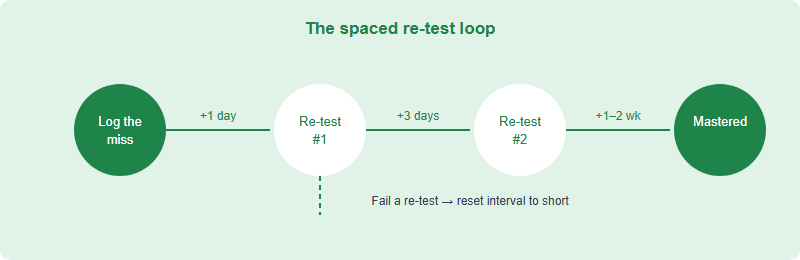
Logging a mistake once does not fix it. Memory fades, and a concept you “got” on Monday is gone by Friday unless you revisit it. This is why the re-test column matters. Use expanding intervals: re-attempt a similar question after roughly one day, then three days, then a week or two. Each successful re-test pushes the interval longer; each failure resets it to short. Over a season this converts scattered misses into durable knowledge.
Add timed pacing drills for the clock
If your log fills with category-4 (timing) misses, no amount of content study helps — you need pacing practice. With 50 questions in 50 minutes, you have an average of one minute per question, and some will be fast recall while others need working. A useful drill is to sit a half-paper (25 questions) under a strict 25-minute timer, flagging any question that takes longer than 90 seconds instead of sinking into it. On the real Open Exam, because there is no penalty, a flagged question still gets a best-guess answer before you move on — never leave a blank. Confirm the current timing, question count and any rule changes on cee.org before your sitting, and remember these details can differ by season.
Chinese international-school students preparing through the China-region pathway should treat pacing as seriously as content: the exam rewards calm, complete coverage, and the log is how you diagnose whether your problem is knowledge or nerves.
A one-week review cycle you can copy
- Day 1: Sit one full past paper under timed conditions. Do not check answers yet.
- Day 2: Mark it, then log every miss and every lucky guess into the five-column table. Classify each.
- Day 3–4: Attack the knowledge-gap topics from the log. Make flashcards; re-read source sections.
- Day 5: Re-test the earliest logged items (the +1 and +3 day ones).
- Day 6: Pacing drill — a timed half-paper focused on speed and flagging.
- Day 7: Review the week’s log by subject area; decide next week’s focus from the pattern.
Repeat across the season and your practice scores start reflecting real, retained gains rather than the noise of which questions happened to appear. The papers are just raw material — the log is where the learning lives.
Frequently asked questions
Should I do a new paper every day?
No. One well-reviewed paper beats three un-reviewed ones. Reviewing and re-testing is where the score gains come from, not raw volume.
Do I log questions I guessed but got right?
Yes. A lucky guess is a hidden knowledge gap. Logging it stops it from inflating your practice score and hiding a real weakness.
How many past papers do I need?
Enough to re-test each weakness on a spaced schedule. Quality of review matters far more than quantity; confirm exam details on cee.org.
Does the no-penalty rule change how I practise?
On the real exam, answer everything. In practice, still log blind guesses so your review reflects genuine understanding, not luck.
This is an independent guide operated by Hanlin Education for China-based international-school students. It is NOT affiliated with, endorsed by, or sponsored by the Center for Excellence in Education (CEE). Competition rules, timing and formats can change between seasons — confirm current details on cee.org. Any error will be corrected within 7 working days of notification.