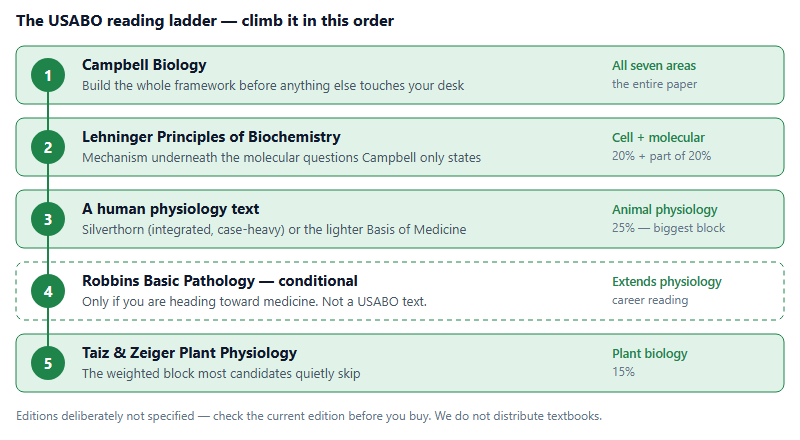
There is no official USABO reading list, but there is a defensible order. Campbell Biology first, to build the whole framework; then Lehninger for molecular mechanism; then a human physiology text for the biggest content block; Robbins Basic Pathology only if you are heading toward medicine; and Taiz & Zeiger for plants. The order is the advice. The list on its own will sink you.
This piece assumes you already have a working study plan and a past-paper habit — if you do not, start with our overview of what the USABO actually is and build the plan first. What follows is the layer above that: which specialist books our coaches put in front of students, in what sequence, and — just as important — which ones most candidates should never open.
Why the order is the actual advice
Search for “USABO textbooks” and you will find lists. Lists are close to useless here, because every book on them is a good book. The failure mode is not choosing a bad text; it is opening a good text at the wrong moment.
Lehninger, Silverthorn and Taiz & Zeiger are university texts. They are written for a reader who already holds the map and wants the terrain in detail. Open Lehninger before you can sketch glycolysis, the citric acid cycle and oxidative phosphorylation from memory, and you will spend three weeks on forty pages, understand them beautifully, and cover roughly two per cent of a paper that samples seven areas in fifty questions.
The ladder works because each rung answers a question the previous rung raised. Campbell tells you that the electron transport chain pumps protons across the inner mitochondrial membrane. That statement is enough for a lot of questions — and it immediately raises a question Campbell answers only lightly: why does the coupling work, thermodynamically, and what happens to it when you change one variable. That is a Lehninger question, and it only becomes worth asking once Campbell has put it in your head.
Two other framing points before the rungs themselves. First, you probably do not need all five books. Only rung 4 is conditional. Second, none of these books replaces past papers — reading is what makes past papers legible, not a substitute for them.
Rung one: Campbell, and the mistake of leaving too early
Campbell is the only book on this ladder that maps onto all seven weighted areas at once. The Open Exam sits at roughly AP Biology plus introductory college level, and Campbell is written at exactly that altitude — which is why it is the framework text and not merely the beginner text.
The characteristic mistake is leaving Campbell too early. A student reads it once, finds most chapters comfortable, decides it was “easy”, and climbs to Lehninger — where they promptly discover that comfort with a summary is not the same as command of a mechanism.
Use a harder exit test than “I read it”. You are ready to leave Campbell when you can, without the book, list the seven content areas, and under each one name the processes you could explain out loud to a classmate, step by step, including what happens when a variable changes. If you cannot do that for a given area, you are not finished with Campbell in that area — and no amount of Lehninger will fix it.
Second Campbell mistake: reading it cover to cover, once, linearly. Read it once for structure, quickly, tolerating gaps. Then return to it chapter by chapter, driven by the errors your past papers throw up. That second pass is where the marks are.
Rungs two and three: mechanism, then physiology
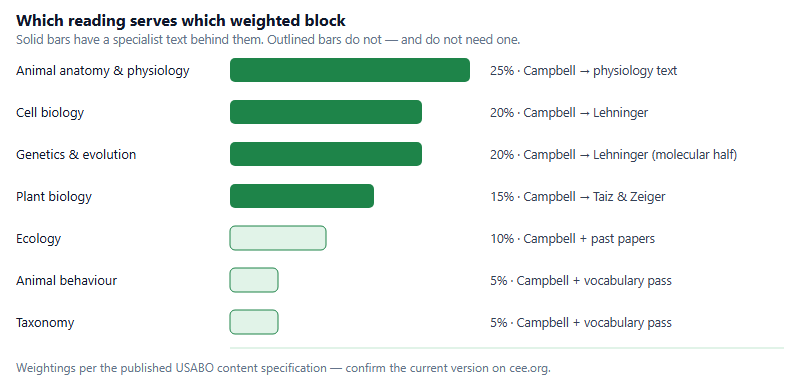
Lehninger Principles of Biochemistry earns its place because two of the seven blocks — cell biology at 20 per cent and the molecular half of genetics and evolution at 20 per cent — contain questions that cannot be reasoned out from a diagram. They turn on mechanism: how enzyme kinetics actually behave under inhibition, why a coupled reaction runs, what a signalling cascade amplifies and where it is regulated.
Read selectively: enzyme kinetics and regulation, bioenergetics, glycolysis and the citric acid cycle, oxidative phosphorylation and photophosphorylation, membrane transport, signal transduction, DNA replication and repair, and gene regulation. Skip the exhaustive structural chemistry and the methods chapters unless a past paper drags you there.
The physiology rung exists because animal anatomy and physiology is the single biggest block at 25 per cent, and because it is the block where knowing the facts most reliably fails to produce the mark. Its questions are of the form “what happens to X if Y changes” — feedback loops, pressures and flows, osmotic gradients, compensation. That is reasoning, and it needs a book built around reasoning.
Our coaches point students at one of two texts. Silverthorn is integrated and case-heavy: it teaches you to reason across systems rather than memorise them one at a time, and it is the better choice if you enjoy problems and have the months to spend. The lighter Human Physiology: The Basis of Medicine is more compact and clinically framed — the better choice when you need coverage of the same block on a shorter runway. Either serves the 25 per cent. Pick one; do not read both.
Rungs four and five: one conditional, one underrated
Robbins Basic Pathology is not a USABO text, and we want to be blunt about that. It is on the ladder because a large share of strong biology-olympiad students are medicine-bound, and Robbins is where physiology turns into disease reasoning. If that is your direction, it will pay you back in interviews, personal statements and first-year undergraduate work at least as much as in any exam. If it is not your direction, skip it entirely — and under no circumstances read it instead of a physiology text.
Taiz & Zeiger Plant Physiology is the opposite case: underrated because plants are the block candidates quietly write off. Plant biology carries 15 per cent — three times the weight of behaviour or of taxonomy — and the questions are answerable from a bounded body of physiology. Read water relations and transpiration, phloem transport, photosynthesis including the C4 and CAM variants, hormones and signalling, and photoperiodism. Skip the research-frontier and molecular-technique chapters.
| Rung | Text | Block it serves | Weight | Read this | Leave this |
|---|---|---|---|---|---|
| 1 | Campbell Biology | All seven areas | 100% of the paper | Everything, twice: once for structure, once error-driven | Nothing — this is the framework |
| 2 | Lehninger Principles of Biochemistry | Cell biology + molecular genetics | 20% + part of 20% | Kinetics, bioenergetics, respiration, membranes, signalling, replication, gene regulation | Exhaustive structural chemistry; methods chapters |
| 3 | Silverthorn or Human Physiology: The Basis of Medicine | Animal anatomy & physiology | 25% | Homeostasis and feedback, cardiovascular, respiratory, renal, endocrine, neuro | The second book — pick one, not both |
| 4 (conditional) | Robbins Basic Pathology | Extends physiology into disease | Not a USABO block | Only if you are medicine-bound: general pathology chapters | Everything, if you are not medicine-bound |
| 5 | Taiz & Zeiger Plant Physiology | Plant biology | 15% | Water relations, phloem transport, photosynthesis incl. C4/CAM, hormones, photoperiodism | Research-frontier and technique chapters |
What the ladder does not cover
Add it up honestly. Ecology carries 10 per cent, animal behaviour 5 per cent and taxonomy 5 per cent — a fifth of the paper — and no book on this ladder is written for them. That is not an oversight. Those three blocks do not reward a specialist university text; they reward Campbell’s own chapters plus a systematic vocabulary pass, because at USABO level they are largely recognition and classification rather than mechanism.
Students who go looking for an ecology equivalent of Lehninger are chasing the wrong 10 per cent. The better investment for those blocks is a terminology sweep and past-paper exposure.
Which brings us to the other thing the ladder does not replace. Reading makes past papers legible; it does not make them unnecessary. Every rung above should be run in parallel with paper practice, not before it, because papers are what tell you which chapters to reopen. Our gathered past-paper pack is the diagnostic instrument that drives everything on this page — note that we have worked solutions for some years only, so treat the solutions as a bonus rather than the plan.
How to read these books, and how not to
Four rules that matter more than which text you buy.
- After Campbell, read by index, not by cover. Specialist texts are reference works. You go in with a question your past paper handed you, you leave when it is answered. Reading Lehninger front to back is a legitimate intellectual project and a poor exam strategy.
- One specialist text at a time. Running Lehninger and Silverthorn concurrently feels productive and produces two half-finished mental models. Finish a rung before starting the next.
- Read to explain, not to recognise. The exam asks you to reason under a tight per-question budget; you cannot reason from a sentence you merely recognise. If you cannot say it out loud without the page, you have not read it yet.
- Cap the specialist reading. Our working recommendation: once past papers are in play, specialist reading should sit at roughly a third of your weekly biology hours, with the rest on papers and error review. If the ratio inverts, you are studying biology rather than preparing for a biology exam. Both are worthwhile. They are not the same activity.
One practical note, because we are asked often: we do not distribute these textbooks. They are copyrighted works — buy them, borrow them from a school or university library, or use a legitimate institutional subscription. The only reading material we compile ourselves is our own vocabulary list and topic notes, which sit alongside the past-paper pack.
Does the ladder work at the top end? Two students we have supported competed at IBO 2026 — one on the United States national team and one on the Canadian national team; their individual medal outcomes are our own de-identified records, reported by us rather than published by the organisers. They reached those teams through the national selection processes of the United States and Canada respectively, not through the China region; national-team eligibility is set by each country's organisers. If you are studying from mainland China, read our China-region pathway page and confirm current eligibility on cee.org before you build any assumption about routes into a national team. Results vary; nothing on this page is a prediction about yours.
Frequently asked questions
Which edition should I buy?
We deliberately do not name editions, because they move and our own notes have lagged behind. Buy the current edition your school or library holds.
Can I skip Campbell if I have taken AP Biology?
No. AP Biology overlaps Campbell but sits below the USABO ceiling. Use Campbell as the framework, and let past-paper errors choose your second pass.
Do I need all five books to place well?
No. Rung 4 is only for medicine-bound students, and many strong candidates work from Campbell, one physiology text and past papers alone.
Can you send me PDFs of these textbooks?
No — they are copyrighted, so buy or borrow them. The only material we compile and share is our own vocabulary list and topic notes.
This is an independent guide operated by Hanlin Education for China-based international-school students. We are not affiliated with, endorsed by, or sponsored by the Center for Excellence in Education (CEE). Exam format, content weightings, eligibility and registration are set by the organisers — please confirm current details on cee.org. Textbook recommendations are our coaches' editorial judgement and are not endorsed by any publisher or by CEE. If you spot an error, tell us and we will correct it within 7 working days.