IB Biology and USABO test different things. The Diploma trains you to interpret data, design investigations and reason from a concept; USABO’s Open Exam asks around 50 multiple-choice questions in 50 minutes across seven weighted content areas at roughly AP Biology plus introductory college level. Diploma students usually arrive with the reasoning already in place and lose marks on coverage — most often in plants, animal physiology and taxonomy, and in the neurobiology and bioinformatics content the organisers have added to the assessed material.
This piece is written specifically for IB Diploma students. If you are on the AP route the mapping is different, and we cover that in our AP Biology vs USABO syllabus map; what follows assumes an IB subject guide, an internal assessment and a May-session calendar shaping your year.
What the Diploma already gives you that USABO rewards
Start with the good news, because it is genuinely an advantage and most DP students undervalue it.
- Data-based questions. The DP examines your ability to read an unfamiliar graph, table or experimental result under time pressure. USABO does the same thing in multiple-choice form. Students who have drilled IB data-based questions typically handle the graph-interpretation items faster than students whose preparation has been purely content recall.
- Experimental design vocabulary. The internal assessment forces you to think about independent and dependent variables, controls, confounds, replication and uncertainty. USABO regularly asks “which result would demonstrate that…” — a question type that rewards exactly this habit of mind.
- Statistical literacy. DP Biology expects you to be comfortable with error bars, correlation versus causation, and tests such as chi-square. Questions built around a statistical claim are much less intimidating when you have already had to defend one in your own write-up.
- Concept-led structure. The current guide is organised around unifying themes rather than a list of topics, which makes it easier to transfer an idea from one context to another — a real asset when a USABO question puts a familiar mechanism in an unfamiliar organism.
What the Diploma does not give you is breadth for its own sake, because breadth for its own sake is not what the Diploma is for. USABO’s format — about 50 items in 50 minutes with no penalty for a wrong answer — is a coverage test. That mismatch is the whole problem, and it is a fixable one. For how the rounds are structured before you plan anything, see our overview of what the USABO is, and confirm current format and rules on cee.org. One caveat that applies to every question count in this article: the organisers publish the 50-minute format and the no-penalty rule but not a fixed question total, so treat the per-area counts below as planning arithmetic rather than a promise.
Mapping the IB themes onto the USABO weightings
USABO does not publish its own syllabus; it aligns closely with the IBO core syllabus, whose subject distribution is animal anatomy and physiology 25%, cell biology 20%, genetics and evolution 20%, plant biology 15%, ecology 10%, ethology (animal behaviour) 5% and biosystematics (taxonomy) 5%. Treat these as guidance rather than a published USABO marking scheme, and confirm current content on cee.org. The table below maps the DP themes onto those areas and grades the gap. The coverage judgements are our editorial assessment from working with DP students, not an official comparison — and IB revises its subject guides on a cycle, so check your current guide rather than assuming this holds forever.
| IB Biology theme | What it broadly covers | USABO areas it feeds | Gap size | Action |
|---|---|---|---|---|
| A — Unity and diversity | Water, nucleic acids, cell structure, viruses, diversity of organisms, classification and cladistics | Cell biology 20%, taxonomy 5% | Medium | Add named-group characteristics; cladistics logic transfers, group-by-group traits do not |
| B — Form and function | Macromolecules, membranes and transport, organelles, gas exchange, transport in plants and animals, muscle, adaptation to environment | Animal anatomy 25%, plant 15%, cell 20% | Large | Your biggest build: organ-system breadth plus the whole plant section |
| C — Interaction and interdependence | Enzymes and metabolism, cell signalling, neural signalling, integration of body systems, populations and communities, energy flow | Animal anatomy 25%, ecology 10%, cell 20% | Medium | Ecology is largely covered; endocrine and homeostatic detail usually is not, and neurobiology now goes well beyond DP-level neural signalling (see Gap 4) |
| D — Continuity and change | DNA replication and protein synthesis, cell cycle, meiosis, inheritance, gene pools and speciation, evolution | Genetics and evolution 20% | Small | Mostly covered — add problem-solving speed rather than new content, but the added bioinformatics content is genuinely new (see Gap 4) |
| Internal assessment and data-based skills | Investigation design, variables and controls, statistics, graph interpretation | Cuts across every area | Advantage | Keep it sharp; this is where DP students out-perform |
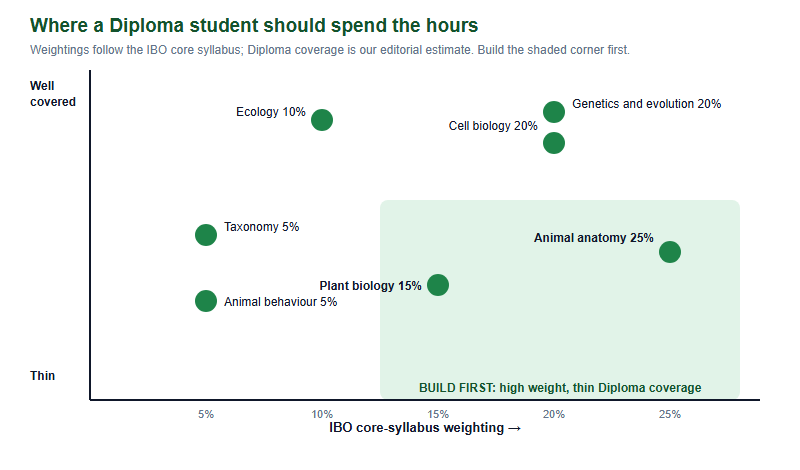
Gap 1 — plant biology: 15% of the weighting, a thin slice of the DP
This is the gap that surprises people. Plant biology carries a 15% weighting — on a paper of about 50 questions that is roughly seven to eight items, planning arithmetic rather than a promise — and the Diploma touches plants far more lightly than that — largely transport in plants and gas exchange, examined at concept level.
What USABO asks for beyond that: tissue-level anatomy and the ability to read a root, stem or leaf cross-section; hormone action across the five classical hormones with their tropism and photoperiodism experiments; the C3, C4 and CAM comparison in enough depth to identify a plant type from a gas-exchange trace; alternation of generations with correct ploidy assignment through bryophytes, ferns, gymnosperms and angiosperms; and the derived traits that separate those groups.
The good news is that this is the most bounded section on the syllabus. It has an end. Eighteen hours of focused work — anatomy, transport, hormones, photosynthesis strategy, life cycles, diversity — genuinely closes it, which is not true of animal physiology. For a DP student deciding where to put a first block of serious USABO study, this is the highest-return choice on the board.
Gaps 2 and 3 — animal physiology breadth (25%), and the cheap taxonomy marks (5%)
The largest weighting on the paper, and the one where the DP’s selective approach costs you most. The Diploma covers gas exchange, transport, neural signalling, muscle and the integration of body systems — but a competition weighting them at a quarter of the paper will reach into digestion, excretion and osmoregulation, endocrine control, immune function, thermoregulation, reproduction and development, and it will ask about them across a range of animal groups rather than only in humans.
Two DP-specific habits to break here:
- Human-only framing. DP examples are frequently human. USABO happily asks about an insect tracheal system, a bird’s respiratory anatomy or an invertebrate excretory organ. Learn each system as a problem an animal has to solve, then note two or three contrasting solutions across taxa.
- Concept without structure. The DP will accept a well-reasoned explanation of a mechanism; USABO may simply ask which named structure does the job. Build a structure-to-function list per system and test yourself on the naming direction, not just the explaining direction.
Realistically you will not finish this section. Aim to cover every system to a working level rather than three systems to an excellent one — on a multiple-choice format with no penalty for wrong answers, broad shallow coverage beats narrow depth, because it converts blanks into informed eliminations.
And the third gap, taxonomy and diversity, is the cheapest fix on the list. Taxonomy carries only 5% — on a paper of about 50 questions, around two or three items on the same planning arithmetic. Diploma students usually have the logic — classification, cladistics, reading a phylogenetic tree — and lack the inventory: which major groups exist and what defines each.
This is worth a deliberate few hours precisely because it is small, closed and highly memorisable. A single well-built table of major groups with two or three defining characteristics each will cover most of what gets asked. Combined with animal behaviour, also 5%, you are looking at around 10% of the paper sitting in two of the most compact topics on the syllabus. Students skip them because they are small; that is exactly why they are worth doing.
Gap 4 — the newly assessed neurobiology and bioinformatics content
The three gaps above are the classical ones, and until recently they were the whole list. They are not any more. Per the organisers, neurobiology and bioinformatics have been added to the assessed content, and neither sits neatly inside the seven classical areas — which means a Diploma student mapping DP themes onto those seven areas maps straight past them. No separate weighting is published for either, so treat this as a coverage gap to close rather than a percentage to budget against, and confirm the current assessed content on cee.org before you finalise a plan.
Neurobiology. The Diploma gives you neural signalling at concept level: a nerve impulse, a synapse, a neurotransmitter crossing a cleft. What is assessed here goes further — resting and membrane potentials as the product of ion gradients and selective permeability, the ionic basis of the action potential and why it is all-or-nothing, saltatory conduction, the sequence of events at a chemical synapse, and synaptic plasticity as the mechanism underlying learning and memory. If you have done a cell-biology block first this is the same membrane-transport machinery in a new context, which makes it far cheaper to learn than it looks.
Bioinformatics. This is the harder half, because the DP barely touches it. Expect sequence alignment basics — what an alignment is, what a gap and a mismatch mean, and why two sequences are compared at all — the ability to read BLAST-style output and say what a hit actually tells you, and phylogenetic inference drawn from sequence data rather than from morphology alone. It links straight back to Gap 3: the Diploma gives you the cladistics logic, and what is missing is the sequence-level evidence that logic now runs on.
Budget a short, separate block for this pair rather than folding it into the genetics build. Neurobiology sits naturally after cell biology; bioinformatics is best done alongside your taxonomy table, since the two answer the same question from different evidence. Because both are recent additions, check the current assessed content on cee.org rather than working from an older syllabus summary — and expect older past papers to under-represent them.
A DP-calendar build plan that avoids the IA and May-session crunch
The real constraint on a Diploma student is not ability, it is calendar. Internal assessment work, the extended essay, mocks and the May session are immovable. USABO preparation has to sit in the gaps.
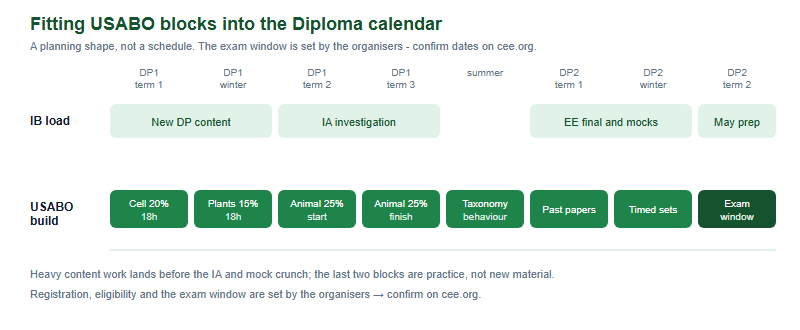
Two rules make this plan survive contact with a real Diploma. First, no new content after mocks begin — at that point USABO work should be past papers and timed sets only, because retrieval practice costs less energy than new learning when your DP load peaks. Second, put practice on real material. Textbook questions test a chapter; competition questions discriminate between candidates, and the difference shows up in your timing. We keep a free past-paper pack we have gathered for exactly this purpose; worked solutions are written up for some years rather than all, and we keep extending the coverage.
One practical point for DP students based in China: USABO has a China region, and how you enter it is decided by the organisers rather than by your school’s curriculum. Read our China-region pathway explainer for the structure as we understand it, then confirm eligibility and registration on cee.org before you commit a year of planning to it.
Frequently asked questions
Is IB Biology HL enough preparation for USABO?
HL gives you strong reasoning and data skills but not full coverage. The largest gaps are plant biology, breadth in animal physiology and named-group taxonomy, plus the neurobiology and bioinformatics content the organisers have added; confirm the current assessed content on cee.org.
Can an SL student attempt USABO?
USABO sets no IB-level requirement, and nothing in the exam is tied to HL; SL students simply carry a larger content gap and should start their build blocks earlier. Eligibility itself, including how students based in China take part, is set by the organisers, so confirm on cee.org.
When in the Diploma should I sit USABO?
Plan around your own calendar: content blocks in DP1, practice in DP2, nothing new once mocks start. Exam dates and eligibility are set by the organisers — confirm on cee.org.
Does my IB internal assessment help on a multiple-choice paper?
More than students expect. IA thinking maps directly onto “which result would show that…” questions, which reward experimental-design reasoning rather than recall.
This is an independent guide operated by Hanlin Education for China-based international-school students. We are not affiliated with, endorsed by, or sponsored by the Center for Excellence in Education (CEE), nor by the International Baccalaureate Organization. Exam format, content weightings, eligibility and registration are set by the organisers — please confirm current details on cee.org, and check your current IB subject guide for syllabus content. If you spot an error, tell us and we will correct it within 7 working days.