AP Biology and USABO draw on overlapping content — USABO is often described as covering roughly AP-level biology plus introductory college biology — but they are not the same test, and treating them as interchangeable costs you marks. AP Bio is a broad course exam with labs, data analysis and free-response; the USABO Open Exam is 50 multiple-choice questions in 50 minutes with no penalty for wrong answers. This guide maps what overlaps, what doesn’t, and how to make your AP Bio work double as USABO preparation. Confirm current details on the USABO overview and cee.org.
The honest headline: big overlap, different depth
If you have studied AP Biology, you already hold most of the vocabulary and core mechanisms USABO tests — cellular respiration, photosynthesis, membrane transport, Mendelian genetics, natural selection, ecology. That is genuinely reassuring for students deciding whether to attempt USABO. But the two exams diverge in three ways that matter: depth (USABO can push further into detail than the AP course requires), breadth (USABO’s content weights give real space to plant biology, animal physiology and taxonomy), and format (dense timed multiple-choice versus AP’s mixed paper). AP Bio is a strong foundation, not a complete preparation.
| Dimension | AP Biology | USABO Open Exam |
|---|---|---|
| Format | Multiple-choice + free-response, with lab/data tasks | 50 multiple-choice questions in 50 minutes |
| Wrong-answer penalty | Per College Board rules | No penalty — answer everything |
| Content level | Introductory college biology (AP course framework) | ~AP level plus introductory college biology, often deeper |
| Run by | College Board | Center for Excellence in Education (CEE) |
| Purpose | Course credit / placement signal | Biology olympiad selection exam |
Confirm all specifics — AP details with the College Board, USABO details on cee.org — as both can change by year.
Where AP Bio carries you a long way
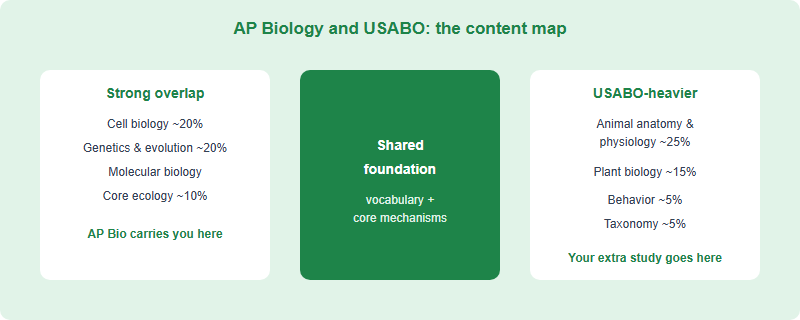
The strongest overlap sits in the topics both exams weight heavily. USABO’s published content weights put cell biology at about 20% and genetics & evolution at about 20% — exactly the molecular and Mendelian material AP Biology drills hard. If your AP course covered enzyme kinetics, the electron transport chain, the cell cycle, transcription and translation, and basic population genetics, that knowledge transfers almost directly. You should not re-learn these from scratch for USABO; you should deepen and speed up.
- Cell biology & biochemistry — respiration, photosynthesis, membranes, signalling: heavy AP overlap.
- Genetics & evolution — Mendelian crosses, Hardy-Weinberg, selection: heavy AP overlap.
- Molecular biology — DNA replication, gene expression, regulation: heavy AP overlap.
Where USABO asks more than AP Bio gave you
This is the part students underestimate. USABO’s content weights make room for areas that many AP courses treat lightly:
- Animal anatomy & physiology (~25%) — the single largest slice. USABO expects real depth in organ systems, physiological regulation and comparative animal biology, often beyond an AP course’s coverage.
- Plant biology (~15%) — plant structure, transport, hormones and reproduction. This is frequently the weakest area for international students, and it is worth more of the paper than behavior and taxonomy combined.
- Behavior (~5%) and taxonomy (~5%) — small but real. Ten percent of the paper sits in two areas most students never revise, which makes them cheap marks if you spend even a little time there.
The strategic reading is clear: AP Biology largely covers the shared middle, so your additional USABO study should concentrate on animal physiology and plant biology, with a quick pass over behavior and taxonomy for easy points. If you want a structured way to allocate hours across these areas, our companion piece on subject weightings walks through it in detail.
The format gap is as important as the content gap
Even with identical knowledge, the two exams reward different exam craft. AP Biology gives you time to reason through free-response and data questions. The USABO Open Exam compresses 50 questions into 50 minutes — about a minute each — with no penalty for wrong answers. That changes your tactics completely: you never leave a blank, you flag-and-move rather than sink into a hard item, and you budget time ruthlessly. A student fluent in AP content who has never practised under a one-minute-per-question clock will still underperform. Timed multiple-choice practice is not optional prep; it is the bridge between AP knowledge and a USABO score.
A practical study plan that uses both
If you are taking AP Biology this year and eyeing USABO, sequence the work so nothing is wasted:
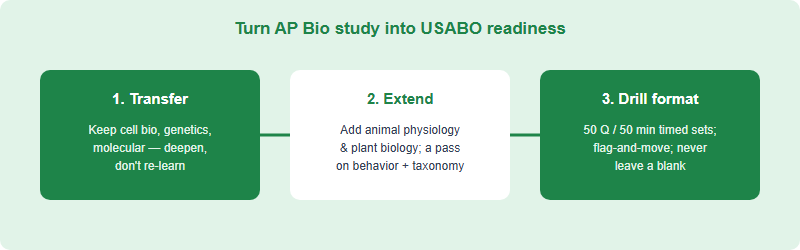
- During AP study: treat the shared topics (cell biology, genetics, molecular, core ecology) as double-duty. Learn them once, to USABO depth where you can.
- After the shared base is solid: open a dedicated USABO track for the heavier areas AP under-serves — animal physiology first (largest weight), then plant biology, then a light pass over behavior and taxonomy.
- Throughout: practise on the USABO past-paper pack under strict timing, because the format is a skill AP does not build.
Students preparing through the China-region pathway often already have AP Biology in progress, which makes this “transfer, extend, drill” approach efficient. What AP Bio does not do is decide your eligibility or entry route for USABO — those follow the official channels, so confirm registration and eligibility on cee.org and the china-region page rather than assuming they mirror the AP process. Note that neither AP Biology nor sitting the Open Exam guarantees any competition result; both are foundations you build on.
Frequently asked questions
Is AP Biology enough to prepare for USABO?
It is a strong foundation for the shared topics, but not complete. USABO asks more in animal physiology and plant biology, and rewards timed multiple-choice craft AP does not build.
Which USABO areas does AP Bio cover least?
Animal anatomy & physiology (the largest weight) and plant biology are typically under-served by AP courses; give them dedicated extra study.
Do I need AP Biology before attempting USABO?
Not necessarily. AP content helps, but eligibility and entry follow official rules — confirm on cee.org and the china-region page.
How different is the exam format?
Very. USABO’s Open Exam is 50 questions in 50 minutes with no penalty; AP Bio mixes multiple-choice with free-response and data tasks.
This is an independent guide operated by Hanlin Education for China-based international-school students. It is NOT affiliated with, endorsed by, or sponsored by the Center for Excellence in Education (CEE), nor by the College Board. Competition and course details can change between years — confirm current USABO details on cee.org and AP Biology details with the College Board. Any error will be corrected within 7 working days of notification.