Plant biology carries 15% of the IBO subject distribution that USABO follows, or around seven to eight questions on a paper of about 50. It is also the most bounded section on the syllabus: a short list of tissues, transport mechanisms, hormones and life cycles that does not sprawl the way animal physiology does. Real weight plus a small footprint makes it the best marks-per-hour trade in your whole revision plan.
Why 15% is worth more than 15% of your attention
Compare two sections honestly. Animal anatomy and physiology carries 25% — but animal physiology means every major organ system, examined across a wide range of taxa rather than only in humans, and no realistic amount of revision closes it completely. Plant biology carries 15%, and the entire examinable territory is roughly six blocks that a motivated student can genuinely finish. You will never finish animal physiology. You can finish plants.
That asymmetry is the argument. If you have 18 hours to spend, 18 hours on animal physiology moves you from partial coverage to slightly less partial coverage. Eighteen hours on plants moves you from “I skipped this” to “I can attempt every plant question on the paper with a real chance”. On a format of about 50 questions in 50 minutes with no penalty for a wrong answer, converting seven or eight near-certain zeros into seven or eight live attempts is one of the largest single moves available to you. Treat those counts as planning arithmetic: the organisers publish the 50-minute format and the no-penalty rule but not a fixed question count — confirm the current format on cee.org.
There is a second reason candidates from Chinese international schools in particular should look here. Most school biology routes — whatever the curriculum — treat plants as a light unit relative to human physiology and genetics. That is a rational choice for a school syllabus. It is not a rational choice for a competition that weights plants at 15%. The gap between what school gave you and what USABO asks is wider here than almost anywhere else, and gaps that everyone shares are exactly where a well-prepared candidate separates. For where this section sits in the overall structure, see our overview of what the USABO is and how the rounds work, and confirm current format details on cee.org.
The plant 15%, mapped into six finishable blocks
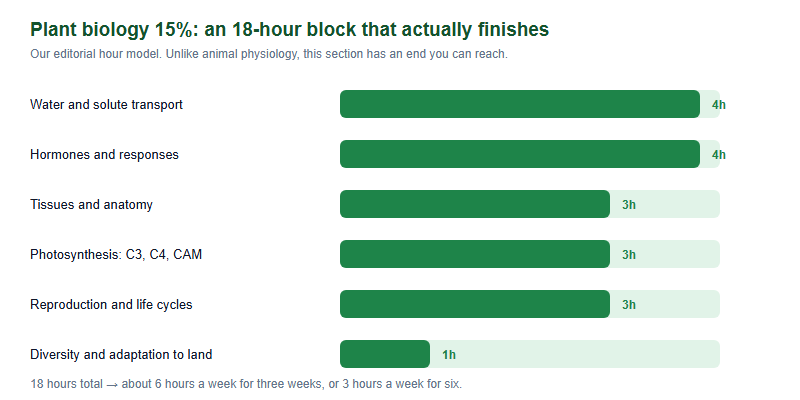
| Block | What you must be able to do | Typical question shape | Hours (our 18-hour model) |
|---|---|---|---|
| Water and solute transport | Use water potential to predict flow; explain cohesion–tension and pressure-flow; describe stomatal control | Calculate or compare water potential between two compartments; predict the direction of movement | 4 |
| Hormones and responses | Name the five classical hormones with a primary effect each; explain tropisms and photoperiodism | Predict the outcome of a classic coleoptile or de-etiolation experiment | 4 |
| Tissues and anatomy | Identify dermal, ground and vascular tissue; distinguish monocot and eudicot root, stem and leaf | Read a cross-section and name the tissue or the group | 3 |
| Photosynthesis at whole-plant level | Separate C3, C4 and CAM by mechanism, anatomy and habitat; explain photorespiration | Identify the plant type from a gas-exchange trace or a temperature response | 3 |
| Reproduction and life cycles | Trace alternation of generations; assign ploidy to every structure; describe double fertilisation | Order the stages, or state whether a named structure is n, 2n or 3n | 3 |
| Diversity and adaptation to land | Order the major land-plant groups and name the derived trait that defines each | Pick the group from a described trait, or the trait that first appeared in a group | 1 |
The two question families that repay the most practice
Two topics generate a disproportionate share of the plant questions on any paper: water transport, which is where the numbers live, and the C3/C4/CAM comparison, which can be asked four different ways. Do these two properly and you have covered most of what the section throws at you.
Family one — water potential and long-distance transport. If a plant question involves a number, it is usually this one. Water potential is written as the sum of a solute component and a pressure component, and water moves from higher to lower water potential. Pure water at atmospheric pressure is the zero point; adding solute makes the value more negative; adding pressure makes it less negative. Almost every question is a variation on “here are two compartments, which way does water go” or “what happens to the cell if the external solution changes”.
Three things separate candidates who score here from those who do not:
- Signs. Solute potential is always negative or zero. Students who lose marks are almost always students who dropped a minus sign, not students who misunderstood osmosis.
- Direction, not magnitude. Many questions never need an exact number; they need you to say which value is less negative. Read the question before you compute.
- The two transport systems are different problems. Xylem transport is passive, driven by transpirational pull through a continuous water column held together by cohesion; the conducting cells are dead at maturity. Phloem transport is a pressure-flow system that requires active loading at a source and unloading at a sink, and the conducting cells are alive and supported by companion cells. Confusing which one costs energy is the single most common plant error we see in past-paper review.
Stomatal control links this block back to cell biology: guard cells take up potassium ions, water follows osmotically, turgor rises and the pore opens. Every part of that sentence is a membrane-transport idea, which is why we recommend doing the cell-biology block before this one.
Family two — C3, C4 and CAM. This trio can be asked as anatomy, as biochemistry, as ecology or as a data trace. Learn it once, as a comparison, and you cover all four framings.
- C3 fixes carbon directly with rubisco. Under hot, dry conditions the stomata close, internal carbon dioxide falls, oxygen rises, and rubisco’s oxygenase activity drives photorespiration — which costs energy and fixes nothing.
- C4 separates the two steps in space. Carbon is first fixed by PEP carboxylase, an enzyme that does not react with oxygen, in mesophyll cells; the four-carbon product is passed to bundle-sheath cells where rubisco works in a carbon-dioxide-rich environment. The associated leaf anatomy is the giveaway in a cross-section question.
- CAM separates the two steps in time. Stomata open at night, carbon is fixed into an organic acid and stored, and the Calvin cycle runs by day with the stomata shut. This is why a gas-exchange trace showing carbon dioxide uptake in darkness identifies a CAM plant immediately.
The exam-technique point: when you see a graph of carbon uptake against time of day, or a photosynthesis rate against temperature, identify which of the three problems the plant is solving before you look at the options. The trace names the strategy, and the strategy names the answer.
Alternation of generations: the diagram that unlocks plant diversity
Life-cycle questions look like memorisation and are actually one idea repeated. Every land plant alternates between a haploid gametophyte and a diploid sporophyte. What changes across the groups is which generation dominates — and the direction of travel is consistent, because it tracks adaptation to life on land.
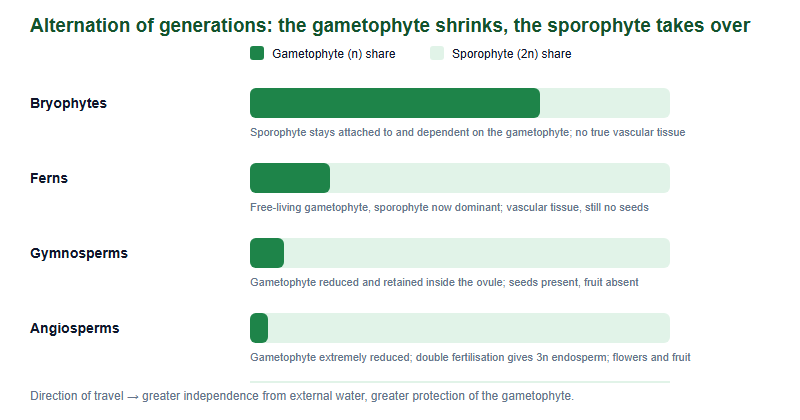
Two details reliably decide questions. First, double fertilisation is an angiosperm feature: one sperm nucleus makes the diploid zygote, the other produces the triploid endosperm. Gymnosperm seeds carry nutritive tissue too, but it is haploid female gametophyte tissue — a different answer to a very similar-looking question. Second, a seed is not a fruit: gymnosperms have seeds without fruit, and the fruit is an angiosperm innovation derived from the ovary wall.
A three-week plant block, and the traps inside it
Six hours a week for three weeks, or three hours a week for six — the total is what matters.
- Week 1 — transport and anatomy (7 hours). Build one labelled cross-section each for root, stem and leaf, in both monocot and eudicot form. Then do water-potential problems until the sign convention is automatic rather than remembered.
- Week 2 — hormones and photosynthesis (7 hours). One table of five hormones: name, main effect, one classic experiment. Then the C3/C4/CAM comparison, written out from memory as a three-column table before you check it.
- Week 3 — life cycles, diversity and timed practice (4 hours). Redraw the alternation-of-generations diagram from blank paper, then pull every plant question you can find from past papers and sit them in timed sets. Our gathered past-paper pack is free to use; worked solutions exist for some years rather than all, and we keep adding to them.
The five traps worth writing on the front of your notes: mixing up which transport system needs energy; dropping the minus sign in water potential; assigning the wrong ploidy to endosperm; attributing double fertilisation to gymnosperms; and describing a CAM plant as fixing carbon by day. Each of those is a whole-mark error that a five-minute check the night before will prevent.
If you are planning a season from China, remember that entry route and eligibility are decided by the organisers, not by us — our China-region pathway explainer sets out what we understand of the structure, and cee.org is the authority to confirm it against.
Frequently asked questions
How much of USABO is plant biology?
Plant biology carries 15% of the IBO subject distribution USABO follows, which on a paper of about 50 questions is roughly seven to eight. USABO does not publish a fixed question count or a per-section breakdown; confirm the format on cee.org.
Is plant biology easier than the animal physiology section?
Not easier, but far more bounded. Animal anatomy and physiology at 25% cannot realistically be finished; the plant syllabus can be, which is why it returns more marks per hour.
Which plant topic appears most often?
Water transport and stomatal control generate the widest range of question types, from calculations to graph reading, which is why we allocate them the most hours.
Do I need to memorise plant families for taxonomy questions?
Focus first on the four major land-plant groups and the derived trait defining each. That covers most diversity questions without open-ended family memorisation.
This is an independent guide operated by Hanlin Education for China-based international-school students. We are not affiliated with, endorsed by, or sponsored by the Center for Excellence in Education (CEE). Exam format, content weightings, eligibility and registration are set by the organisers — please confirm current details on cee.org. If you spot an error, tell us and we will correct it within 7 working days.