Most students who lose marks to language on the USABO Open Exam are not weak at biology. They know the process; they meet it under a different name, a different spelling or a different question construction, and they spend twenty seconds decoding before they can even start thinking. With 50 questions in 50 minutes, those seconds come out of your reasoning time — and reasoning time is where the marks are.
This article is about that specific gap: not content, but the English the content arrives in. It is written for candidates in China-based international schools, including those who learned parts of their biology in Chinese, those on IB or UK-style curricula, and those who simply have never sat a US-written multiple-choice paper at speed. If you have not yet mapped the content itself, start with our overview of the exam; what follows sits on top of it.
Where the sixty seconds actually go
The arithmetic is unforgiving and worth doing once, properly. Fifty questions in fifty minutes is an average of sixty seconds per question, and that sixty seconds has to cover four separate jobs: read and decode the stem, retrieve the relevant biology, evaluate the answer options against it, and record the answer.
For a fluent reader, decoding is cheap — perhaps a third of the budget on a wordy stem, less on a short one — leaving a comfortable margin for the part that actually distinguishes candidates. For a reader who hits two unfamiliar terms in the stem and one in the options, decoding can swallow more than half the minute. The biology knowledge is identical. The available thinking time is not.
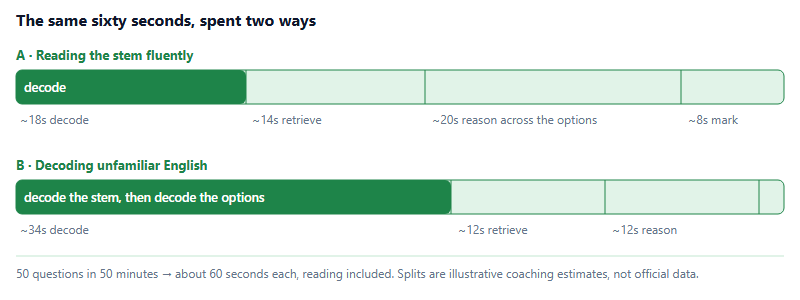
One rule follows immediately, and it is not obvious: if a stem takes you more than about fifteen seconds to parse, mark an answer anyway before you move on. The Open Exam applies no penalty for a wrong answer, so an unparsed question left blank is strictly worse than an unparsed question guessed. Language difficulty is the most common reason a candidate leaves marks on the table for free.
Three different gaps that all feel like “I did not know that”
When students review a paper and mark a question as content failure, it is often one of three language failures instead. Separating them matters, because they have different fixes.
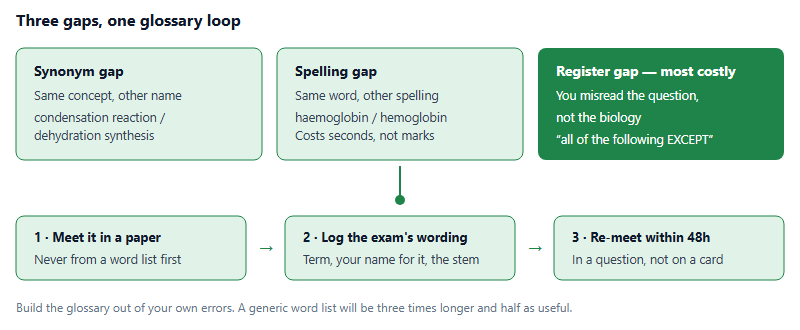
- The synonym gap. You know the concept securely under another name. A student who learned condensation reaction meets dehydration synthesis and hesitates. Nothing is missing except the label. Fix: a synonym column in your glossary.
- The spelling gap. You know the word and the American spelling briefly derails you — haemoglobin against hemoglobin, oesophagus against esophagus, foetal against fetal. Trivial in isolation, expensive at a question a minute. Fix: exposure, not study.
- The register gap. You know the biology and misread the question. This is the most costly of the three, because it converts knowledge into a wrong answer rather than a slow one. Fix: drill the constructions, below.
Students who were taught a topic in Chinese are especially prone to the first gap, and it is worth naming why it is not a knowledge problem: the concept is held securely, the English label is held loosely, and under time pressure the loose thing fails first. The remedy is not to relearn the biology. It is to attach the English label to knowledge you already have — a much faster job than it feels.
Terminology that shifts between curricula
The table below collects conventions that commonly differ between UK or IB-style teaching and US-published biology material. These are language conventions rather than exam rules, and the list is illustrative rather than exhaustive — your own textbook remains the reference, and past papers are the best evidence of the register a US-written paper actually uses.
| Often taught as (UK / IB style) | Common in US-published material | Where it tends to appear |
|---|---|---|
| Condensation reaction | Dehydration synthesis | Cell biology; macromolecule formation |
| Cell surface membrane | Plasma membrane | Cell biology; transport questions |
| Cell respiration | Cellular respiration | Bioenergetics stems |
| Gaseous exchange | Gas exchange | Animal physiology (25% block) |
| Sex linkage | X-linked inheritance | Genetics problems and pedigree stems |
| Haemoglobin, oesophagus, foetal, glycolysis unchanged | Hemoglobin, esophagus, fetal | Everywhere — a pure spelling gap |
| Partial pressures often in kPa | Pressures often in mm Hg | Respiratory and cardiovascular physiology |
| Volumes often in dm³ and cm³ | Volumes often in L and mL | Any quantitative stem or data table |
The unit conventions in the last two rows deserve more attention than they usually get. A candidate who reads a pressure in mm Hg and has only ever handled kPa does not merely lose a second — they can lose confidence in an answer they had correct, and start second-guessing. Meet the units before exam day, in a paper, where the cost is zero.
Question-stem constructions that carry the marks
US-style multiple choice has a house style, and it is learnable in an afternoon. These constructions do most of the work:
- “All of the following are true EXCEPT” and “which is NOT” — you are hunting the false statement. The classic error is finding a true statement, recognising it, and selecting it with satisfaction.
- “LEAST likely” and “best explains” — several options are defensible; you are ranking, not filtering. If two options both look right, that is the intended experience, and re-reading the biology will not resolve it. Re-read the stem.
- “Which result would demonstrate that…” — an experimental-design question. The answer is the observation that would discriminate between hypotheses, not the observation that is merely consistent with one.
- “If X increases, what happens to Y?” — the physiology workhorse. It rewards a causal chain, and it is why the 25% animal physiology block punishes memorised lists.
- “Most directly” and “primarily” — qualifiers that eliminate options which are true but indirect. Underline them.
Drill these by reading stems without answering them. Take a past paper, spend fifteen minutes reading only the question stems, and classify each one by construction. You will finish faster than you expect, and you will have removed a whole category of avoidable error. Our gathered past-paper pack is the natural material for this; worked solutions exist for some years only, but for this particular exercise you do not need them, because you are studying the questions rather than the answers.
The twenty per cent that is mostly vocabulary
Look at the published weightings with a language eye and something useful appears. Animal behaviour carries 5 per cent and taxonomy 5 per cent; ecology carries 10 per cent. At USABO level these three blocks lean far more heavily on recognising and correctly applying terminology than on multi-step mechanism — classification ranks and defining characteristics, behavioural categories and their definitions, ecological relationships and the vocabulary of population and community structure.
That makes them, for a candidate whose gap is linguistic rather than conceptual, the highest-yield vocabulary work on the paper: a fifth of the questions where knowing the exact English term is close to knowing the answer. It is precisely backwards to skip them because they are “only 5 per cent” each.
Building a glossary that is actually yours
The glossary that works is short, personal and error-derived. Four columns, no more: the term as the paper wrote it; the name you already knew it by, if any; a one-line definition in your own words; and the question that caught you out. That last column is the one students skip and the one that makes the entry stick, because it restores the context in which the word will next appear.
Three habits make it work:
- Terms enter only from papers you have sat. Downloading a thousand-word biology vocabulary list feels like progress and is mostly words you already own.
- Re-meet, do not re-read. Seeing the term again inside a question within about forty-eight hours beats reviewing the card. Recognition under time pressure is the skill being trained.
- Write the definition in your own words. If you cannot, the gap was never linguistic and you have found a genuine content hole — which is useful information, not a failure.
For what it is worth: the only reading material we compile ourselves is exactly this kind of thing — a vocabulary list and topic notes built from the errors we see repeatedly across cohorts. We do not distribute textbooks, which are copyrighted. And a note on scope, because the language question and the eligibility question often get tangled: preparing in English is a study problem, while who may sit which stage is a rules problem, set by the organisers and differing by region. See our China-region pathway page and confirm current eligibility on cee.org.
Frequently asked questions
Should I study biology vocabulary from a word list?
Only as a supplement. Terms that enter your glossary from papers you sat are retained better, because they arrive with question context attached.
Does the exam use American spellings?
US-published material and past papers use American conventions, so meet them in practice. Confirm current exam materials on cee.org.
What do I do when I cannot parse a question stem?
Mark an answer and move on. There is no penalty for a wrong answer, so a blank is strictly worse than a guess.
Is a vocabulary gap the same as a knowledge gap?
No. If you can define the term in your own words once you see it, the gap was linguistic; if you cannot, you have found genuine content to study.
This is an independent guide operated by Hanlin Education for China-based international-school students. We are not affiliated with, endorsed by, or sponsored by the Center for Excellence in Education (CEE). Exam format, content weightings, eligibility and registration are set by the organisers — please confirm current details on cee.org. Terminology comparisons above are illustrative curriculum conventions, not an official glossary. If you spot an error, tell us and we will correct it within 7 working days.