Most of what goes wrong for China-based USABO candidates is not a knowledge problem. It is a planning problem built on an assumption nobody checked: that the exam is in February, that the American olympiad leads everyone to the same place, that a medal converts into an offer. Below are the seven assumptions we see most often, what is actually the case in each, and the one thing to do about it this week.
Two of these are far more expensive than the rest, so they come first. If you read nothing else, read the section on route and calendar.
The two expensive ones: the route and the calendar
Misconception 1: “It is the American olympiad, so a strong result carries us to the international team.”
USABO is run by the Center for Excellence in Education, and there is a China region — which is why families reasonably assume one continuous ladder. But eligibility and national-team selection are set by the organisers, and they are not settled by where a student happens to be studying. The China region and the US national-team path are best understood as two different destinations that share an exam name, not two rungs of one ladder. Do not plan a season around an outcome you have not confirmed applies to you: check the current rules on cee.org and on our China-region page before you set a goal.
The cost of getting this wrong is not a wasted exam — the biology is real either way. The cost is a family that spends two years pursuing a specific endpoint and only discovers late that the endpoint was never available on their route. That is avoidable with one afternoon of checking.
Misconception 2: “The exam is in February.”
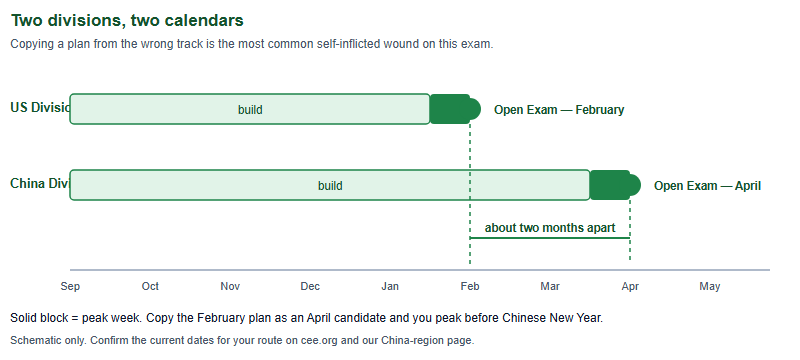
The US Division Open Exam sits in February. The China Division Open Exam sits in April. These are different calendars and must never be merged. Confirm the current dates for your own route before you build a plan around either.
This matters more than it sounds, because almost all of the English-language advice a student finds online is written for the February calendar. Follow it faithfully as an April candidate and you will do everything correctly on the wrong dates: your heaviest revision block lands in December, your final mock in late January, your taper in early February — and then you sit an exam roughly two months later, having already peaked and started to slide. Students in this position often describe it as “going stale”, and they are right.
The preparation misconceptions
Misconception 3: “It is basically AP Biology, so an AP Biology plan is enough.”
Two things are true at once: USABO sits at roughly AP Biology plus introductory college biology, and its subject weighting is its own, not AP’s. The published weights are animal anatomy and physiology 25%, cell biology 20%, genetics and evolution 20%, plant biology 15%, ecology 10%, animal behaviour 5% and taxonomy 5%. Plant biology, behaviour and taxonomy together are a quarter of the paper, and those are precisely the areas a course-shaped plan tends to skim. Treating an AP course as the whole preparation leaves you strong across roughly three-quarters of the paper and thin exactly where the cheap marks live.
Misconception 4: “More past papers is the preparation.”
Past papers are the most-visited material on this site, and for good reason — they are the only honest picture of what the questions look like. But a paper measures; it does not teach. Ten papers with no content work between them produce a flat line and a demoralised student, because each one re-diagnoses the same gaps without anything having been done about them.
There is also a supply problem families rarely account for. The number of real papers is finite, worked solutions exist for some years only, and a paper you have already worked through can never again give you a clean reading — recognition inflates the score. Treat unseen USABO past papers as a small stock of measuring instruments to be spent deliberately, and do your volume practice on question banks and textbook problems.
The scoring misconception
Misconception 5: “If you are not sure, leave it blank.”
This is imported from exams that penalise wrong answers, and on this paper it is a pure loss. There is no penalty for wrong answers on the USABO Open Exam. A blank and a wrong answer score identically; a guess has strictly better expectation than a blank, and an educated guess between two remaining options is better still.
The same fact has a second implication that students miss. With 50 questions in 50 minutes, an item you cannot crack is not worth three minutes of heroics — those minutes are being taken from questions you would have got right. The correct behaviour is: eliminate what you can, commit, mark it for review if there is time at the end, and move. Families who have coached a child through a negatively-marked exam system often have to actively unteach the careful-blank habit, and it is worth doing early rather than in the final week.
What the result is actually evidence of
Misconception 6: “A strong result guarantees an offer, or adds points.”
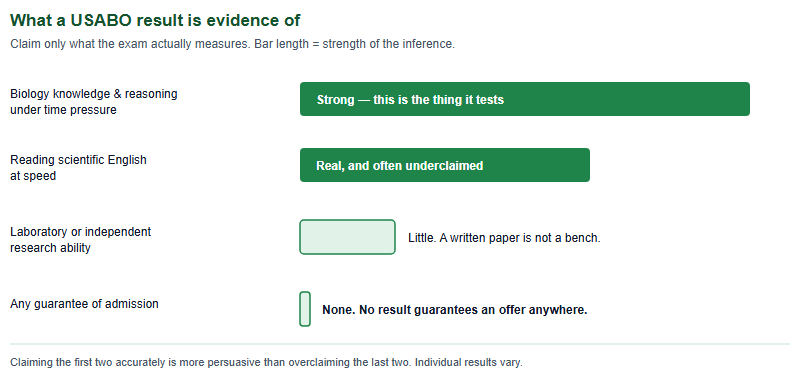
No competition result guarantees admission anywhere, and we will not pretend otherwise. A USABO result is one signal among many in a file that also contains transcripts, teacher references, tests and writing. It is a good signal — a nationally-recognised biology examination, sat cold, in English, against a serious level — but it is evidence of a specific and fairly narrow thing.
Misconception 7: “An award label travels between routes.”
When it comes time to write the result down, the temptation is to translate it into whichever label sounds most familiar to the reader. Resist it. Write what you actually sat, on which route, in which year, and what you actually received. Teachers, counsellors and admissions readers can check, and a mismatch costs far more than the upgrade gains — particularly for a family whose whole case rests on the student being precise and honest about evidence.
We hold ourselves to the same rule. Where we quote cohort figures, we say what period they cover: our own dual-award total, for instance, is a cumulative figure across the 2020–2026 seasons rather than a single year’s result, and describing it as annual would be a straightforward misrepresentation. Results vary between students and between seasons. If a number in any promotional material does not say what period it covers or how many students it is drawn from, ask.
The seven, in one table
| # | The assumption | What is actually the case | Do this week |
|---|---|---|---|
| 1 | The China route leads to the international team | Eligibility and national-team selection are set by the organisers, and are not settled by where you study. | Read the rules for your own route on cee.org and the China-region page before setting a goal. |
| 2 | The exam is in February | US Division in February; China Division in April. Different calendars, never merged. | Write your own exam date at the top of your plan and count backwards from it. |
| 3 | AP Biology preparation is enough | Level is roughly AP Bio plus introductory college biology, on USABO’s own weights — plant 15%, behaviour 5%, taxonomy 5%. | Audit those three areas honestly. They are a quarter of the paper. |
| 4 | More past papers means more marks | Papers measure, they do not teach, and the supply of unseen papers is finite. | Reserve three unseen papers as calibration; do volume work elsewhere. |
| 5 | Leave it blank if unsure | No penalty for wrong answers. A blank is strictly worse than a guess. | Answer all 50 in your next timed set, without exception. |
| 6 | A medal guarantees an offer | No result guarantees admission anywhere. It is one signal, and a narrow one. | Draft the two sentences you would actually write about it. Keep them checkable. |
| 7 | Award labels transfer between routes | They do not. Write the route, the year and the actual award. | Ask any provider quoting figures what period and cohort those figures cover. |
None of these are exotic mistakes. They are the ordinary result of planning from the most available information rather than the applicable information — which, for a China-based family reading English-language sources, is usually written for someone on a different calendar and a different route. Start from your own route, confirm it at source, and most of this list stops applying. For the underlying shape of the exam, our overview of the USABO is the place to begin.
Frequently asked questions
Can a Chinese student in China reach Team USA or the IBO through USABO?
That is set by the organisers, and is not settled by where you study. Confirm the rules for your route on cee.org and our China-region page.
When is the USABO exam for China-based students?
The China Division Open Exam sits in April; the US Division sits in February. Confirm current dates on cee.org before planning.
Is it worth guessing on the USABO Open Exam?
Yes. There is no penalty for wrong answers, so a blank scores the same as a wrong answer but forfeits any chance of a mark.
Will a USABO award get my child into a top university?
No result guarantees admission anywhere. It is one signal among many, and results vary between students and seasons.
This is an independent guide operated by Hanlin Education for China-based international-school students. We are not affiliated with, endorsed by, or sponsored by the Center for Excellence in Education (CEE). Eligibility, registration channels and exam dates are set by the organisers and can change — confirm current details on cee.org before you rely on anything here. Errors reported to us are corrected within 7 working days.