Most USABO candidates spend the season collecting practice material and almost none of it gets audited. That is a mistake, because a wrongly keyed or badly written question does not cost you nothing — it costs you more than skipping practice altogether. Five quick tests will tell you whether a question deserves your attention, and what role it should play if it only half-qualifies.
This matters more every year. Question sets now circulate through group chats, shared drives and generated banks faster than anyone can check them, and the ones that look most professional are often the least traceable. The skill you need is not access to more material. It is a habit of asking, before you answer anything, where this came from and whether its answer can be defended.
Why a bad practice question costs more than no practice
Answering a question is not a neutral act of measurement. Retrieval writes as well as reads: pulling an answer out of memory strengthens whatever you pulled, which is exactly why practice testing works and exactly why it backfires on faulty material. Confidently selecting a wrong-keyed option, then having that choice confirmed by the key, installs the error more firmly than reading it passively ever would.
The second cost is contamination you cannot trace. Six months later, when you assert in an exam that a particular hormone acts on a particular tissue, you will have no memory of whether that came from a textbook, a teacher, or a PDF someone posted at midnight. Beliefs lose their sources quickly. Once a bad set is in your rotation, the damage is not confined to the items in it.
The third cost is false calibration. A set pitched far below the exam tells you that you are ready. A set pitched far above it tells you to give up. Neither is information about your actual standing, and both feel like information, which is worse. That is the whole case for auditing before answering rather than after.
The five tests
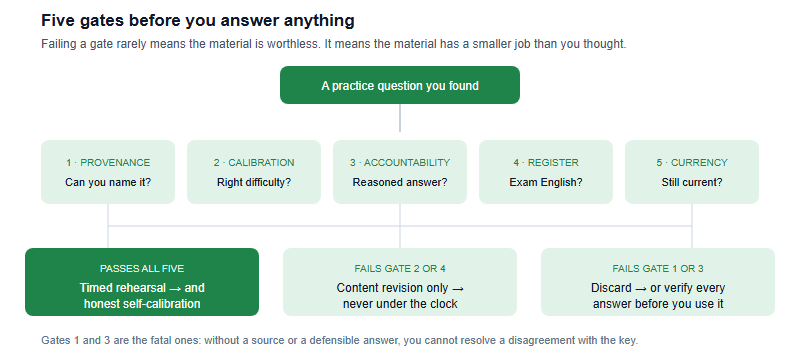
1. Provenance — can you name where it came from? A real past paper carries a year. A textbook question carries a book. A university problem set carries a course. “A file in a shared folder” is not provenance, and neither is “my friend’s tutor said it is the real thing”. If you cannot name the origin, you cannot weigh the answer key against anything when you disagree with it — and you will disagree with it.
2. Calibration — is it pitched near the real thing? The exam is 50 questions in 50 minutes with no penalty for a wrong answer, which is about a minute an item, and it sits at roughly AP Biology plus introductory college biology. A set of ten-minute multi-part problems is a perfectly good learning exercise, but it is not rehearsal for that format. If you score close to full marks or close to nothing on a set, it is telling you about the set rather than about you.
3. Answer accountability — is there defensible reasoning, not just a letter? A key that says “C” and nothing else is unfalsifiable. When you disagree with it you have two bad options: overrule yourself when you were right, or dismiss the key when you were wrong. Both make you worse. The rule to adopt is simple — if you disagree with a bare key, treat the item as unresolved and settle it against a textbook rather than against the letter.
4. Register — is it in the English the exam actually uses? Multiple-choice biology carries its meaning in small qualifying words: most likely, primarily, best explains, all of the following EXCEPT. Translated sets almost always lose those qualifiers, because a translator preserves the biology and quietly drops the hedging that decides the answer. Practising in a different register trains the wrong reading habit, however sound the underlying content is.
5. Currency — is the biology and the format still current? Older items can carry superseded taxonomy or terminology that has since shifted, and exam formats are set by the organisers and can change from season to season. Never infer this year’s format from an old paper; confirm current format, rules and dates on cee.org. Old papers remain excellent content practice even when their packaging has aged — the two things fail separately.
The material you will actually meet, scored honestly
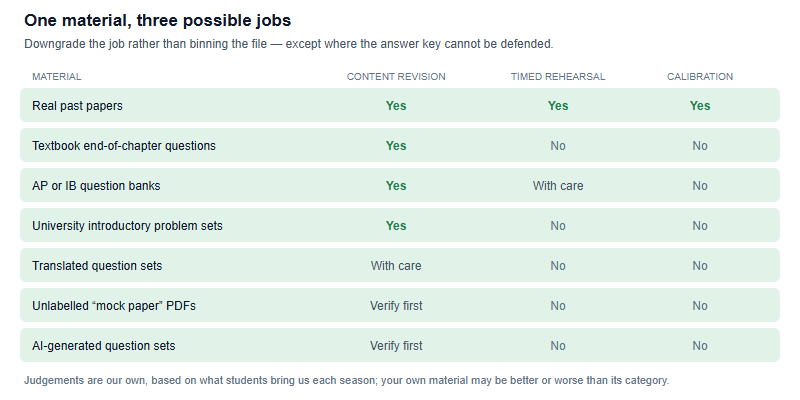
| Material | What it is genuinely good for | Where it fails | What to watch |
|---|---|---|---|
| Real past papers | Everything: content, timing, self-calibration | Nothing structural | Format can change season to season |
| Textbook end-of-chapter questions | Building and checking content | Pacing and item style | Written to teach a chapter, not to discriminate |
| AP or IB question banks | Content, and English register practice | Depth and calibration | Close enough to feel like rehearsal; is not |
| University introductory problem sets | Depth in a weak subject area | Format entirely | Excellent biology, wrong shape and length |
| Translated question sets | Content revision, with care | Register — the qualifiers are gone | The word that decides the answer is the one lost |
| Unlabelled “mock paper” PDFs | Little, until each answer is verified | Provenance and accountability | Looking official is not being sourced |
| AI-generated question sets | Content prompts, if you verify every key | Accountability above all | Fluent, plausible stems with subtly wrong keys |
Two rows deserve expansion. AI-generated sets fail the accountability gate in a distinctive way: the output is fluent, well formatted and superficially exam-like, so the ordinary warning signs of a bad question — clumsy phrasing, four implausible options — are absent. What remains wrong is buried in the biology, which is precisely the layer you were using the question to test. Verifying every key against a textbook takes about as long as reading the textbook section, so ask whether the detour is worth it.
Unlabelled mock PDFs fail differently. Some of them are genuine papers stripped of their headers, and some are somebody’s reconstruction from memory. From the inside they look identical, and the reconstruction is the more dangerous of the two because its errors are confident. Never adopt a set into your rotation on the strength of a group-chat claim that it is the real thing.
Downgrade the job, do not always bin the file
Practice material does three separable jobs, and each has different requirements. Content revision only needs the biology to be right. Timed rehearsal needs correct format, correct register and correct pacing on top of that. Score calibration — forming a view of where you actually stand — needs authentic provenance and comparable conditions, and almost nothing except real papers can supply it.
So a university problem set that fails the format gate is not junk; it is excellent content material for a weak subject area, and you should stop trying to time yourself on it. A translated set with sound biology is content material too, provided you accept that it will not train the reading habit an English paper demands. What you cannot do is promote material upward: no amount of familiarity turns an AP bank into a calibration instrument.
Because real papers are the only material that does all three jobs, treat them as a limited resource. Burning your whole archive in October as reading material leaves you with nothing to measure against in March. A workable split is to reserve at least a third of the papers you hold, untouched, for timed rehearsal in the final stretch, and to do your content learning on everything else.
Being straight about our own pack
The same tests apply to us, so here is the honest description. What we make available is our own compiled collection of past papers together with our notes — it is our compilation, not an official distribution, and it is described on our past-papers page. We do not supply textbooks; our reading lists point you at books to obtain yourself, and we deliberately quote no edition numbers, because editions move and a stale number is a small lie that spreads.
On the accountability gate, our pack passes only partly, and it would be dishonest to imply otherwise: worked solutions exist for some years, not all of them, and the exact coverage follows the materials our teachers send you. Coverage keeps being extended, and where a year has no worked solution you should treat a disputed item exactly as this article recommends — unresolved until you settle it against a textbook. A pack that claimed complete solutions and quietly had gaps would be the failure mode described three sections up.
For anything the organisers control — format, rules, eligibility and dates — cee.org is the source, and our China-region page tracks what applies on the China route. Material quality and competition facts are separate questions, and it is worth keeping them separate in your own notes as well: one file for biology you are learning, one for administrative facts you will re-confirm before the season starts.
Frequently asked questions
Are AI-generated USABO questions useful?
Only for content prompts, and only if you verify every key. Fluent stems with subtly wrong answers are the common failure.
Can I use AP Biology question banks for USABO?
Yes for content and English register. Not for calibration — the depth and pacing differ enough to give you a misleading score.
How do I know a past paper is genuine?
It should carry a year and a consistent format. If nobody can say where a PDF came from, treat it as unverified material.
Do worked solutions exist for every past paper?
Not in our pack. We have worked solutions for some years only, the exact coverage follows the materials our teachers send you, and it is still being extended.
This is an independent guide operated by Hanlin Education for China-based international-school students. We are not affiliated with, endorsed by, or sponsored by the Center for Excellence in Education (CEE). Exam format, eligibility, registration channels and dates are set by the organisers and can change — confirm current details on cee.org before you rely on anything here. Errors reported to us are corrected within 7 working days.