Immunology is the clearest example of a topic where school biology and olympiad biology part company. IB, A-Level and AP courses give you phagocytes, antibodies and vaccination, then move on. The USABO expects the layer beneath: how the innate system recognises anything at all, where antibody diversity comes from, why two classes of MHC molecule exist, and what a response curve is telling you.
It is also unusually good value to revise. The material is finite, it is heavily mechanistic rather than list-based, and it reaches into three other content areas at once — which means an hour spent here pays out in more places than an hour spent on almost anything else.
Where immunology actually sits on the paper
There is no immunology band. On our own reading of the material, the content divides roughly into animal anatomy and physiology 25%, cell biology 20%, genetics and evolution 20%, plants 15%, ecology 10%, and behaviour and taxonomy 5% each. Immunology lives inside the first of those — the largest slice — but it does not stay there.
Antibody diversity is a genetics question about DNA recombination. Antigen presentation is a cell biology question about membrane proteins, vesicle traffic and protein sorting. MHC polymorphism is an evolution question about why variation is maintained in a population. Vaccination and herd immunity reach into ecology and epidemiology. This is why immunology repays study out of proportion to any percentage you could assign it: it is a hub, not a leaf.
It also suits the format. The Open Exam gives you 50 questions in 50 minutes with no penalty for a wrong answer, so items must be answerable in about a minute. That favours questions with a clean mechanistic core — which cell recognises what, which signal follows which — and immunology is full of them. Formats are set by the organisers and can change between cycles, so confirm the current position on cee.org.
Three layers, three timescales — and the joins between them
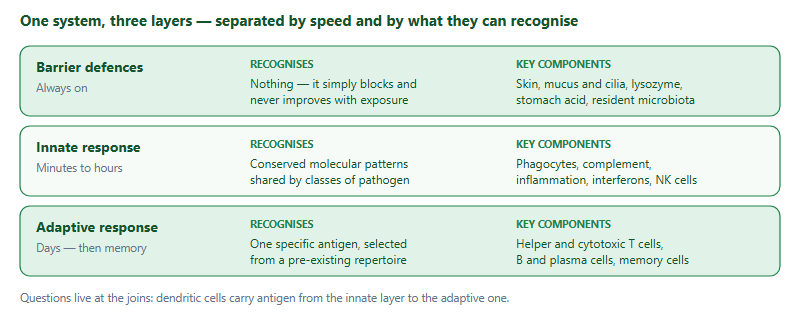
Most candidates can name barrier, innate and adaptive defences. Fewer can say what distinguishes them, and the distinction is the thing questions test.
Barriers are always on and recognise nothing. Skin, mucus and the cilia that move it, lysozyme in tears and saliva, stomach acid, and the resident microbiota that occupies niches a pathogen would otherwise take. Nothing here is triggered, which is exactly why nothing here improves with exposure.
The innate response acts in minutes to hours and recognises molecular patterns shared by whole classes of pathogen — components of bacterial cell walls, flagellin, double-stranded viral RNA — through pattern-recognition receptors. Calling it “non-specific” is the compression that costs marks: it is not specific to individual pathogens, but it is precisely specific to conserved molecular signatures, and it can distinguish a bacterium from a virus. Its machinery includes phagocytes, the complement cascade, inflammation driven by histamine release causing vasodilation and increased vessel permeability, interferons that warn neighbouring cells of a viral infection, and natural killer cells.
The adaptive response takes days on first encounter and recognises one specific antigen, through clonal selection. Its defining property is memory, which is why the second encounter looks nothing like the first.
The examinable action is at the joins. Dendritic cells take up antigen at a site of infection, migrate to a lymph node, and present it — they are the hand-off from innate to adaptive, and a question about why an adaptive response fails often has its answer at this step. Complement, usually filed under innate, is also recruited by antibodies, which is adaptive. Natural killer cells kill cells displaying too little MHC class I, which is a direct response to a strategy viruses use to hide from the adaptive system. A candidate who has memorised three separate lists cannot answer any of these; a candidate who has understood one integrated system can answer all of them.
Five things school courses compress
1. Clonal selection is a selection process, not an instruction process. Your lymphocytes carry an enormous pre-existing diversity of receptors, generated before any pathogen arrives. An antigen does not teach a cell what to make; it binds whichever cells already happen to fit and drives them to proliferate. That distinction — selection from standing variation rather than instruction — is precisely the logic of natural selection, and questions frequently probe whether you have noticed the parallel.
2. Antibody diversity is a genetics mechanism. The number of possible antibody specificities vastly exceeds the number of antibody genes, and the resolution is recombination: gene segments are cut and rejoined in each developing lymphocyte, with additional variability introduced where the segments meet. Later, in an ongoing response, mutation in the variable region combined with selection for tighter binding improves average affinity over time. Class switching changes the constant region — and therefore what the antibody can recruit — while leaving the specificity intact. A candidate who knows only “antibodies are specific proteins” cannot touch any of this.
3. Antibody structure explains antibody function. Four chains, two identical binding sites formed by variable regions, and a constant region that determines class. From that geometry, every function follows: two binding sites allow cross-linking and agglutination, the binding end neutralises by blocking, and the constant end is the handle for phagocytes and complement. Structure-to-function reasoning is faster than recall and far more reliable under time pressure.
4. Two MHC classes exist because there are two problems. A cell infected from within must advertise what is inside it, so all nucleated cells display fragments of their own cytosolic proteins on MHC class I, and cytotoxic T cells kill those displaying something foreign. A cell that has eaten something must report what it found outside, so antigen-presenting cells display digested external material on MHC class II to helper T cells, which then coordinate the response. Inside versus outside is the whole logic. Once you hold it, you can derive which T cell subset responds to a virus replicating in cytoplasm and which to a bacterium taken up by a macrophage, without memorising a table.
5. Helper T cells are the coordination point, which is why losing them is catastrophic. They are required for a full antibody response and for effective cytotoxic responses, so a pathogen that destroys them — as HIV does — degrades both arms of adaptive immunity at once. This is a favourite question because it can only be answered by someone holding the architecture in mind rather than a list of cell names.
Those five ideas generate almost every cell in the table below, which is worth revising with the right-hand column covered.
| Cell or component | Layer | What it recognises | What it does | Classic exam hook |
|---|---|---|---|---|
| Neutrophils and macrophages | Innate | Molecular patterns; antibody-coated targets | Engulf and destroy; macrophages also present antigen | Why opsonisation raises phagocytosis rates |
| Dendritic cells | Innate to adaptive | Antigen at the infection site | Carry antigen to lymph nodes and present it | The hand-off step; where an adaptive response can fail |
| Complement proteins | Innate, also antibody-recruited | Pathogen surfaces; bound antibody | Opsonise, drive inflammation, lyse via membrane pores | Being classified as innate yet activated by adaptive antibody |
| Natural killer cells | Innate | Cells with abnormally low MHC class I | Kill stressed, infected or altered cells | Why hiding from cytotoxic T cells backfires on a virus |
| Helper T cells | Adaptive | Antigen on MHC class II | Release cytokines coordinating B and cytotoxic responses | Why their loss collapses both antibody and killing arms |
| Cytotoxic T cells | Adaptive | Antigen on MHC class I | Kill the displaying cell | Choosing the right subset for an intracellular pathogen |
| B cells and plasma cells | Adaptive | Intact antigen via surface receptor | Differentiate and secrete antibody | Distinguishing the secreting cell from the memory cell |
| Memory cells | Adaptive | The same antigen, later | Persist and respond rapidly on re-exposure | Explaining the shape of the secondary response curve |
| Mast cells | Innate, allergy | Cross-linked IgE on their surface | Release histamine, driving inflammation | Why an allergic reaction is a misdirected defence |
Reading the response curve
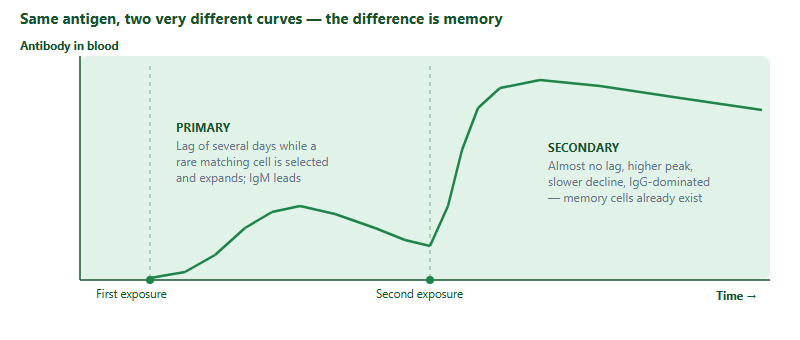
If immunology appears as a figure, it is very often antibody concentration against time across two exposures. The curve is worth studying until you can narrate it, because every feature encodes a mechanism.
The primary response opens with a lag of several days — the delay while a rare matching lymphocyte is selected and proliferates. It peaks modestly, with IgM appearing first and IgG following, then declines as plasma cells are short-lived. The secondary response has almost no lag, climbs much higher, is dominated by IgG of higher average affinity, and persists far longer. Nothing about the antigen changed; what changed is that a large population of memory cells already exists and does not need to be built from scratch.
That single comparison explains vaccination, which produces memory without requiring the disease, and explains boosters, which deliberately trigger a secondary response. It also frames the distinction between active immunity, where you make the response and keep the memory, and passive immunity, where antibodies are transferred to you — across the placenta, in breast milk, or as an injected antiserum — giving immediate protection with no memory and therefore no durability. A question asking why passive protection fades is asking whether you understand that no memory cells were ever made.
A two-week immunology block
Treat this as a bounded project rather than open-ended reading, or it will expand to fill whatever time you give it.
Days one to three — build the architecture. Draw the three layers and the traffic between them from memory, on one page, without notes. Redraw it the next morning. The goal is not a beautiful diagram; it is the ability to reproduce the system cold, because everything else attaches to this scaffold.
Days four to seven — work the four mechanisms. Clonal selection, antibody diversity through recombination, the inside-versus-outside logic of MHC classes, and the primary-to-secondary transition. For each, write the causal chain in your own words and then explain it aloud as if to someone taking A-Level biology. Any step you cannot say plainly is a step you do not yet have.
Days eight to ten — chase the cross-links deliberately. Answer four questions in writing: how is clonal selection like natural selection; why is MHC among the most variable regions in the genome; how does recombination generate more antibodies than there are genes; why does herd immunity protect people who were never vaccinated. These are exactly the cross-topic joins the paper likes.
Days eleven to fourteen — test under time. Pull the immunology items from our compiled past-paper pack, a set our teachers have gathered and annotated with worked solutions for some years rather than all of them, and give yourself a minute an item. Sort your misses into two piles: things you never knew, and things you knew but could not retrieve fast enough. They need different fixes, and treating the second as though it were the first wastes a week.
If you are planning a first season and want the surrounding structure — who takes part and how the route works — the China-region path page covers it, with eligibility and entry arrangements per the official position rather than second-hand accounts.
Frequently asked questions
How much immunology does the USABO test?
There is no separate immunology band. It sits within animal anatomy and physiology and reaches into cell biology, genetics and evolution.
Is AP Biology immunology enough?
It gives the outline but usually stops before MHC classes, antibody diversity mechanisms and response kinetics.
What is the single highest-value idea here?
The inside-versus-outside logic of MHC class I and II. It lets you derive which T cell responds instead of memorising cases.
Should I memorise antibody classes?
Know that the constant region sets the class and function, and that IgM leads a primary response while IgG dominates a secondary one.
This is an independent guide operated by Hanlin Education for China-based international-school students. We are not affiliated with, endorsed by, or sponsored by the Center for Excellence in Education (CEE), which runs the USA Biology Olympiad. Content weightings described here are our own reading of the material, not an official published breakdown. Confirm current rules, formats, dates and eligibility on cee.org. Errors reported to our editorial desk are corrected within 7 working days.