Animal anatomy & physiology is the single largest slice of the USABO Open Exam — 25% of the paper, more than any other domain — so it deserves your most structured plan. The key insight: the USA Biology Olympiad sits at roughly AP Biology plus introductory college biology, which means AP gives you the vocabulary and the diagrams, but the extra marks come from mechanism, regulation, and comparison. This roadmap shows how to layer that depth, system by system.
Why This Section Carries the Most Marks
On a 50-question, 50-minute paper with no penalty for wrong answers, a 25% weight means physiology is roughly one question in four. Get fluent here and you have anchored a quarter of the exam before touching anything else. That is a strong reason to make it the first domain you take from “revised” to “mastered,” rather than the last. Our overview of the USA Biology Olympiad sets out how the Open Exam fits into the wider competition; this article zooms into the one domain that moves your Open Exam score the most. As always, the domain weights can be adjusted between cycles, so confirm the current blueprint on cee.org.
Map the Organ Systems First
Physiology feels bottomless until you draw its map. At the AP-plus-intro-college level, you should be fluent across the core animal systems below. Think of the left column as your foundation and the right column as where olympiad questions tend to reach deeper. The exact emphasis can vary, so treat this as a fluency checklist rather than a guaranteed question split — confirm scope on cee.org.
| System | AP-level foundation | Where olympiad depth appears |
|---|---|---|
| Circulatory | Heart chambers, vessels, blood components | Comparative hearts, pressure & flow, oxygen-transport curves as a concept |
| Respiratory | Gas-exchange surfaces, ventilation | Counter-current vs tidal designs, control of breathing rate |
| Digestive | Enzymes, absorption, gut regions | Comparative diets & guts, hormonal regulation of digestion |
| Excretory & osmoregulation | Nephron structure, filtration | Water balance across habitats, the counter-current multiplier |
| Nervous | Neuron, synapse, reflex arc | Action-potential detail, sensory transduction, signal integration |
| Endocrine | Major hormones and glands | Feedback axes, second-messenger cascades, hormone interactions |
| Musculoskeletal | Muscle and bone basics | Sliding-filament detail, energetics of contraction |
| Immune | Innate vs adaptive response | Clonal selection, antigen recognition, signalling logic |
| Reproductive & development | Gametes, cycles, fertilisation | Hormonal control of cycles, early developmental patterning |
Print this map and colour each row by confidence. The red rows are your syllabus for the next fortnight; the green rows only need timed practice to stay sharp.
If you cannot revise every system at once, sequence by connectivity. Start with the systems that anchor the feedback-and-regulation questions — endocrine, excretory and osmoregulation, and nervous — because their logic reappears everywhere else on the paper. Circulatory and respiratory pair naturally as a single gas-transport unit and are worth studying together. Leave the systems you already handled well at AP for timed practice rather than fresh reading, and spend the reclaimed time where the map shows red.
Go Beyond AP: Where the Extra Depth Lives
If AP Biology were enough on its own, everyone with a 5 would ace this section. The “introductory college biology” layer is what separates a good score from a great one, and it shows up in three predictable ways:
- Mechanism over label. AP may ask what the loop of Henle does; olympiad depth asks how the counter-current multiplier concentrates urine and why medullary gradients matter.
- Regulation and feedback. Expect to reason about set points, negative feedback, and how hormone axes correct a disturbance — not just to name the hormone.
- Comparison across animals. The same problem — getting oxygen, balancing water, sensing the world — is solved differently by fish, insects, and mammals. Questions reward students who think in trade-offs rather than in a single “human” default.
Comparative reasoning is easier to see with one problem viewed three ways. Take oxygen delivery: a fish uses counter-current flow across its gills, a mammal uses tidal ventilation of alveoli, and an insect bypasses blood almost entirely with a branching tracheal system that pipes air to the tissues. Three animals, one challenge, three engineering answers — and a USABO item may hand you an unfamiliar animal and ask you to predict which solution fits its environment. Students who have practised thinking in trade-offs answer with confidence; students who memorised only the human default freeze.
None of this requires memorising more facts than AP; it requires connecting the facts you already have into cause-and-effect chains.
Think in Feedback Loops, Not Flashcards
The most reusable idea in animal physiology is negative feedback, because so many systems — temperature, blood glucose, water balance, calcium, breathing rate — run on the same loop. Learn the pattern once and you can reconstruct a dozen “how is X regulated?” answers on the spot. Internalise the shape below and physiology questions start to feel like variations on a theme.
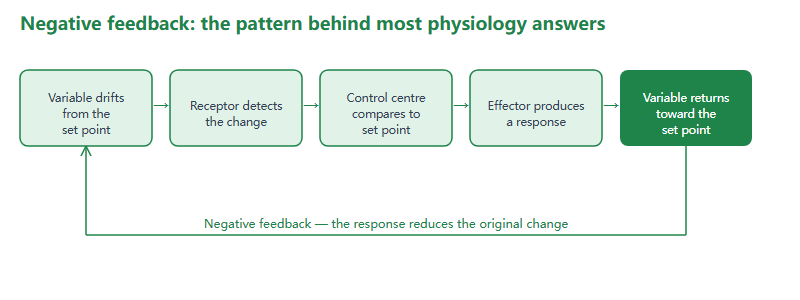
When you revise a new system, force yourself to name each box: what is the set point, what senses the deviation, what corrects it? If you cannot fill all four, you have found the gap the exam will probe.
Practise the pattern on the classics until it is reflexive: blood glucose held by the opposing push of insulin and glucagon; core temperature defended by shivering, sweating and changes in blood flow; water balance tuned by antidiuretic hormone acting on the kidney. Each is the same four-box loop with different labels. Once you can rebuild any of them from the set point outward, “explain how X is regulated” stops being a memory test and becomes a reconstruction you can always perform under pressure.
A Three-Layer Revision Cycle
Physiology rewards a specific order of study. Build from the base up, and only move to timed questions once the mechanism layer is solid — otherwise you are guessing dressed up as practising.
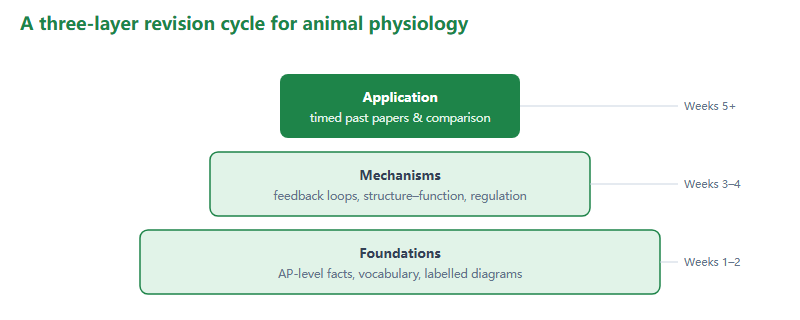
The weeks are illustrative and relative to your own start point, not official dates — confirm the real season timeline on cee.org. The order, however, is the part that matters: students who jump straight to papers before the mechanism layer is built tend to plateau, because they are memorising answers instead of understanding systems.
Notice the cycle is a loop, not a staircase. Every timed paper you sit in the application layer sends you back down to patch one specific foundation or mechanism, and then you climb again a little stronger. Physiology rewards the students who keep circling — foundations, mechanisms, application, and back — far more than those who read the chapter once and hope it holds on exam day.
Drill With Past Papers, Then Diagnose by System
Diagnosis is what turns physiology practice into progress. For every missed item, label the organ system and the failure type — a fact you never learned, a mechanism you could not run, or a comparison you had not seen before. A run of “mechanism” errors in one system tells you to go back to the feedback layer there; a scatter of “fact” errors tells you the foundations still have holes. The pattern of your mistakes is a more useful study plan than any generic checklist could be.
Once the mechanism layer holds, physiology practice should be timed and specific. Pull the physiology questions from full sets and, for every miss, name the organ system and the type of error — a missing fact, a broken mechanism, or a comparison you never learned. Our free USABO past-paper pack collects several years, with worked solutions for some, so you can trace the reasoning behind an answer rather than just marking it wrong. The content is the same whether you sit through the USABO China-region path or elsewhere; only the logistics differ, so confirm eligibility, dates, and the timezone of any deadline on the official and China-region pages before you plan your calendar. Master the 25% domain first, and the rest of the exam feels a great deal smaller.
Is animal physiology really the hardest USABO section?
It is the largest at 25% and often the deepest, so treat it as your anchor domain. “Hardest” depends on your background, but its weight makes it the highest-value.
Does AP Biology cover enough animal physiology for USABO?
AP gives the foundation, but USABO reaches into intro-college depth. Expect more mechanism, regulation, and comparison across animals.
Which organ systems should I prioritise?
Build fluency across all core systems, then attack the ones you score lowest on. Confirm the current emphasis on cee.org rather than guessing splits.
How do I practise physiology under time pressure?
Use timed past-paper sets from our free pack and review every miss by organ system and error type. Worked solutions are available for some years.
This is an independent guide operated by Hanlin Education for China-based international-school students. It is not affiliated with, endorsed by, or sponsored by the Center for Excellence in Education (CEE), which runs the USA Biology Olympiad. Competition details change year to year — always confirm current registration, eligibility, format, deadlines, and the timezone of any deadline on the official site, cee.org. Spotted an error? We correct verified mistakes within 7 working days.