USABO can strengthen a university application, but only when it is presented honestly. It is a signal of genuine interest and academic rigor — not a guarantee of admission, and not a substitute for grades. The craft is in naming the exact recognition you actually earned, placing it in the right slot on a US or UK application, and framing it so an admissions officer sees the thinking behind the line rather than a bare trophy. This guide shows how.
What a Biology Olympiad Actually Signals
Admissions officers read activities as evidence, not as points to be tallied. Sitting the USA Biology Olympiad Open Exam — run by the Center for Excellence in Education (CEE) — signals that you sought out a demanding standard beyond your school syllabus and prepared for it. Recognition on that exam signals performance against a rigorous benchmark. Neither line admits you anywhere on its own; both add weight to a coherent story about a student who is serious about biology. Our overview of the USA Biology Olympiad explains the exam itself; here we focus on turning it into a credible line on an application.
- It evidences initiative: you pursued a challenge your curriculum did not require.
- It evidences rigor: the Open Exam is pitched at roughly AP Biology plus introductory college biology.
- It does not evidence outcomes: no olympiad line guarantees an offer, and officers know it.
Context matters most for international applicants, whose schools and grading systems an admissions officer may not know well. A recognised external benchmark like a biology olympiad is legible precisely because it is standardised: it lets a reader calibrate your ability against a known yardstick rather than an unfamiliar school report. That is part of why it can be worth including even when the recognition is modest — it speaks a language the admissions office already understands, which a school-specific prize may not.
Name the Exact Recognition You Earned
The fastest way to lose credibility is to inflate. State precisely what you did: prepared for and sat the Open Exam; earned a specific recognition tier; or advanced to a further round. Do not imply national-team selection or international-olympiad participation you were not actually chosen for — eligibility and pathways are set by the official organiser, and for China-based students the details live on the USABO China-region path page. Confirm the exact name of any recognition on cee.org and the China-region page before you write it down, then describe it in plain, verifiable language.
| What you did | Overclaiming (avoid) | Honest phrasing (use) |
|---|---|---|
| Sat the Open Exam | “USABO national finalist” | “Prepared for and sat the USABO Open Exam” |
| Earned a recognition tier | “Top biology student in the USA” | “Earned [exact tier] recognition on the USABO Open Exam” |
| Took part via the China region | “Selected for the US national biology team” | “Participated through the USABO China region (see official page)” |
The right-hand column is not weaker — it is stronger, because it is checkable and confident. Admissions officers reward precision and are quick to distrust a line that sounds bigger than the evidence behind it.
It helps to see the same achievement written three ways. Inflated: “National biology champion.” Vague: “Did well in a biology competition.” Honest and specific: “Prepared independently for and sat the USABO Open Exam; earned [exact tier] recognition.” Only the third version survives scrutiny, and it is also the only one that tells the reader something concrete about you. When in doubt, write the sentence you would be comfortable explaining, in detail, in an interview — if a claim would make you nervous face to face, it does not belong on the page.
The Signal Ladder: From Sitting the Exam to Earned Recognition
Not every USABO line carries the same weight, and that is fine. Think of it as a ladder: each rung evidences something a little stronger, and you claim exactly the rung you reached — no higher.
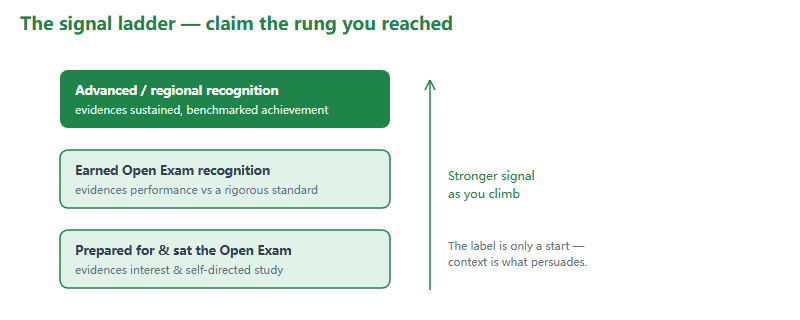
A student who honestly claims the bottom rung and explains what the preparation taught them can read as more impressive than one who overreaches for the top. Officers are pattern-matching for authenticity across your whole file.
Where It Goes: US Applications vs UK UCAS
The same achievement lands in different places depending on the system. US applications spread it across structured slots; the UK concentrates everything into one academic personal statement. Put the line where it belongs and give it room to breathe.
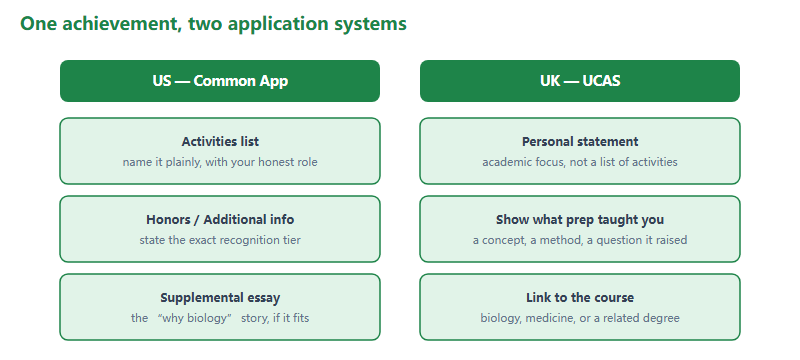
In both systems the golden rule is the same: never simply list “USABO.” Attach the evidence and the meaning, so the reader learns something about how you think.
A note on timing: sit the exam early enough that any recognition is confirmed before you finalise applications, and never list a result you are still waiting on as though it were secured. If the timeline is tight, describe your participation honestly in the present tense rather than claiming an outcome you do not yet have. Confirm the season's dates on cee.org so your calendar, not your optimism, drives what you write.
Turn the Line Into Evidence, Not Decoration
A trophy line is forgettable; a line that shows growth is not. The most persuasive way to use USABO is to connect the preparation to something concrete — a topic that hooked you, a method you now understand, a question the syllabus left you asking.
- Name a specific concept the preparation made vivid — a physiological mechanism, an evolutionary idea — rather than “I studied hard.”
- Show the habit behind the result: how you self-tested, reviewed past papers, and tracked your weak domains.
- Point forward: link it to what you want to study next, so the achievement reads as a beginning, not a plaque.
Compare two versions of the same supplement sentence. Before: “I competed in USABO, which deepened my passion for biology.” After: “Preparing for USABO, I got stuck on how the kidney concentrates urine — chasing that one mechanism is what turned me from a student who memorised biology into one who wanted to understand it.” The second says nothing boastful, yet it shows curiosity, specificity and growth. That is the texture an admissions reader remembers long after a list of activities has blurred together.
Backing the claim with genuine preparation also protects you: if you write about biology with real fluency, an interview or supplement will confirm it. Working through our free USABO past-paper pack — several years, with worked solutions for some — is one honest way to build the substance behind the line.
Red Lines: What Never to Claim
A few missteps can turn a strength into a liability. Avoid all of them:
- Never invent a rank or tier. If you cannot verify it on cee.org or the China-region page, do not write it.
- Never imply team or international selection you were not chosen for. Eligibility is set by the official organiser; misstating it is easy to catch and hard to recover from.
- Never let the line contradict your record. A dazzling olympiad claim beside a modest biology grade invites scrutiny, not admiration.
- Never treat it as a guarantee. No olympiad result guarantees an offer; present it as one honest signal among many.
One more safeguard: your application is read as a whole, so an olympiad line should sit comfortably beside your transcript, your teacher references, and anything a recommender might say. If a claim would surprise the biology teacher writing your letter, it is either mis-worded or overstated. Alignment across every part of the file is what makes a strong claim believable rather than suspicious, and it is entirely within your control.
Handled with that discipline, USABO becomes a credible, verifiable piece of a bigger story — which is exactly what a strong application is. Confirm the current recognition names, eligibility, and format on cee.org before you commit anything to the page.
Does USABO guarantee a better chance of admission?
No. It is a signal of interest and rigor, not a guarantee. Officers weigh it as one honest piece of a wider, coherent application.
Can I say I made the US national team through the China region?
Only if you were actually selected. Eligibility and pathways are set by the official organiser — confirm on cee.org and the China-region page and never overstate.
Where does USABO go on a US application?
Name it in the activities list, state the exact recognition in the honors or additional-info section, and expand only if a supplement fits.
How do I use USABO in a UK personal statement?
Fold it into your academic argument: what the preparation taught you and how it links to your intended course, not a bare mention.
This is an independent guide operated by Hanlin Education for China-based international-school students. It is not affiliated with, endorsed by, or sponsored by the Center for Excellence in Education (CEE), which runs the USA Biology Olympiad. Competition details change year to year — always confirm current registration, eligibility, format, deadlines, and the timezone of any deadline on the official site, cee.org. Spotted an error? We correct verified mistakes within 7 working days.