The Scarcity Problem: Why Even Dedicated Students Run Out of Authentic USABO Practice
Strong content knowledge does not guarantee USABO success. The exam rewards rapid decision-making under time pressure, integration across biological subdisciplines, and interpretation of novel data presentations. Yet the pool of officially released USABO practice questions is shallow. Students who exhaust past papers often find themselves repeating familiar problems rather than encountering the fresh challenge formats the actual exam demands.
According to Hanlin’s 2027 season guide, USABO now covers AP and university-level biology content with newly added emphasis on neurobiology and bioinformatics. The exam content distribution places 25% weight on animal physiology and anatomy (including neurobiology), 20% on cell biology, 20% on genetics and evolution, 15% on plant anatomy and physiology, 10% on ecology, 5% on ethology, and 5% on biological systematics. This breadth means students need practice spanning far more territory than any single question bank easily provides.
The solution is not merely to search harder for existing questions, but to develop the skill of constructing valid USABO-style items from the biology materials already at hand. This article presents four specific transformation techniques, with suggested applications for each.
The Campbell Conversion: Turning Textbook End-of-Chapter Questions Into USABO-Format Items
Campbell Biology serves as the shared foundational text for both USABO and BBO preparation. Its end-of-chapter questions, however, typically test single concepts in isolation. The transformation to USABO format requires deliberate structural changes.
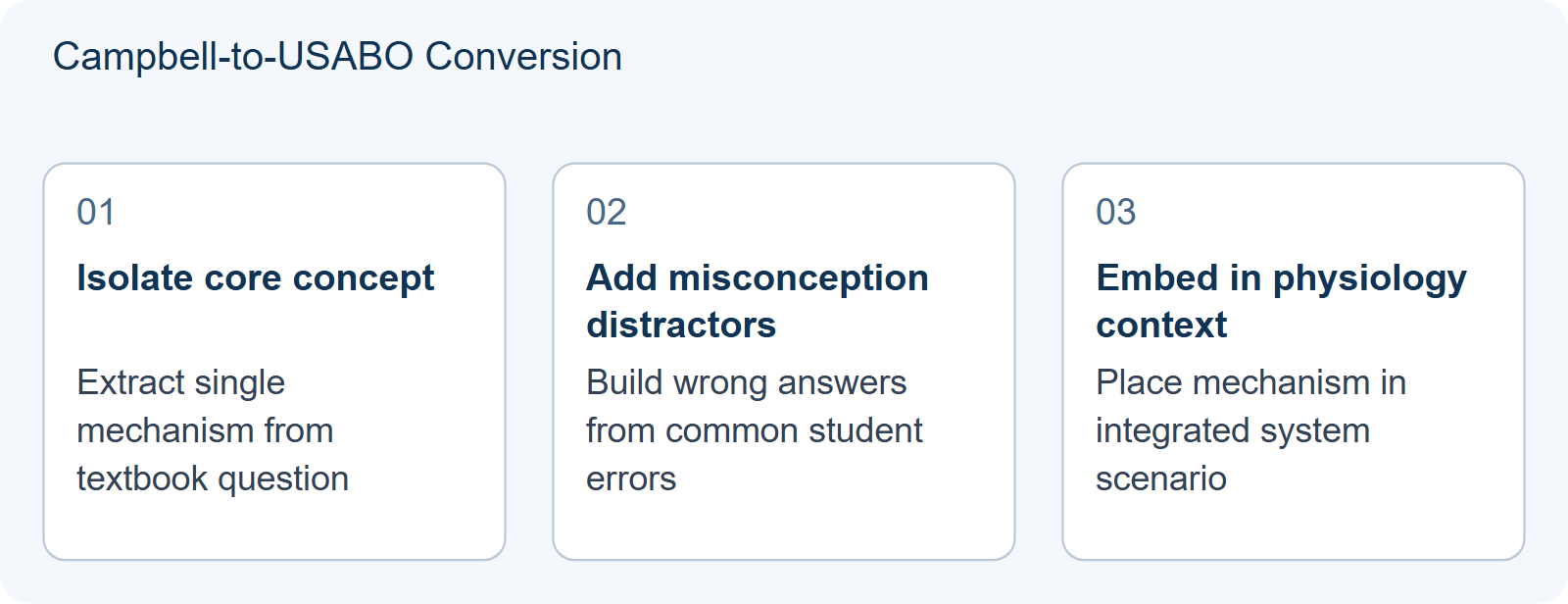
Suggested conversion technique: Take any Campbell conceptual question and add a distractor set that mirrors common student misconceptions. For example, a question about membrane transport might include options confusing active transport with facilitated diffusion, or conflating the energy source (ATP vs. electrochemical gradient) with the mechanism. USABO’s 50-minute, 50-question format demands that each item discriminate between students who understand mechanisms and those who merely recognize terminology.
A second suggested layer: embed the concept within a physiological context. Rather than asking about sodium-potassium pumps in isolation, frame the question within the context of nerve impulse propagation or renal function—domains where the pump’s role must be integrated with other systems. This aligns with the exam’s emphasis on judging practice question quality before trusting it as representative.
AP Bio to USABO: Adapting Free-Response Prompts Into Tight Multiple-Choice With Plausible Distractors
AP Biology free-response questions often present rich scenarios with multiple analytical steps. These contain excellent raw material for USABO practice questions, but require compression and restructuring.
Suggested transformation: Identify the core reasoning chain in an AP Bio prompt. For instance, a question about population genetics might require students to connect Hardy-Weinberg equilibrium to selection pressure, then predict allele frequency change. For USABO conversion, preserve the multi-step reasoning but present it as a single best-answer multiple choice with distractors representing each plausible misstep in the chain.
Constructing effective distractors is the critical skill. Each wrong answer should reflect a specific, tempting error: arithmetic mistakes in frequency calculation, confusing dominant and recessive allele behavior, or misapplying the equilibrium conditions. The goal is not trickery but diagnostic precision—distinguishing between levels of understanding. This approach builds on the principle of reviewing past papers deeply rather than merely completing them.
Figure-First Construction: Building Data-Interpretation Questions From Primary Literature Images
USABO increasingly presents figures as the question itself—students must interpret gel electrophoresis results, phylogenetic trees, or experimental outcome graphs without lengthy textual preamble. Primary literature figures offer an untapped reservoir for practice construction.
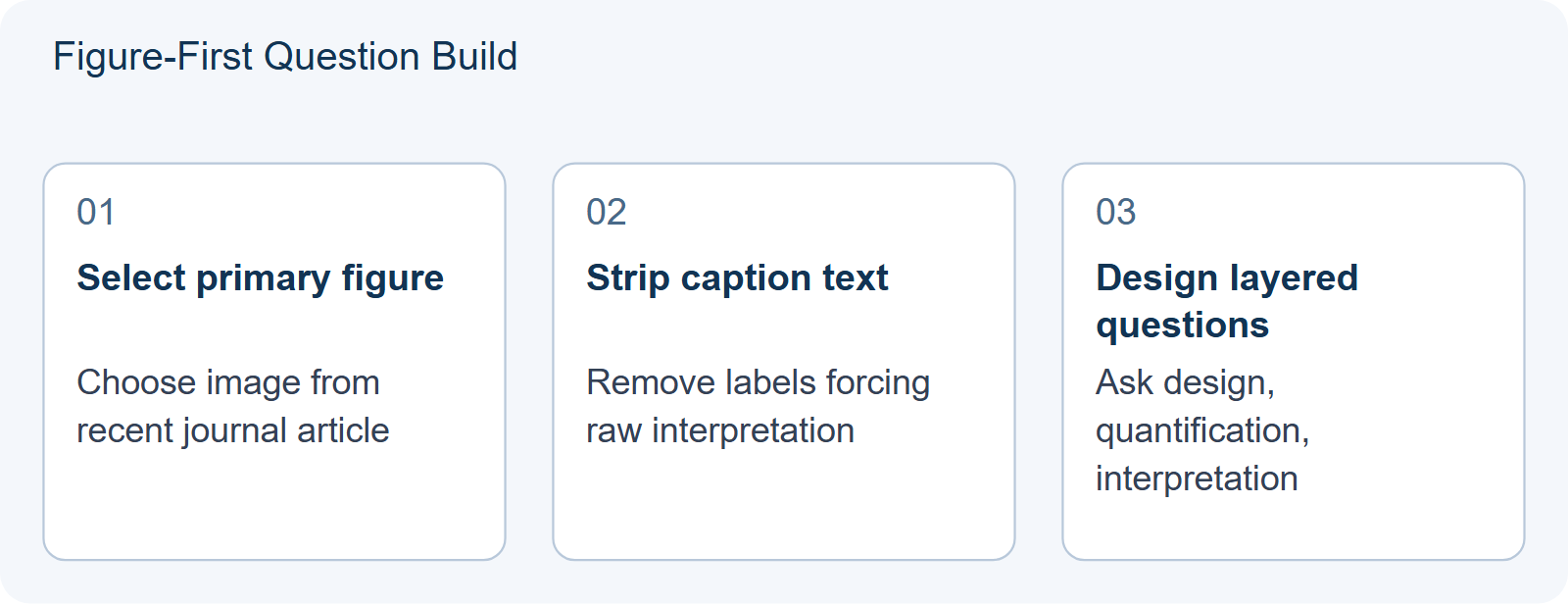
Suggested technique: Select a figure from a recent biology journal article. Remove its caption and surrounding text. Ask yourself what biological conclusion the figure supports, what alternative interpretations exist, and what additional information would be needed to strengthen the claim. Then construct a question that requires the student to perform this same analysis.
For example, a Western blot showing protein expression levels across treatments can become a question about experimental design (what controls are present?), data quantification (how would you normalize these bands?), or biological interpretation (which signaling pathway might explain this pattern?). The figure becomes the entire stimulus, testing whether students can extract meaning from visual data under time pressure.
This method is particularly valuable given USABO’s expanded neurobiology and bioinformatics coverage, where novel data presentations are common and students cannot rely on memorized templates.
Cross-Topic Fusion: Creating the Integrated Problems USABO Rewards Most Highly
The highest-value USABO practice questions integrate multiple content areas. The exam content distribution—spanning cell biology, genetics, physiology, ecology, and beyond—provides a framework for deliberate fusion.
Suggested construction approach: Select two content areas with genuine biological connections, then build a scenario requiring simultaneous application. For instance, combine plant physiology (15% of exam content) with genetics (20%): a question about photoperiodism might incorporate quantitative trait locus mapping, requiring students to connect hormonal signaling with inheritance patterns.
Another suggested fusion: animal physiology with evolution. A question about hemoglobin oxygen affinity could incorporate phylogenetic comparison across species adapted to different environments, requiring students to integrate physiological mechanism with evolutionary adaptation. These integrated items mirror the highest-level demands of the competition.
Quality Control: Testing Your Self-Made Questions Against USABO Difficulty Benchmarks
Self-constructed questions require validation. Without external review, students risk practicing with items that misrepresent actual exam difficulty or test irrelevant skills.
Suggested validation criteria: First, time yourself solving the question under realistic conditions—USABO allows approximately one minute per question. If your constructed item requires significantly more time, it may test calculation speed rather than biological reasoning. Second, verify that the correct answer requires genuine understanding rather than pattern matching. Third, ensure distractors are chosen based on documented student errors rather than arbitrary wrong answers.
For students seeking professionally validated question banks, Hanlin’s exclusive preparation materials include over 200 categorized questions organized by theme. These can serve as calibration standards for self-made items.
Preparing for a Course-Fit Discussion
If you are considering structured preparation alongside self-generated practice, gathering the following information beforehand will help advisors assess fit efficiently:
- Your current biology coursework completed (AP Biology, A-Level, or equivalent) and grades achieved
- Prior competition experience in USABO, BBO, or related science olympiads
- Specific topics where self-made questions reveal persistent gaps—neurobiology, bioinformatics, or data interpretation, for example
- Weekly hours available for preparation and target competition date
- Whether you are pursuing USABO alone or alongside BBO, given the 70-90% content overlap that enables coordinated preparation
With this context, an advisor can recommend whether a 60-hour foundational course, 40-hour intensive, or 20-hour sprint format aligns with your starting point and goals.
Frequently Asked Questions
How do I know if my self-made USABO practice questions are too easy or too hard?
Time yourself solving each item under one-minute conditions. If the correct answer requires genuine multi-step reasoning rather than pattern recognition, and if distractors reflect documented misconceptions rather than random wrong answers, the difficulty is likely appropriate. Compare against professionally curated question sets for calibration.
Can I use BBO past papers to supplement my USABO practice question pool?
Yes, with awareness of differences. BBO emphasizes breadth and data interpretation over USABO's depth and speed. The 70-90% content overlap means many BBO items transfer well, but you should adapt them to USABO's tighter time constraints and more demanding distractor construction.
What makes a primary literature figure suitable for USABO-style question construction?
Look for figures that present quantitative biological data with clear experimental logic. Western blots, dose-response curves, phylogenetic trees, and microscopy time-series work well. Avoid figures dependent on specialized techniques beyond general biology knowledge or those requiring extensive domain-specific background to interpret.