Cell biology carries 20% of the IBO subject distribution USABO follows, second only to animal anatomy and physiology. On an Open Exam of around 50 multiple-choice questions in 50 minutes that works out to roughly ten questions, and because there is no penalty for a wrong answer, every one of them is worth attempting. This guide breaks the 20% into five revisable clusters and shows what each looks like under exam conditions.
What 20% actually buys you on a paper of about 50 questions
USABO does not publish its own syllabus; it aligns closely with the IBO core syllabus, whose subject distribution is animal anatomy and physiology 25%, cell biology 20%, genetics and evolution 20%, plant biology 15%, ecology 10%, ethology (animal behaviour) 5% and biosystematics (taxonomy) 5%. Treat these as guidance rather than a published USABO marking scheme, and confirm current content on cee.org. Cell biology sits in second place, and it is the area most candidates assume they already own because they met it in school.
Here is the arithmetic that should change how you plan. Twenty per cent of a paper of about 50 questions is roughly ten questions. Treat that as planning arithmetic rather than a promise: the organisers publish the 50-minute format and the no-penalty rule but not a fixed question count, and there is no question-by-question breakdown for any given paper, so the real count varies. But if you are budgeting revision hours, ten is the number to plan against, and it is far too many to leave to “I did that in Year 11”.
Two features of the Open Exam format make cell biology behave differently from other sections. First, about 50 questions in 50 minutes means an average of roughly 60 seconds per item — there is no time to reconstruct a pathway from first principles, so recall has to be automatic. Second, there is no penalty for a wrong answer, which means a blank is strictly worse than a guess. Your revision target for cell biology is therefore not “know everything” but “never be at zero” — get every plausible question to the point where you can eliminate two options in fifteen seconds. Confirm the current format and rules on cee.org, and if you are new to the competition structure, start with our overview of what the USABO actually is.
One note on entry route: USABO has a China region, and how candidates based in China enter is not the same as the route a US school uses. Eligibility and registration are set by the organisers, so check the China-region pathway and confirm the current position on cee.org before you plan a season around it.
The five clusters inside “cell biology”
No examiner ever writes a question called “cell biology”. They write a question about a membrane protein, an enzyme curve, a checkpoint or a second messenger. Splitting the 20% into five clusters turns a vague heading into five finishable jobs, and it lets you stop revising a cluster when it is done instead of endlessly re-reading a chapter.
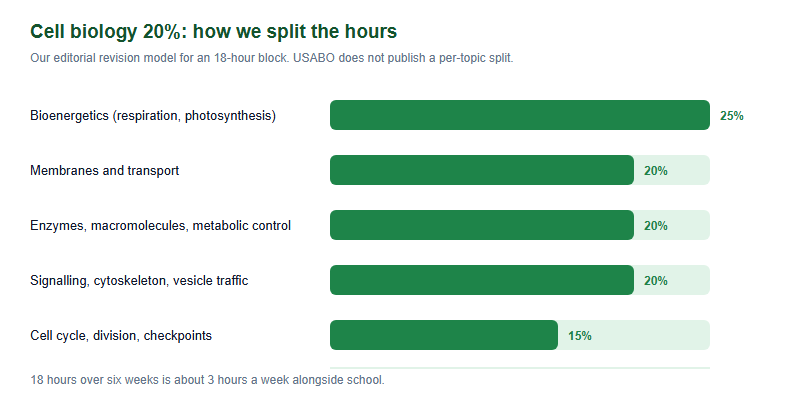
| Cluster | Our suggested share of your cell-biology hours | What a USABO-level question looks like | Where it goes beyond a standard school course |
|---|---|---|---|
| Bioenergetics — respiration and photosynthesis at the cell level | 25% | Which step regenerates NAD+ when oxygen is absent; what happens to ATP yield if a specific complex is inhibited | Named electron-transport complexes, proton-motive force as a gradient rather than a molecule, uncouplers and inhibitors acting at different points |
| Membranes and transport | 20% | Which curve shows facilitated diffusion saturating; predicting net water movement between two compartments | Channel versus carrier versus pump, secondary active transport running on an existing gradient, aquaporins, membrane fluidity factors |
| Macromolecules, enzymes and metabolic control | 20% | How a competitive inhibitor moves Km and Vmax; identifying an allosteric effect from a sigmoid curve | Enzyme-kinetics vocabulary used precisely, allosteric and feedback regulation, covalent modification by phosphorylation |
| Cell signalling, cytoskeleton and vesicle traffic | 20% | Which second messenger amplifies a signal; what a receptor tyrosine kinase does that a G-protein-coupled receptor does not | Signal amplification as a quantitative idea, motor proteins and their tracks, targeting of vesicles to the correct compartment |
| Cell cycle, division and checkpoints | 15% | Which checkpoint is being described; consequence of a cyclin that is never degraded | Cyclin–Cdk control, spindle-assembly checkpoint, the link from checkpoint failure to uncontrolled division |
Cell biology’s hidden weight: it is tested inside other sections too
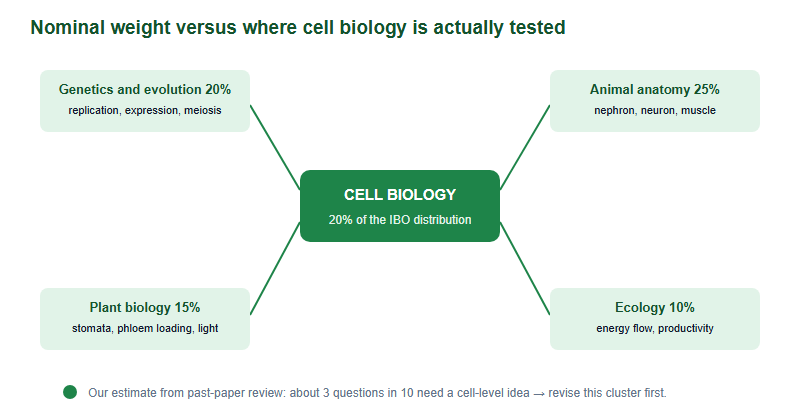
The 20% label is applied to questions whose subject is a cell. It does not capture the questions where cell biology is the tool you need to answer something else. Work through a set of papers and the pattern is hard to miss:
- Inside animal anatomy and physiology (25%): the nephron is a transport problem, a neuron is a membrane-potential problem, and muscle contraction is a signalling-plus-ATP problem. None of these are solvable by anatomy recall alone.
- Inside plant biology (15%): stomatal opening is ion transport and water potential, phloem loading is secondary active transport, and the light reactions are the same chemiosmosis you learned for mitochondria.
- Inside genetics and evolution (20%): replication, transcription and the mechanics of meiosis are all cell-level processes before they are inheritance patterns.
- Inside ecology (10%): energy flow and productivity questions rest on what respiration actually costs an organism.
Our editorial estimate, from working through the free past-paper set we have gathered, is that roughly three questions in ten across a full paper need a cell-level idea to resolve — not one in five. That is an estimate from our own review, not an official figure, and the exact number will differ paper by paper. The practical consequence is the useful part: revise cell biology first, because it compounds. Hours spent on chemiosmosis pay again in the plant section; hours spent on membrane transport pay again in animal physiology. Very little else on the syllabus behaves that way.
Four question shapes, and a 60-second routine for each
About fifty questions in fifty minutes gives an average of roughly 60 seconds per item, but the average is a trap. Recall items should take 25 to 40 seconds; that surplus is what funds the data-interpretation items, which can honestly need 90 seconds. Practise to the shape, not to the average.
- Shape 1 — recall and identify. “Which organelle / which molecule / which term.” Answer or eliminate within 25 seconds. If nothing arrives in 25 seconds, cut two options and commit. There is no penalty for being wrong, so a considered guess costs nothing but the seconds you already spent.
- Shape 2 — mechanism and causal chain. “What happens next / what is the consequence of blocking X.” Find the step being interrupted first, then read forward one step only. Most wrong answers here are correct statements about a different step in the same pathway.
- Shape 3 — data and graphs. Read the axes and units before the curve, and before the question stem. Saturation, a shifted intercept and a changed slope each mean something specific in enzyme and transport questions; naming the shape usually names the answer.
- Shape 4 — experimental design. “Which result would show that…” Work backwards from what the hypothesis predicts, then ask which option distinguishes it from the alternative. An option that is merely consistent with the hypothesis is not the answer; the answer discriminates.
Practise these shapes on real material rather than on textbook end-of-chapter questions, which are written to test a chapter rather than to discriminate between candidates. We maintain a free pack of past papers we have gathered; worked solutions are available for some years rather than all of them, and coverage keeps growing as we write more of them up.
A six-week cell-biology block, and the errors it should eliminate
Eighteen hours, three hours a week, six weeks. It fits alongside a full timetable and it finishes — which matters more than volume, because unfinished blocks are what leave holes in a paper.
- Weeks 1–2, bioenergetics (5 hours). Reconstruct glycolysis, the link reaction, the Krebs cycle and the electron transport chain on blank paper before you open a book. Then check, mark your own gaps in a different colour, and repeat two days later. Add the light-dependent and light-independent reactions in week 2 and deliberately note every point where the two chemiosmotic systems are the same idea.
- Week 3, membranes and transport (4 hours). Build one table: mechanism, energy source, saturable or not, protein type, worked example. Every membrane question in the paper is a lookup against that table.
- Week 4, enzymes and metabolic control (3 hours). Draw the four inhibition curves from memory, label Km and Vmax on each, then write one sentence explaining why the curve moves as it does. Curves without the sentence do not survive exam pressure.
- Week 5, cell cycle and signalling (3 hours). One diagram for cyclin–Cdk control and the checkpoints; one diagram tracing a signal from ligand to cellular response with the amplification step marked.
- Week 6, mixed timed sets (3 hours). Pull only the cell-biology questions from several past papers and sit them in 20-question, 20-minute blocks. This is where you convert knowledge into the speed the format demands.
Run the block against a checklist of the six errors that most often cost otherwise strong candidates marks. Each one is a whole-mark mistake that five minutes of deliberate checking will prevent:
- Treating anything involving ATP as active transport. Secondary active transport runs on a gradient that was built earlier; it does not hydrolyse ATP at the transporter itself. Question writers use this distinction constantly.
- Mixing up competitive and non-competitive inhibition. Know which one changes apparent Km, which one changes Vmax, and be able to say why in one sentence.
- Describing the proton gradient as “stored ATP”. The gradient is potential energy across a membrane; ATP is made when protons return through the synthase. Uncoupler questions punish this directly.
- Assuming every signalling cascade ends at the nucleus. Many end by phosphorylating enzymes that already exist, which is exactly why the response can be fast.
- Forgetting that cytokinesis differs in plant cells. A cell plate forms rather than a cleavage furrow — a small fact that shows up at the boundary between the cell-biology and plant sections.
- Leaving a hard question blank. With no penalty for a wrong answer, a blank scores zero for certain while a considered guess does not. Mark it, answer it anyway, and come back if time allows.
Frequently asked questions
How many cell biology questions are on the USABO Open Exam?
Cell biology carries 20% of the IBO subject distribution USABO follows, not a fixed count. On a paper of about 50 questions that is roughly ten questions; the organisers publish the 50-minute format but not a fixed question count. Confirm the current format on cee.org.
Is a standard school biology course enough for this section?
It covers most concepts but rarely the depth. Enzyme-kinetics vocabulary, named transport-chain components and signalling detail usually need an introductory college-level text as well.
Should I guess on a cell biology question I am unsure about?
There is no penalty for a wrong answer on the Open Exam, so a blank can only cost you. Eliminate what you can, commit to an answer, and move on.
Which cell biology cluster gives the fastest return?
Bioenergetics. Respiration and photosynthesis at cell level reappear inside the plant and animal physiology questions, so the hours are used twice.
This is an independent guide operated by Hanlin Education for China-based international-school students. We are not affiliated with, endorsed by, or sponsored by the Center for Excellence in Education (CEE). Exam format, content weightings, eligibility and registration are set by the organisers — please confirm current details on cee.org. If you spot an error, tell us and we will correct it within 7 working days.