A-Level Biology prepares you well for roughly 45% of the USABO Open Exam and barely touches another quarter of it. The overlap is animal physiology and cell biology; the structural gap is plant biology, animal behaviour and taxonomy; and a further slice depends entirely on what your specification schedules for the second year. This article maps those gaps against USABO’s published subject weights and gives you a closing order that starts with the cheapest marks.
Two things make the A-Level route distinctive. The first is that its strengths and weaknesses are unusually predictable — far more so than for a self-taught candidate. The second is that its sequencing, not its content, is what most often catches students out. If you have not yet mapped the exam itself, read our overview of the USABO first; this piece assumes you already know the shape of the paper.
Two exams built on opposite principles
A-Level Biology is depth-first. It examines a deliberately limited set of topics through extended written answers, and the mark scheme rewards showing your route: command words, defined terms, method marks, structured explanation. A student who has trained hard for it can hold a complex physiological argument together across half a page.
The USABO Open Exam is breadth-first. It asks 50 multiple-choice questions in 50 minutes, with no penalty for wrong answers, at roughly AP Biology plus introductory college biology, spread across seven subject areas with published weights. Nothing in it asks you to write.
Put those two descriptions side by side and the consequence is uncomfortable but clear: the skill your A-Level has spent two years building — sustained written explanation of a small number of systems — is not directly examined, while the areas your specification may not cover at all are examined at full weight. Neither exam is harder than the other. They are different shapes, and the gap between the shapes is what you have to close.
The gap map: seven areas, and where your specification leaves you
The table below sets USABO’s seven subject areas against what a typical two-year A-Level Biology course gives you. Specifications differ between boards and are revised periodically, so treat the middle column as a prompt to check your own specification rather than as a statement about it.
| USABO area | Weight | What A-Level typically gives you | Verdict |
|---|---|---|---|
| Animal anatomy & physiology | 25% | Gas exchange, circulation, nervous coordination, homeostasis and immunity, usually in real depth — but almost entirely as human physiology. | Your strongest area, with one structural blind spot: comparative physiology across animal groups. |
| Cell biology | 20% | Membranes and transport, respiration, photosynthesis, the cell cycle, biological molecules and enzymes. | The cleanest overlap on the map. Extend the molecular treatment upward rather than starting again. |
| Genetics & evolution | 20% | Mendelian inheritance reliably; population genetics, selection mechanisms and phylogeny to a degree that varies sharply by specification and often sits in the second year. | Half home ground, half a sequencing problem. See the next section. |
| Plant biology | 15% | Transport in plants and photosynthesis, usually well. Plant development, hormones, reproductive strategies and structural diversity, usually thinly or not at all. | The single biggest structural gap on the A-Level route. |
| Ecology | 10% | Sampling technique, succession, nutrient cycling and energy transfer in most specifications. | Partial. The conceptual coverage is often fine; the quantitative treatment varies. |
| Animal behaviour | 5% | Rarely a named topic on current specifications. | Close to a total gap — and one of the cheapest to close. |
| Taxonomy | 5% | Classification and phylogeny appear on some specifications and have been reduced or removed on others. | Gap or near-gap, and small enough to fix in a fortnight. |
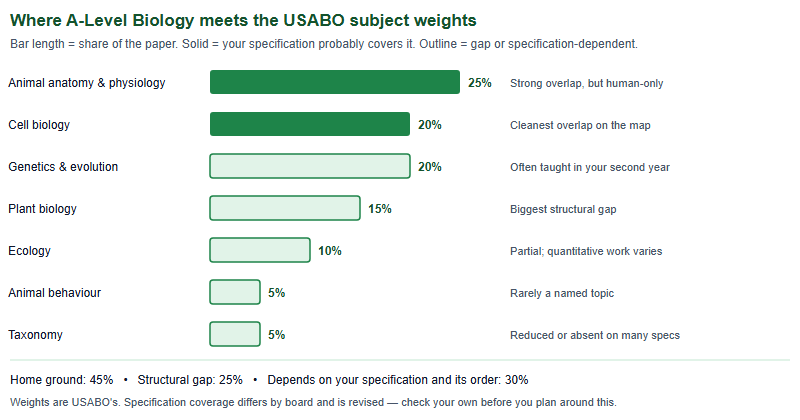
The arithmetic is worth stating plainly. Animal physiology and cell biology together are 45% of the paper, and an A-Level student walks in with genuine depth in both. Plant biology, behaviour and taxonomy together are 25% — a full quarter — and that is exactly where the specification is least likely to have taught you. The remaining 30% is neither strength nor gap: it is a question of when your course reaches it.
The sequencing trap: your second-year content may arrive after the paper
This is the failure specific to the A-Level route, and it is a calendar problem rather than an ability problem. A two-year course is deliberately back-loaded: the deeper treatment of genetics, evolutionary mechanism and quantitative ecology commonly sits in the second year. Meanwhile the exam does not wait for your scheme of work.
The two USABO divisions also run on different calendars, and this is the point at which A-Level students most often plan from the wrong source. The US Division Open Exam sits in February; the China Division Open Exam sits in April. They are not the same date and must never be merged — confirm the current dates for the route that actually applies to you on cee.org and on our China-region page. A revision plan copied from a US-oriented blog will place a China Division candidate’s peak roughly two months early.
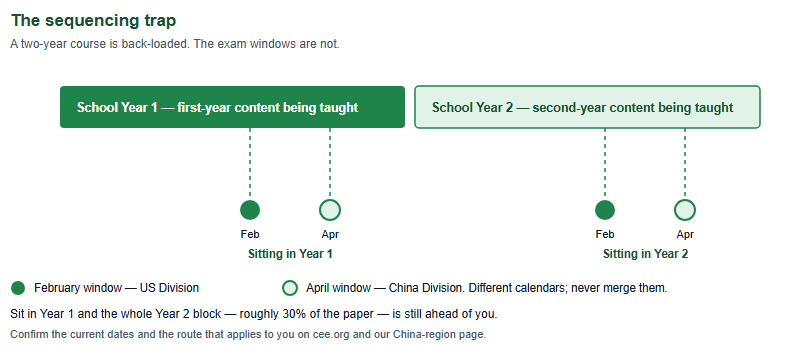
You have two honest options. The first is to sit in your first year as a calibration exercise, accept that a slice of the syllabus is untaught, and use the result to aim the following year. The second is to pre-read the second-year units that map onto genetics, evolution and quantitative ecology, so that you arrive at the paper with the whole map rather than half of it. What does not work is planning as though your school’s teaching order and the exam calendar were designed together. They were not.
The format gap: from method marks to 50 questions in 50 minutes
Content is only half of the transition. Three features of the Open Exam cut directly against A-Level habits.
- There is no partial credit inside an item. A-Level rewards a partly correct route; a multiple-choice item does not. “Nearly right” scores the same as “no idea”. Precision of recall matters more than the quality of your presentation, which is a genuinely different target.
- There is no penalty for wrong answers. Any habit of leaving blank what you cannot fully justify — a reasonable instinct in a written exam where an unsupported assertion earns nothing — is a pure loss here. A blank is strictly worse than a guess.
- Fifty questions in fifty minutes is about a minute each. The A-Level reflex of defining terms, setting up the argument and then explaining is far too slow. The skill you need is elimination: reading a stem, discarding two options on a structural mistake, and choosing between the remaining two quickly.
Retraining this takes weeks, not months, and it is best done separately from content work. Short timed sets first — twenty questions in twenty minutes — before full sittings, so that pacing becomes automatic before you spend a whole paper on it. Save complete USABO past papers for genuine timed calibration rather than burning them as casual reading; once you have seen a paper, it can no longer measure you.
A closing order: cheapest marks first
The instinct is to attack the hardest gap first. The better order is by marks per hour, because the light areas are small enough to finish and finishing builds the momentum that carries you through the heavy ones.
| Order | What to close | Share of paper | Why here |
|---|---|---|---|
| 1 | Animal behaviour and taxonomy | 10% | Smallest volume of material on the whole map. Largely recognition-level, and finishable inside a fortnight of steady work. |
| 2 | Plant biology beyond transport and photosynthesis | 15% | Your biggest structural gap, and the one where an A-Level student most often assumes coverage they do not have. |
| 3 | Comparative animal physiology, including neurobiology | Part of 25% | You already have the mechanisms; you are widening them from human-only to animal-wide. Cheap relative to the weight it protects. |
| 4 | Population genetics and evolutionary mechanism, if your specification schedules them late | Part of 20% | Only urgent if you are sitting before your course teaches it. Check your scheme of work before deciding. |
| 5 | Format: elimination, pacing, timed sets, calibration papers | All of it | Runs alongside from the start, and takes over in the final weeks. |
One caution on step 3. “I know physiology” is the most common overconfidence on the A-Level route, because the knowledge is real but its scope is narrower than the student believes. The test is simple: name an animal you have never studied, and try to predict how it exchanges gases, moves blood and excretes nitrogen. If the answer only works when the animal is a mammal, your physiology is human physiology, and a quarter of the paper is asking for something wider.
Frequently asked questions
Is A-Level Biology enough on its own for USABO?
It covers roughly 45% of the paper well. Plant biology, behaviour and taxonomy — a further 25% — usually need separate work.
Do I need to take AP Biology as well as A-Level for USABO?
No. You need the content level, not the course. USABO sits at about AP Biology plus introductory college biology; any route there works.
Should I sit USABO in my first A-Level year or my second?
Eligibility is set by the organisers — confirm on cee.org. On content alone, the second year is stronger; the first year buys calibration.
Which USABO exam calendar applies to an A-Level student in China?
Depends on your route. The US Division sits in February, the China Division in April. Confirm dates on cee.org and our China-region page.
This is an independent guide operated by Hanlin Education for China-based international-school students. We are not affiliated with, endorsed by, or sponsored by the Center for Excellence in Education (CEE). Eligibility, registration channels and exam dates are set by the organisers and can change — confirm current details on cee.org before you rely on anything here. Errors reported to us are corrected within 7 working days.