Missing the advancing score tells you almost nothing on its own. A student who never opened the plant chapters and a student who knew everything but lost fourteen questions to the clock can finish on identical marks — and the two of them need completely different years. Before you plan a second attempt, diagnose which one you were.
A score is not a diagnosis
The reflex after a disappointing result is to resolve to “work harder,” buy a new textbook, and restart chapter one. It is the single most wasteful response available, because it treats every failure as the same failure — a shortage of effort — when effort is usually not what was short.
Start from the structure of the paper. The USABO Open Exam is 50 questions in 50 minutes with no penalty for a wrong answer. That format constrains how a low score can happen, and the constraint is genuinely useful. Because wrong answers cost nothing, no rational candidate leaves blanks, so a shortfall is never made of unanswered questions. It is made of wrong ones. And wrong answers come in only a few flavours.
Every mark you dropped falls into one of four buckets: you had never met the material, you had met it at the wrong depth, you knew it but ran out of time, or you knew it and misread the question. Those four need different fixes, on different timescales, and telling them apart takes about ninety minutes of honest work.
The four failure modes
| Mode | What it looks like on the paper | What it actually is | Rough time to fix |
|---|---|---|---|
| 1. Coverage | Errors cluster by topic. Whole bands are near-random. Some stems contain terms you have never seen | Syllabus never finished — usually plant biology, taxonomy or behaviour, the bands students postpone | 6–10 weeks of targeted reading |
| 2. Depth | Errors scattered everywhere. You recognised every topic. Your answer was the textbook-level statement, and it was a distractor | You know the school version of the syllabus, and the exam asked the level above it | 3–5 months. The expensive one |
| 3. Pacing | Errors concentrate in the last ten to fifteen questions. Early answers correct but slow. You remember rushing | Retrieval too slow, or too long spent on two hard items early | 4–6 weeks of timed drilling |
| 4. Exam craft | You can explain the correct answer instantly once you see it. Misread negative stems, “all of the following except”, multi-statement combinations | Reading discipline, not biology | 2–4 weeks. The cheapest fix on this list |
There is a fifth possibility, and it deserves saying plainly because nobody else will say it to you: you may simply not have enjoyed any of it. If the honest answer to “did I like the preparation?” is no — not “it was hard,” but no — then the diagnostic below is beside the point, and the right move is a different competition or a different use of the year. Choosing that is not failure. Spending twelve more months on something you resent, to produce a line on a form, is a much worse outcome than a clean redirection.
Reconstructing the evidence
You cannot diagnose from a total. You need item-level evidence, and there are two ways to get it depending on how fresh the paper is.
If you sat recently: reconstruct within about two weeks, while recall is still usable. Sit down with a blank sheet and write down every question you can remember, in order, tagging each one with the content band and with a code: K (knew it, got it), S (knew it, too slow), G (guessed), N (never seen this material), M (misread the stem). You will not recover all fifty. Thirty is plenty — the pattern shows up long before the list is complete.
If the paper has gone cold: do not guess at what happened. Sit a fresh paper under full exam conditions instead and diagnose from that, because your error pattern is a property of your preparation and it repeats. Mark your finishing time per block of ten questions as you go, since that column is what separates mode 3 from everything else. Our past-paper pack exists for exactly this; the point is not the score but the shape of the errors.
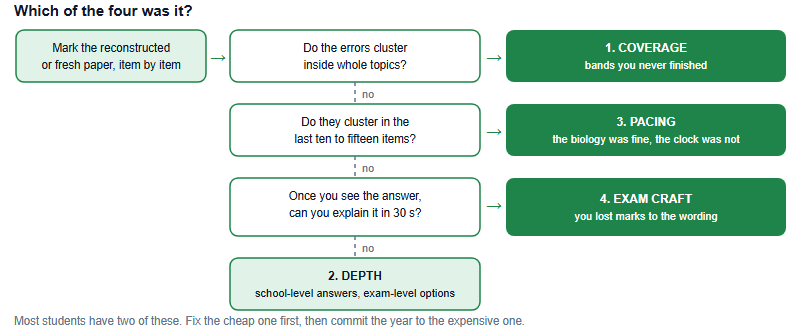
Two warnings about running this honestly. First, mode 4 is systematically under-diagnosed, because admitting you misread six stems feels worse than concluding your knowledge was thin — even though misreading is far cheaper to fix. Second, if you find yourself with more than about eight items where you thought I knew that, you are looking at a retrieval problem rather than a knowledge problem, and the repair is speed work, not more reading.
Deciding whether to sit again at all
A diagnosis is not automatically a mandate. Four questions decide it, and they should be answered in this order.
How many school years do you actually have left? A student with two clear years ahead can absorb a depth rebuild. A student entering a public-examination year, with an IB or A-Level timetable landing in the same window, is choosing between two things rather than adding one.
Does your diagnosis match the time available? Coverage, pacing and exam craft are three-month problems. Depth is a year-long one. Committing to a second attempt on a three-month runway when the diagnosis says depth is how students produce two disappointing results instead of one.
What does advancing actually mean for you? The score that advances candidates is set by the organiser and moves between years, so do not plan against last season’s figure — check cee.org. What sits beyond the Open Exam also depends on which region you sit in, so read the China-region pathway page alongside the official site before you set a target. Building a year around an assumed pathway is a common and avoidable mistake.
What is the honest opportunity cost? The hours have to come from somewhere. If they come from a research project you are genuinely engaged in, or from the coursework that carries your predicted grades, the trade may not be worth it — and a thinner transcript is harder to repair than a missed cutoff.
The rebuild, in relative weeks
If you are going again, sequence the work by diagnosis rather than by chapter order. The shape below assumes roughly a 26-week run at the paper; compress or extend it to fit your own calendar, and count the weeks backwards from your own region’s date rather than a generic one.
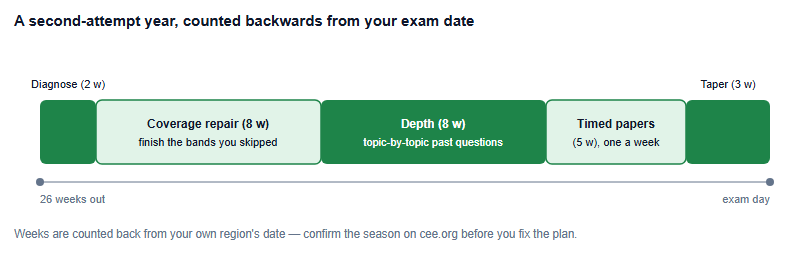
Three rules make the difference between a second attempt and a repeat of the first.
Change one thing at a time. New textbook, new schedule, new tutor, new note system, all in September, and by November you will not know which change is working. Keep whatever demonstrably worked — and something did, or you would have scored lower.
Do not hoard papers. The commonest self-sabotage is saving the “good” papers for later and then arriving at the exam having done four. Papers are the diagnostic instrument, not the prize; spend them steadily and re-sit old ones, because by the time a paper comes round again you have forgotten the items and kept the reasoning.
Give the fix to the diagnosis, not to your comfort zone. Students with a plant-biology coverage gap spend the autumn re-reading genetics, because genetics is where they feel competent. Track your weekly hours against the four modes for a month and the drift will be obvious.
How a second attempt reads inside an application
Students worry that sitting twice looks like weakness. It does not. Repeat entries are ordinary in olympiad competitions, and an admissions reader is not comparing your two attempts — they are checking whether the result you report is corroborated by everything else in your file.
That is the useful way to think about it. A biology olympiad score is one piece of evidence, and it becomes believable when the rest of the file agrees with it: biology grades on the transcript that move in the same direction, an activity list that shows sustained work in the same subject rather than a single winter of cramming, a teacher who can describe how you think about biology, and any other science results that point the same way. Several independent signals that agree are what make a profile read as real. One isolated line, with nothing around it that matches, is what invites doubt.
A second attempt actually helps that story rather than hurting it, because it is documented persistence in a stated interest — provided the rest of the file did not stall while you were doing it. What no result can do is guarantee any admissions outcome, and any programme that tells you otherwise is selling something. Write about what you learned honestly and let the corroboration do the work; the overview of the exam is worth re-reading before you describe it to anyone.
Does sitting the USABO twice look bad on an application?
No. Repeat entries are normal in olympiads, and readers check whether a result is corroborated by the rest of your file.
How soon should I start the rebuild?
Start the diagnosis within two weeks of results, while the paper is fresh. The rebuild itself can wait for the new term.
What if I cannot remember the questions?
Sit a fresh past paper under timed conditions and diagnose from that instead. Your error pattern reliably repeats.
Should I switch to a different competition instead?
Only if the calendar or syllabus genuinely suits you better. Switching to dodge a depth problem moves the same gap to a new paper.
This is an independent guide operated by Hanlin Education for China-based international-school students. We are not affiliated with, endorsed by, or sponsored by the Center for Excellence in Education (CEE). Exam format, advancing scores, eligibility and registration are set by the organisers and change between seasons — please confirm current details on cee.org. The failure modes, timings and rebuild schedule above are our coaches' editorial judgement, not official guidance, and no preparation can guarantee a result or an admissions outcome. If you spot an error, tell us and we will correct it within 7 working days.