For families preparing students for the USA Biology Olympiad (USABO), plant physiology represents a critical scoring opportunity. While often perceived as less dynamic than animal systems, plant anatomy and physiology appears across multiple USABO questions each year. A common pitfall for candidates is memorizing terms like “xylem” or “phloem” without understanding the underlying physical forces driving transport. The core challenge in USABO plant questions is not just identifying structures, but predicting the direction of water and solute movement based on water potential (Ψ). This article resolves that precise question by connecting the mathematical concept of water potential to biological outcomes, offering worked teaching cases and diagnostic strategies to help students move beyond rote memorization to genuine mechanistic understanding.
The Physics of Flow: Why Water Moves from High to Low Ψ
To answer any USABO question about plant transport, one must first internalize the definition of water potential. Water potential (Ψ) is a measure of the potential energy in water relative to pure water at standard conditions. It is expressed in megapascals (MPa). The fundamental rule governing movement is simple yet frequently misapplied: Water moves spontaneously from regions of higher water potential to regions of lower water potential.
At the local scale of cells and short tissue segments, water potential is determined primarily by two components: solute potential (Ψs) and pressure potential (Ψp). The simplified equation is:
Note: This simplified form neglects gravitational potential (Ψg) and matric potential (Ψm), which are appropriate omissions for cellular-scale problems but become significant when considering water movement over vertical distances of more than a few meters—such as in tall trees, where gravity contributes approximately -0.01 MPa per meter of height.
Solute potential (Ψs) is always negative or zero. Adding solutes decreases the free energy of water molecules because they bind with water, reducing its ability to do work. Therefore, more concentrated solutions have more negative Ψs. Pressure potential (Ψp) can be positive or negative. In turgid plant cells, cell walls exert inward pressure, making Ψp positive. In xylem vessels under tension, Ψp is negative.
Many students mistakenly believe water moves from low concentration to high concentration (osmosis intuition) without accounting for pressure. In USABO scenarios, especially involving xylem transport or guard cell mechanics, ignoring Ψp leads to incorrect predictions. Understanding this balance is the key to solving transport problems.
Worked Teaching Illustration: Predicting Movement Across a Membrane
Teaching Illustration: This is a hypothetical scenario designed to demonstrate logical application, not an official contest problem.
Scenario: Consider a plant cell placed in a solution. The external solution has a solute potential (Ψs) of -0.4 MPa and no applied pressure (Ψp = 0). The plant cell initially has a solute potential of -0.8 MPa and a pressure potential of +0.3 MPa.
Step 1: Calculate External Water Potential.
Step 2: Calculate Internal Water Potential.
Step 3: Determine Direction.
Compare the values: -0.4 > -0.5. Since the external water potential is higher (less negative) than the internal water potential, water will move into the cell.
Analysis: A superficial reading might suggest that because the internal solute potential (-0.8) is more negative than the external (-0.4), the inside is “saltier,” so water should rush in via osmosis. This happens to be correct here, but only coincidentally. Consider a modified case: if the cell had a pressure potential of +0.6 MPa instead, the internal Ψ would become -0.8 + 0.6 = -0.2 MPa. In that case, despite having a more negative solute potential, water would move out of the cell because -0.4 < -0.2. This illustrates why calculating total Ψ is mandatory. Students who rely solely on solute concentration comparisons will fail USABO questions involving turgid cells or xylem tension.
Contrasting Teaching Illustration: Where Solute-Only Intuition Fails
Teaching Illustration: This is a hypothetical scenario designed to demonstrate a common error pattern, not an official contest problem.
Scenario: Consider two hypothetical compartments separated by a selectively permeable membrane. Compartment A has Ψs = -0.2 MPa and Ψp = -1.5 MPa. Compartment B has Ψs = -0.9 MPa and Ψp = +0.4 MPa. Predict water movement.
Incorrect Approach (Solute-Only Intuition): Compartment B has more negative Ψs (-0.9 vs -0.2), so water should move from A to B.
Correct Calculation:
Compartment A: Ψ = -0.2 + (-1.5) = -1.7 MPa
Compartment B: Ψ = -0.9 + 0.4 = -0.5 MPa
Conclusion: -1.7 < -0.5, so water moves from B to A—opposite to the solute-only prediction. The extreme negative pressure in compartment A overcomes the solute gradient.
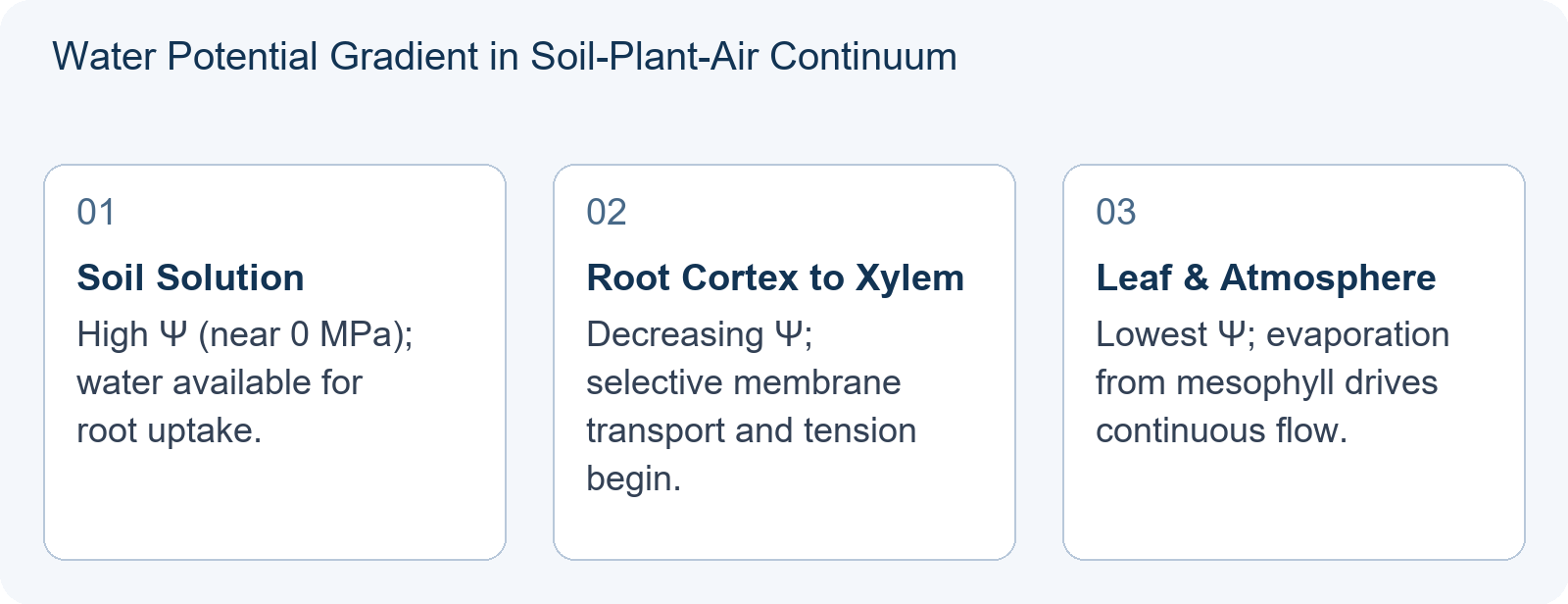
Important Context: This is a deliberately constructed hypothetical to test calculation discipline. It is not intended to represent normal transpiration physiology. In normal plant function, water flows from soil → root → xylem → leaf evaporating surfaces → air, driven by the transpiration-cohesion-tension mechanism. The normal pathway follows progressively more negative water potentials along this route. The hypothetical above reverses the expected gradient for pedagogical purposes only.
Diagnostic Value: This case exposes why memorizing “water moves to higher solute” is dangerous. The arithmetic is simple, but the conclusion reverses naive intuition. USABO questions frequently test whether students complete the full Ψ calculation.
Xylem Transport: The Transpiration-Cohesion-Tension Mechanism
A frequent error occurs when students apply cellular osmosis logic directly to bulk flow in xylem vessels. In xylem, water movement is driven primarily by the transpiration-cohesion-tension mechanism, not by osmotic gradients across membranes in the same way as parenchyma cells.
Scenario: A tree loses water from leaves via transpiration. The leaf mesophyll cells develop a highly negative water potential due to evaporation. The roots are in moist soil with a near-zero water potential.
Common Misconception: Students often ask, “How does water get up against gravity? Is there a pump?” They may incorrectly assume that root pressure alone drives long-distance transport. Root pressure can push water upward in small plants or during periods of low transpiration (guttation), but it cannot account for water movement to significant heights where gravity becomes substantial.
Correct Mechanism: The driving force is the gradient in water potential created by transpiration. As water evaporates from leaf cell walls, the remaining water film develops a curved meniscus, creating negative pressure (tension). This lowers the Ψ in the leaf apoplast significantly below that of the roots. Because water molecules cohere via hydrogen bonds, this tension pulls the entire column of water upward from the roots. The movement is from high Ψ (soil/roots) to low Ψ (leaves/atmosphere). Over substantial heights, gravitational potential must be included: the full equation becomes Ψ = Ψs + p + Ψg, where Ψg increases by approximately +0.01 MPa per meter of elevation.
Note on Directionality: While xylem transport is predominantly upward from roots to shoots, it is not universally so. In some situations, such as root pressure-driven flow in small herbaceous plants, or in specialized structures, xylem sap may move in different patterns. The key is always to calculate the water potential gradient, not to assume direction based on tissue type alone.
Diagnostic Check: If a USABO question asks about water movement in a wilted plant versus a hydrated plant, focus on the magnitude of the gradient. In a wilted plant, stomata close to conserve water, reducing transpiration rate. The hydraulic state is complex: tension in the xylem may decrease, but the relationship between wilting and xylem water potential depends on the specific hydraulic conditions. Water potential gradients between roots and leaves may flatten, slowing water movement. Students must link physiological state (wilted/hydrated) to physical parameter (gradient steepness) without oversimplifying.
Phloem Loading and Transport: Pressure Flow with Important Nuances
While xylem transport is passive (driven by physical forces), phloem transport involves processes that create the necessary pressure gradients. The Münch Pressure Flow Hypothesis explains how sugars move from source to sink.
Key Concept: Sucrose is loaded into sieve tube elements at the source (e.g., mature leaves). This loading decreases the solute potential (Ψs) inside the sieve tubes. Water then enters the sieve tubes from adjacent xylem vessels via osmosis, increasing the hydrostatic pressure (Ψp). At the sink (e.g., roots or fruits), sucrose is unloaded, increasing Ψs, causing water to leave, and decreasing pressure. The resulting pressure gradient drives bulk flow from source to sink.
Important Nuance: Loading is not universally active. Some plants use active transport (e.g., sucrose-H+ symport in apoplastic loaders), but others use passive loading through plasmodesmata (symplastic loading). USABO questions may test this distinction.
Teaching Illustration: Consider a simplified model where loading at the source creates high pressure, and unloading at the sink creates low pressure. The pressure differential drives bulk flow through the sieve tube. Unlike xylem, where flow is predominantly from roots to shoots, phloem transport can be bidirectional in different sieve tubes at different times—transporting sugars from leaves to roots during the growing season, or from storage organs to new growth in spring. However, within any single sieve tube, flow is unidirectional at a given time; simultaneous opposite bulk flows in the same tube do not occur.
Diagnostic Application: Analyzing Guard Cell Mechanics
Guard cells provide a perfect microcosm for testing understanding of water potential dynamics. Stomatal opening and closing are regulated by changes in turgor pressure within guard cells.
Question Type: “Explain how blue light triggers stomatal opening.”
Annotated Reasoning:
1. Signal: Blue light activates proton pumps (H+-ATPases) in the guard cell plasma membrane.
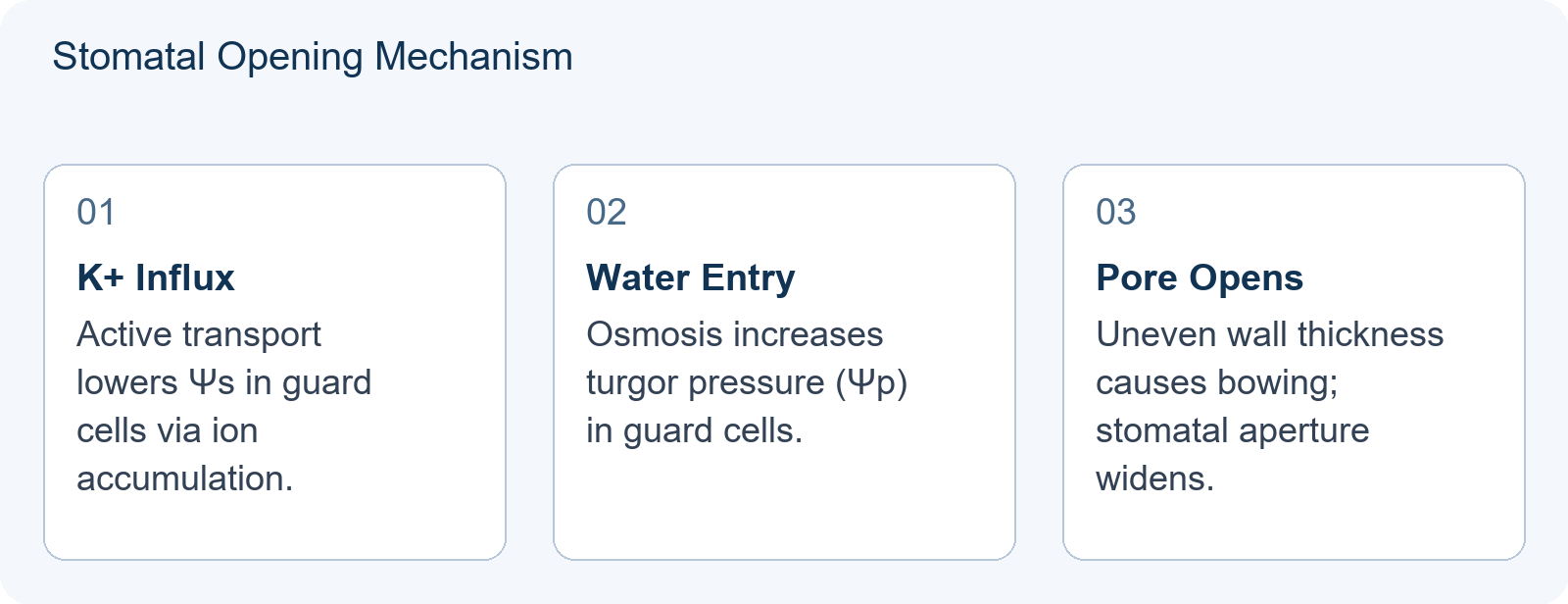
2. Ion Movement: Protons are pumped out, hyperpolarizing the membrane. This creates an electrochemical gradient that drives potassium ions (K+) into the guard cells through voltage-gated channels.
3. Water Potential Change: The influx of K+ (and accompanying anions like malate) lowers the solute potential (Ψs) inside the guard cells.
4. Osmosis: Water follows the solute into the guard cells from surrounding epidermal cells, moving from higher Ψ to lower .
5. Turgor Increase: The influx of water increases the volume of the guard cells. Due to their unevenly thickened cell walls, the cells bow outward, opening the stomatal pore.
6. Conclusion: Stomatal opening is a direct result of decreased Ψs leading to increased Ψp (turgor).
Failure Mode: Students who say “light makes the cells expand” miss the causal chain. They must articulate the role of ion fluxes in altering water potential. Conversely, during drought stress, abscisic acid (ABA) triggers K+ efflux, raising Ψs, causing water loss, lowering turgor, and closing stomata. Linking hormone signaling to physical parameters is a hallmark of advanced USABO preparation.
Implications for Next Learning Tasks
If a student struggles with these concepts, it indicates a gap in integrating physics with biology. The next learning task should not be more memorization of pathways, but rather quantitative practice. Students should solve problems where they calculate Ψ for various compartments and predict net flow. Resources such as Campbell Biology provide foundational exercises, but USABO-specific prep requires applying these principles to novel experimental setups.
Useful feedback for parents and teachers should focus on whether the student can explain why water moves, not just where it goes. Ask them to sketch a diagram showing Ψ values in soil, root, xylem, and leaf, and indicate arrows for flow. If the arrows point from low to high Ψ, the conceptual model is broken. Correcting this early prevents errors in ecology and physiology sections later.
For those seeking structured guidance, reviewing past papers helps identify recurring patterns in plant transport questions. However, simply checking answers is insufficient. One must analyze the reasoning behind each option. For instance, if a question asks about the effect of cutting a ring of bark (girdling), the answer relies on understanding that phloem is severed, blocking sugar transport downward, while xylem remains intact. This tests the distinction between vascular tissues and their respective drivers.
Course Fit and Resource Preparation
Preparing for the USABO plant section requires resources that bridge introductory biology and university-level physiology. Standard high school curricula often simplify plant transport, omitting detailed water potential calculations or molecular mechanisms of loading. Families should look for materials that explicitly cover:
- Mathematical applications of the water potential equation with proper attention to all terms.
- Detailed mechanisms of xylem cohesion-tension and phloem pressure flow, including passive loading variants.
- Hormonal regulation of stomata and growth.
- Experimental design questions involving dye tracing or pressure probes.
Preparation should emphasize deep conceptual understanding over rote learning. Students should engage with mock exams that simulate the time pressure and complexity of the actual competition. When selecting a course or tutor, verify that they teach the physics behind the biology. Ask instructors to demonstrate how they guide students through multi-step problems involving changing environmental conditions. This approach ensures that students are not just guessing answers but deriving them from first principles.
Additionally, consider cross-referencing with other topics. Plant transport intersects with ecology (water cycles), cell biology (membrane transport), and genetics (aquaporin expression). A holistic view strengthens performance across all sections. For further reading on related topics, explore our articles on The Plant Biology 15%: USABO’s Best Marks-Per-Hour Section, and Why Most Candidates Skip It, Circulation and Gas Exchange on the USABO: Oxygen Curves, Pressure and Countercurrent Flow, and Mastering the USABO’s Biggest Section: A Roadmap for Animal Anatomy & Physiology (25%) to see how similar physical principles apply across biological systems.
Frequently Asked Questions
Does water always move from low solute concentration to high solute concentration?
No. Water moves from high water potential to low water potential. Solute concentration affects solute potential, but pressure potential also plays a crucial role. In xylem, negative pressure can drive flow even when solute gradients would suggest otherwise. Always calculate total Ψ = Ψs + Ψp (+ Ψg for tall structures).
Is root pressure the main driver of water transport in plants?
No. Root pressure contributes to water movement in small plants or during guttation, but the transpiration-cohesion-tension mechanism is the primary driver for long-distance transport. Root pressure is generally insufficient to overcome gravity for significant heights.
How does girdling affect plant transport?
Girdling removes the phloem, blocking the downward transport of sugars from leaves to roots. The xylem remains intact, so water continues to move upward, but roots eventually starve due to lack of carbohydrates. This demonstrates the functional separation of xylem (water/minerals) and phloem (sugar transport).