IGCSE Biology gives you a broad, descriptive foundation, but it stops well short of the depth the USA Biology Olympiad demands. You do not need to wait for AP, IB or A-Level to begin preparation. You do, however, need to close four specific gaps—molecular biochemistry, genetics beyond Mendel, animal behaviour and taxonomy, and mechanism-level physiology—before the exam tests them. This article maps those gaps and gives you a decision path.
What IGCSE Biology Actually Gives You
IGCSE Biology is a transition-level course, typically studied in Year 10 and Year 11, before a student has entered any senior biology programme such as IB Higher Level, AP Biology or A-Level Biology. According to Hanlin’s teaching material, the course covers a wide set of core modules: cell structure, basic molecular biology, human organ systems, introductory plant biology, elementary genetics, and ecology. That breadth is a genuine asset. You will arrive at USABO preparation already comfortable with English biological terminology, accustomed to reading labelled diagrams, and familiar with the major topic headings that the competition uses.
The problem is not coverage but depth. Every IGCSE topic is treated descriptively. You learn what happens—the heart pumps blood, enzymes speed up reactions, DNA carries genetic information—but you rarely encounter the how and why at the molecular or quantitative level that USABO questions probe. The official USABO site describes the competition as providing “the motivation, curricular resources, and skills training to take [students] beyond their classroom experience to the level of international competitiveness.” IGCSE, by design, does not reach that level. The question is whether you can bridge the distance yourself, and in what order.
Where IGCSE Stops: The Four Gaps
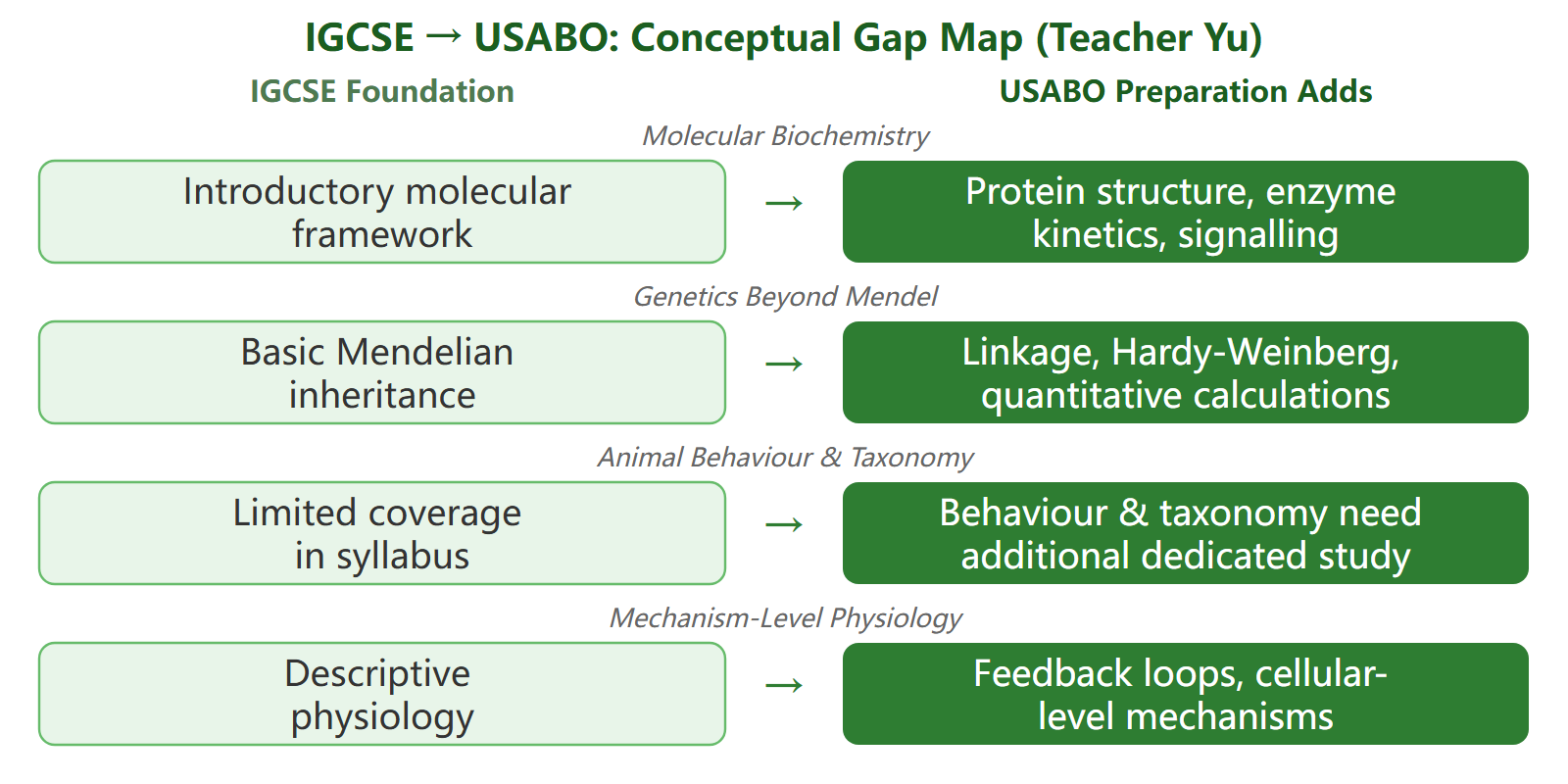
Hanlin’s biology teaching team, after systematically comparing the IGCSE syllabus against the USABO content distribution, identifies four areas where IGCSE preparation is insufficient on its own. These are not minor omissions; they correspond to sections that collectively account for the majority of USABO marks.
| Gap Area | What IGCSE Covers | What USABO Expects |
|---|---|---|
| Molecular biochemistry | Basic enzyme description; simple molecular vocabulary | Protein higher-order structure, enzyme kinetics (Km, Vmax), cell-signalling cascades |
| Genetics beyond Mendel | Simple monohybrid/dihybrid ratios; basic Punnett squares | Gene linkage and mapping, Hardy-Weinberg equilibrium calculations, multi-step pedigree analysis |
| Animal behaviour & taxonomy | Virtually absent from the syllabus | Innate vs. learned behaviour, kin selection, invertebrate phyla characteristics, phylogenetic tree interpretation |
| Mechanism-level physiology | Descriptive phenomena (“the kidney filters blood”) | Feedback-regulation loops, cellular-level transport mechanisms, multi-system integration |
The USABO content distribution, as outlined in Hanlin’s teaching material and consistent with the competition’s published scope, allocates roughly 25 % to animal anatomy and physiology, 20 % to cell biology, 20 % to genetics and evolution, 15 % to plant anatomy and physiology, 10 % to ecology, 5 % to animal behaviour, and 5 % to taxonomy. Three of the four IGCSE gaps fall squarely inside the three largest slices. Ignoring them is not a rounding error; it is leaving most of the paper unprepared.
The Decision Rule: Bridge Now or Wait?
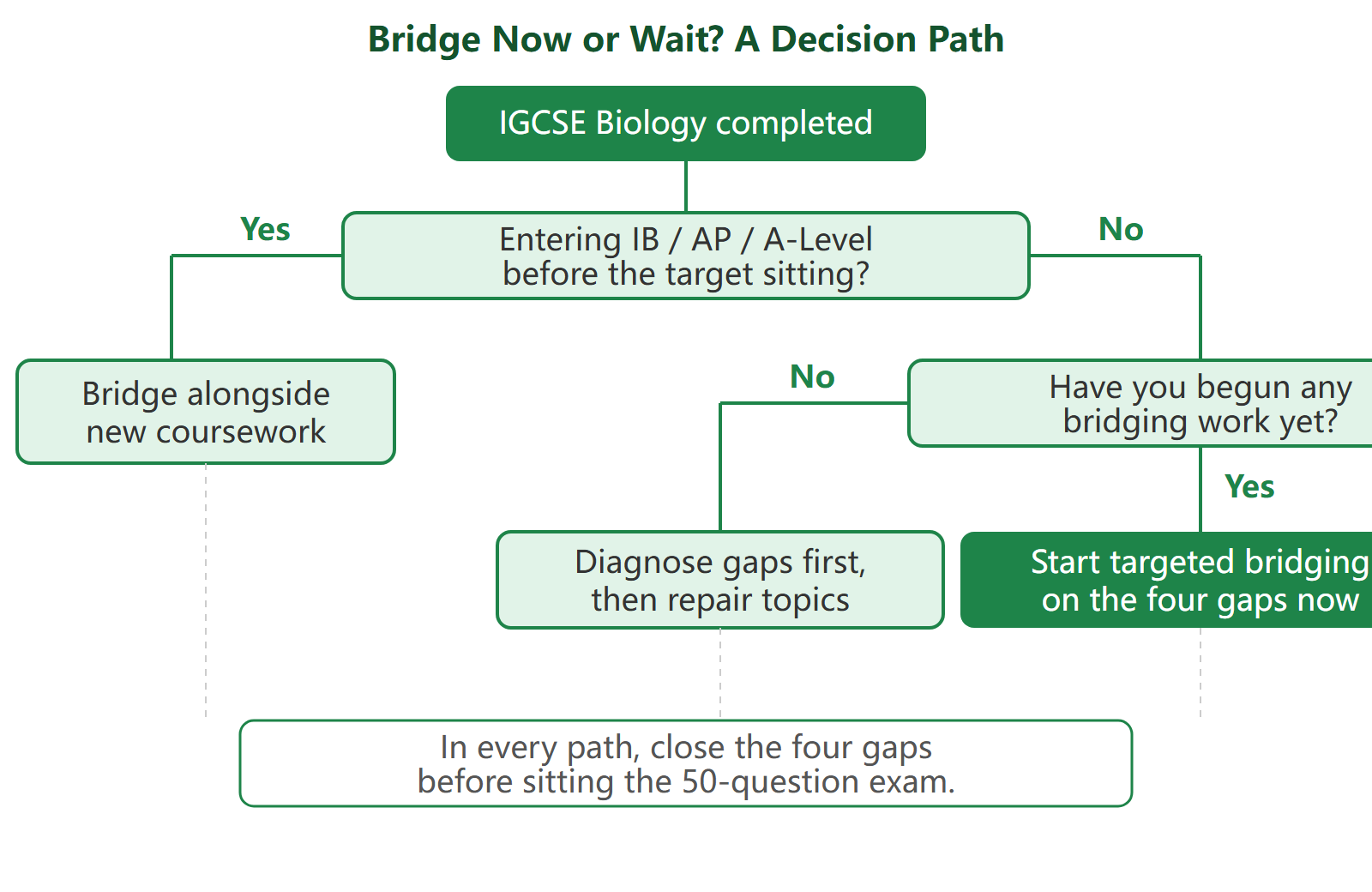
A frequent consideration for IGCSE students and their families is whether to start USABO preparation immediately or wait until a senior biology course such as IB, AP or A-Level begins. The answer depends on practical circumstances: how soon the next structured biology course starts, how much preparation time remains before a target sitting, and whether any bridging work has already begun.
Start targeted bridging now if you have finished IGCSE Biology and a substantial gap lies before your next formal biology course. An extended period with no structured biology study allows terminology and diagram-reading skills to fade. In that window, focused bridging on the four gap areas is more productive than waiting idle. The USABO is aimed at high-school students of any grade, but individual eligibility and registration routes vary by country and school; confirm your entry path with your school coordinator or the relevant organiser before planning a sitting.
Bridge alongside coursework if a senior biology course—IB HL, AP Biology or A-Level Biology—is about to begin. Those courses will fill part of the molecular and genetics gap as part of normal classwork, and you can layer USABO-specific depth on top rather than learning the material twice. Hanlin’s teaching material notes, however, that even AP Biology—whose overlap with USABO is the closest of the three senior curricula—still leaves significant gaps in plant biology, animal taxonomy and quantitative genetics. Waiting for coursework does not eliminate the bridging task; it only changes when you do it. For a fuller comparison, see AP Biology vs USABO: What Actually Overlaps, From IB Biology to USABO, and From A-Level Biology to USABO.
Diagnose first, then repair if you have not yet begun any bridging work and the target sitting is approaching. Rather than skipping the exam outright, consider using a short section of a past paper or a topic-specific question set as a low-stakes diagnostic to identify which of the four gaps are widest for you personally. Use the results to prioritise topic repair in the time available. If the diagnostic reveals that the gaps are too large to close fully before the sitting, you can still register and treat the experience as a benchmark, then continue building foundations for a stronger attempt later. The article Which Year Should You First Sit USABO? discusses readiness in more detail.
A Bridging Sequence Prioritised by USABO Weight
If you decide to bridge now, the order matters. The sequence below is this article’s adaptation of the gap map in Teacher Yu’s Hanlin teaching material, arranged by both the size of each gap and the weight of the corresponding USABO section. Individual students may find a different order suits their strengths; treat this as a starting framework, not a rigid prescription.
Phase 1 – Molecular foundations. Begin with protein structure (primary through quaternary), enzyme kinetics including Km and Vmax, and the major cell-signalling pathways. This material underpins both the 20 % cell-biology section and much of the 20 % genetics-and-evolution section. Without it, later topics in genetics and physiology will feel abstract and disconnected. For a deeper treatment of the molecular and gene-regulation content the USABO expects, see Gene Regulation on the USABO: From the lac Operon to Epigenetics.
Phase 2 – Genetics problem-solving. Move from simple Punnett squares to gene-linkage mapping, Hardy-Weinberg equilibrium calculations, and multi-generation pedigree analysis. USABO genetics questions are calculation-heavy and time-pressured; practising the arithmetic until it is automatic is as important as understanding the concepts. The Genetics & Evolution 20 % playbook walks through the problem types in detail.
Phase 3 – Mechanism-level physiology. This is the single largest USABO section at 25 %. IGCSE teaches you that the kidney filters blood; USABO asks you to trace the countercurrent multiplier, explain how ADH adjusts collecting-duct permeability, and predict what happens when a specific transporter is blocked. Work through each organ system at the cellular and feedback-regulation level. The articles on Circulation and Gas Exchange and The Nervous System on the USABO illustrate the depth jump.
Phase 4 – Animal behaviour and taxonomy. Together these account for 10 % of the exam. They are the two areas most completely absent from IGCSE, but they are also the most self-contained: you can learn the key ethology concepts (innate behaviour, learning types, kin selection) and the major invertebrate phyla in a focused block of study. The animal behaviour and taxonomy guide covers this 10 % in detail; because the material is largely absent from IGCSE, students who study it systematically can pick up marks that many competitors leave blank.
Three Common Pitfalls When Starting Early
The following pitfalls are worth watching for when an IGCSE student begins USABO preparation without a structured plan. They are drawn from the gap analysis in Hanlin’s teaching material and from general preparation logic.
Treating IGCSE notes as sufficient revision. Re-reading IGCSE summaries feels productive but does not add the molecular or quantitative depth the exam requires. Every study session should introduce material above IGCSE level, not recycle it.
Skipping calculations because “biology is memorisation.” Hardy-Weinberg problems, genetic-map distances, and enzyme-kinetics graphs are arithmetic tasks dressed in biology language. Students who avoid practising the maths lose marks they could have secured with routine drilling.
Skipping the diagnostic step. Before committing to a full timed sitting, use a short section of a past paper or a topic-specific question set as a low-stakes diagnostic. This reveals which of the four gaps are most urgent for you personally, without the pressure of the fifty-question, fifty-minute format. Once you have identified priorities, build content systematically; save full timed papers for later, following the protocol in How to Sit a USABO Past Paper Properly.
Frequently Asked Questions
Can I start USABO preparation with only IGCSE Biology, or do I need AP, IB or A-Level first?
You can start. However, Hanlin’s teaching material identifies four gaps—molecular biochemistry, genetics beyond Mendel, animal behaviour and taxonomy, and mechanism-level physiology—that IGCSE alone typically does not cover at USABO depth. How quickly an individual student can close those gaps varies with prior reading, self-study habits and available resources, so treat the four-gap list as a diagnostic checklist rather than a fixed barrier.
Should I wait until I begin IB or A-Level Biology before starting USABO preparation?
Not necessarily. If a senior biology course is about to begin, bridging alongside that coursework is efficient because IB, AP or A-Level will fill part of the molecular and genetics gap in class. If there is a longer gap before the next course, starting targeted bridging sooner helps prevent terminology and diagram-reading skills from fading. The right timing depends on your individual schedule; confirm your entry route with your school or the relevant organiser.
Which of the four IGCSE gaps matters most for USABO scoring?
Mechanism-level physiology carries the highest individual stakes because animal anatomy and physiology accounts for roughly 25 % of USABO content, the largest single section. However, molecular biochemistry and genetics together underpin another 40 %, so Hanlin’s teaching material recommends addressing all four gaps rather than prioritising only one.
This article is part of the curriculum-bridge series on en.usabo.org.cn, helping students map their current biology coursework against USABO demands. The site is an independent editorial project and is not affiliated with, endorsed by, or connected to the Center for Excellence in Education (CEE) or the USABO organising committee.